
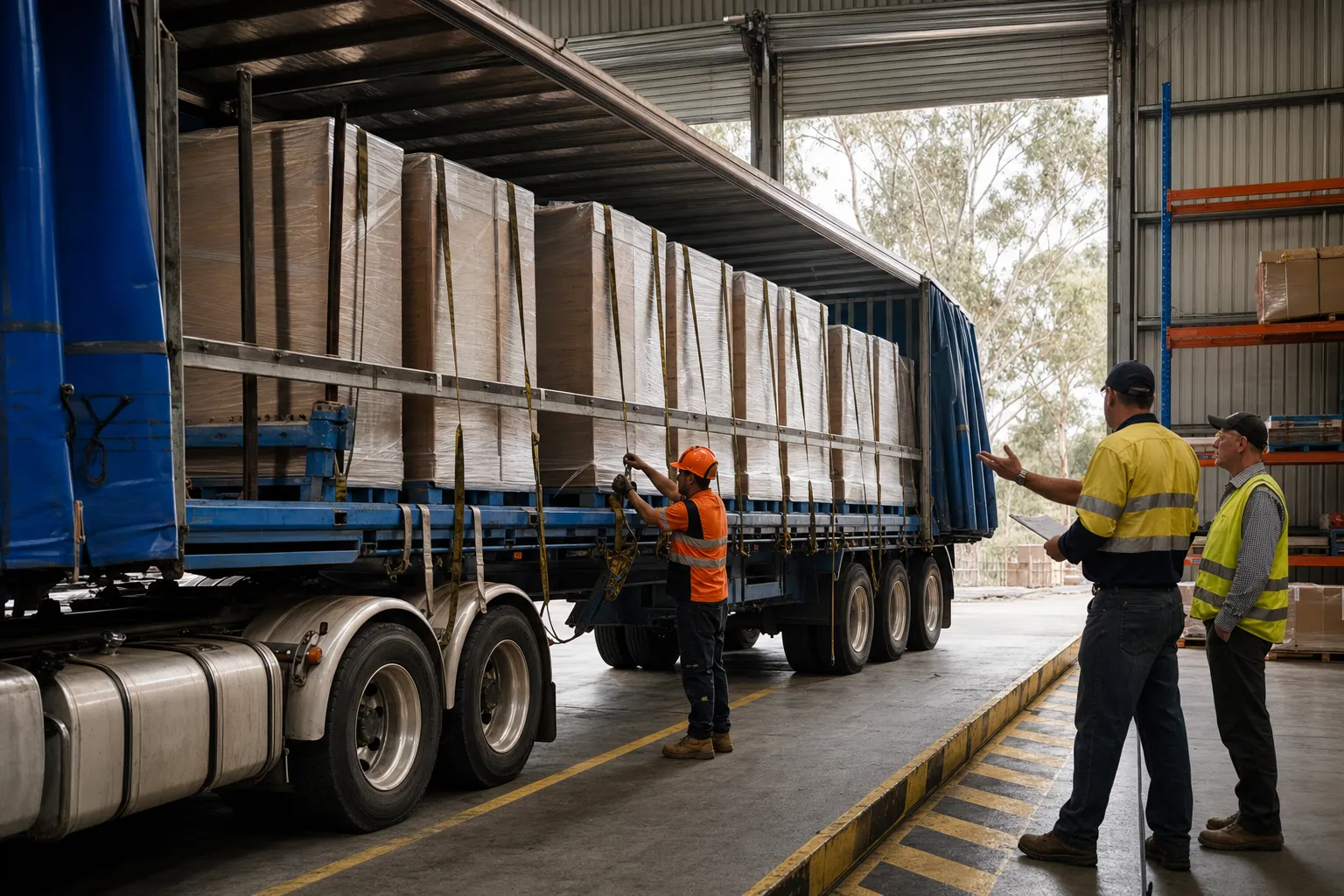
What Is the Chain of Responsibility Under the Heavy Vehicle National Law?
The Chain of Responsibility (CoR) is the legal framework in Australia's Heavy Vehicle National Law (HVNL) that extends road safety duties beyond the driver to every party who influences a transport task. If you consign goods, receive goods, pack a load, manage a loading dock, schedule drivers, or operate a heavy vehicle, you are a CoR duty holder with a legal obligation to prevent breaches of mass, dimension, load restraint, speed, and fatigue laws. The principle is simple: if you can influence the safety of a heavy vehicle on the road, you share responsibility for it.
The HVNL enshrines this through the principle of shared responsibility (section 26A) and the principles applying to duties (section 26B), which together establish that no single party in the chain can push all liability onto the driver. The law binds consignors, consignees, packers, loading managers, loaders, unloaders, schedulers, employers, prime contractors, operators, drivers, and executives of entities that operate heavy vehicles. For a broader overview of how CoR works in practice, see About Chain of Responsibility | MAEZ.
Key Takeaways
- CoR duties apply to at least ten distinct roles in the supply chain, not just drivers and operators. Consignors, consignees, packers, loaders, unloaders, loading managers, schedulers, employers, prime contractors, and executives all hold duties under the HVNL.
- The HVNL primary duty (section 26C) requires each duty holder to ensure, so far as is reasonably practicable, the safety of heavy vehicle transport activities — not merely to avoid committing an offence.
- Executives of transport businesses carry a personal due diligence duty under section 26D, meaning directors and senior managers can be personally prosecuted for systemic CoR failures.
- Breaches are categorised into offences by severity: Category 1 (most serious, exposing individuals to risk of death or serious injury), Category 2, and Category 3, each carrying escalating maximum penalties.
- A Safety Management System (SMS) is the strongest practical defence because it produces the documented evidence that a business has identified risks, implemented controls, and monitored compliance across the chain.
Who Are the CoR Duty Holders in the Australian Transport Supply Chain?
The National Heavy Vehicle Regulator (NHVR) identifies the parties in the Chain of Responsibility as those who consign goods, pack goods, manage loading premises, load or unload vehicles, schedule transport, employ drivers, or operate heavy vehicles. Each role carries obligations tailored to the degree of influence that party has over the transport task. Understanding which role applies to your business is the first step in meeting your duty.
Consignors
A consignor is the party that engages a heavy vehicle to transport goods. Under the HVNL, a consignor must take all reasonable steps to ensure that the goods they consign do not cause or contribute to a mass, dimension, load restraint, or speed breach. Operationally, this means the consignor must provide accurate information about the weight, dimensions, and nature of the goods, and must not set delivery timeframes that pressure the driver to speed or exceed fatigue limits. A consignor who knowingly dispatches an overloaded container — or who omits weight details from the consignment — can be held liable alongside the operator and driver.
Consignees
A consignee is the party that receives goods transported by heavy vehicle. The consignee's duty extends to the unloading process and the accuracy of any information they provide that affects the transport task. For example, if a consignee demands unreasonably fast turnaround at the receiving dock, or if their site conditions force unsafe loading or unloading practices, the consignee can be held responsible for any resulting breach. Consignees must also ensure that they do not make requests or enter contracts that would require a driver or operator to breach the HVNL.
Packers
Packers are responsible for how goods are packed, stacked, and secured within a container, pallet, or load unit. Their duty is to ensure that packing does not contribute to mass, dimension, or load restraint breaches. A packer who overloads a container beyond its declared weight, or who packs goods in a way that shifts in transit and compromises restraint, is a duty holder under the HVNL. The accuracy of container weight declarations (discussed below) is directly tied to the packer's role.
Loaders and Unloaders
Loaders are parties who place goods onto a heavy vehicle, and unloaders are parties who remove goods from it. Both roles must ensure that the loading or unloading process does not cause the vehicle to exceed mass limits, that the load is properly restrained, and that the vehicle's dimensions remain within legal limits. Loaders must also verify that the mass of each axle group is within limits and that the load distribution is safe. Unloaders must ensure that partial unloading does not create an unsafe axle mass distribution. A forklift operator at a warehouse who loads a truck beyond its legal payload is a CoR duty holder — not merely a warehouse employee.
Loading Managers
A loading manager is the person who manages the premises where five or more heavy vehicles are loaded or unloaded each day. This threshold is set by the NHVR and triggers specific obligations, including the duty to take reasonable steps to ensure that the loading practices on those premises comply with the HVNL. Loading managers must have systems in place to monitor load weights, prevent overloading, and manage queue and scheduling pressures that could lead to fatigue or speed breaches.
Schedulers
Schedulers are parties who plan or allocate the timing of heavy vehicle transport tasks. Under section 264 of the HVNL, employers, prime contractors, operators, and schedulers all have a duty to ensure driver compliance with work and rest requirements. A scheduler who plans a run that is physically impossible to complete within legal driving hours is creating a CoR breach — even if the driver is the one who ultimately exceeds the hours. Schedulers must understand fatigue management, standard hours, and Basic Fatigue Management (BFM) or Advanced Fatigue Management (AFM) frameworks if applicable.
Operators, Employers, and Prime Contractors
An operator is the person or entity that operates a heavy vehicle — typically the business that holds the vehicle registration and manages its use. Employers and prime contractors also hold duties under the HVNL to ensure that drivers comply with mass, dimension, load restraint, speed, and fatigue requirements. The operator is often the most visible duty holder, but the HVNL's shared responsibility principle means that the operator is not automatically the only party liable when a breach occurs.
Executives of Transport Businesses
Section 26D of the HVNL imposes a personal due diligence duty on executives of entities that operate heavy vehicles. This means directors, CEOs, and senior managers must actively understand CoR risks, ensure the business has appropriate compliance systems, and verify that those systems are working. An executive who turns a blind eye to systemic overloading or scheduling pressure cannot escape liability by delegating compliance to a middle manager. For a detailed guide on this, see Chain of Responsibility Training for Executives and Managers: A Practical Guide for Australian Transport Operators.
What Is the Primary Duty Under the HVNL?
The HVNL establishes a primary duty under section 26C, which requires each duty holder in the Chain of Responsibility to ensure, so far as is reasonably practicable, the safety of heavy vehicle transport activities. This is not a narrow duty to avoid committing an offence. It is a positive, proactive obligation to identify risks, implement controls, and continuously monitor their effectiveness.
The primary duty covers all aspects of the transport task that a duty holder can influence — including mass, dimension, load restraint, speed management, and fatigue. What "reasonably practicable" means depends on the specific circumstances: the likelihood of the risk, the severity of potential harm, what the duty holder knows or ought to know about the risk, and the cost and availability of ways to eliminate or reduce it.
The practical implication is that a business cannot simply point to a contract clause that says "the driver is responsible for load restraint" and consider itself compliant. If the business packs the goods, sets the delivery deadline, or manages the loading dock, it must actively ensure those activities do not create safety risks.
What Are Prohibited Requests and Contracts Under the HVNL?
Section 26E of the HVNL addresses prohibited requests and contracts. This provision makes it an offence for any party in the chain to ask, direct, or require — whether by contract, agreement, or informal instruction — another party to breach the HVNL. A consignor who offers a premium for same-day delivery knowing that the only way to achieve it is by speeding or exceeding driving hours is committing a prohibited request. A customer who includes a penalty clause for late delivery that pressures an operator to breach fatigue laws is entering a prohibited contract.
Operationally, this means businesses must review their commercial agreements, rate structures, and delivery expectations to ensure they do not inadvertently incentivise CoR breaches. A Chain of Responsibility Consulting | Practical CoR Risk Review | MAEZ engagement can help identify these hidden risk triggers before the NHVR does.
What Offences Apply When a CoR Duty Holder Breaches Their Duty?
The HVNL categorises breaches into three tiers of severity:
- Category 1 offences (section 26F) are the most serious. They apply where a duty holder's conduct exposes an individual to a risk of death or serious injury, and the duty holder was reckless or negligent about that risk. Category 1 offences carry the highest maximum penalties under the law.
- Category 2 offences (section 26G) apply where a duty holder fails to comply with their primary duty and the conduct creates a risk of serious harm, but without the recklessness or negligence element required for Category 1.
- Category 3 offences cover lower-level breaches where a duty holder fails to comply with a duty but the conduct does not create a high-risk situation.
The offence category determines the maximum penalty a court can impose. Penalties escalate for body corporates, with the most serious offences attracting fines in the hundreds of thousands of dollars. Importantly, multiple parties can be charged for the same breach — a consignor, loader, and operator can all be prosecuted for a single overloaded vehicle.
How Does the HVNL Address Transport Documentation and Container Weight Declarations?
The HVNL includes specific provisions on transport documentation. Section 186 creates an offence for providing false or misleading transport documentation for goods. Section 187 extends this to false or misleading information in a container weight declaration. These provisions are directly relevant to consignors, packers, and loaders, who are responsible for the accuracy of information that accompanies a load.
A container weight declaration (CWD) is a document that states the verified gross mass of a packed container. Section 190 imposes a duty on the responsible entity to ensure a complying CWD is provided before the container is transported. If a packer states a container weighs 18 tonnes but it actually weighs 26 tonnes, and the truck is loaded accordingly, every party in the chain who relied on that declaration — and especially the packer — faces liability. The legal and operational risks of inaccurate container weights have been highlighted in industry commentary on managing freight in shipping containers.
How Does Fatigue Management Fit Into CoR Duties?
Fatigue is one of the core risk areas the HVNL regulates. Chapter 6 of the HVNL governs driver fatigue, including work and rest hours, work diaries, and fatigue management schemes. Section 264 specifically imposes a duty on employers, prime contractors, operators, and schedulers to ensure driver compliance with work and rest requirements.
Under the current HVNL, drivers of fatigue-regulated heavy vehicles must carry and complete a work diary (section 293). The work diary records driving hours, rest breaks, and other critical information that allows the NHVR and authorised officers to verify compliance with standard hours, BFM, or AFM arrangements.
For businesses seeking formal accreditation, NHVAS Basic Fatigue Management (BFM) accreditation provides a structured framework for managing fatigue risk — but it requires documented systems, driver records, and ongoing audit readiness. MAEZ helps operators maintain fatigue and driver diary checks as part of their current compliance capability. Note that an Electronic Work Diary (EWD) is not yet live in the MAEZ platform; current capability relies on manual work diary verification and fatigue record checks.
How Does a Safety Management System Support CoR Compliance?
A Safety Management System (SMS) is the structured framework that ties all CoR obligations together. An effective SMS documents how a business identifies CoR risks, implements controls, trains staff, monitors performance, and responds to incidents. Under the NHVAS Master Code, an SMS is a foundational element for accreditation modules including Mass Management, Maintenance Management, and Fatigue Management.
The SMS is also the strongest form of evidence a duty holder can produce if the NHVR investigates a breach. An SMS that demonstrates active risk assessment, documented controls, training records, and corrective actions shows that the business took all reasonable steps — which is the standard the HVNL requires. Without an SMS, a business is left to argue compliance from memory after an incident, which is a far weaker position.
CoRGuard, the SaaS SMS platform available at chainresponsibility.au, provides a structured environment for building and maintaining this evidence. However, software does not guarantee compliance or remove liability — it supports the process of documenting and managing the systems that duty holders are legally required to have. MAEZ provides the advisory, training, and chartered risk review that sits behind the software, ensuring the SMS reflects real operational practice.
How Does NHVAS Accreditation Relate to CoR Compliance?
NHVAS accreditation is the National Heavy Vehicle Accreditation Scheme administered by the NHVR. It provides a structured pathway for operators to demonstrate compliance with specific HVNL requirements through documented systems and periodic audits. The core NHVAS modules — Mass Management, Maintenance Management, and Fatigue Management — align directly with the major CoR risk areas.
Maintaining NHVAS accreditation requires ongoing evidence: vehicle maintenance records, mass loading records, driver fatigue records, and documented procedures. If an operator loses accreditation due to audit failures or repeated breaches, the commercial and legal consequences can be severe — including loss of mass concessions, increased scrutiny, and potential prosecution. For more on protecting your accreditation, see How MAEZ Helps Owner-Operators Protect NHVAS Accreditation and Avoid Compliance Fines.
What Should Australian Operators Do Next to Close CoR Gaps?
Closing CoR gaps requires a structured, evidence-based approach. Here is how MAEZ works with operators:
-
Identify every duty holder in your supply chain. Map who consigns, packs, loads, schedules, operates, and receives goods. Many businesses are surprised to discover they hold multiple duty holder roles simultaneously.
-
Conduct a chartered risk review. A structured gap review examines your current systems against HVNL requirements, identifying where controls are missing, undocumented, or not followed in practice. See Chartered Risk Review for Chain of Responsibility Gaps: A Practical Guide for Australian Operators for the methodology.
-
Build or strengthen your Safety Management System. Whether you use CoRGuard for software-supported evidence management or work with MAEZ advisory to build documented procedures, the SMS must reflect how your business actually operates — not a template that sits on a shelf.
-
Train every duty holder. Chain of Responsibility training is not a one-time induction. Consignors, loaders, schedulers, and executives all need role-specific training that explains what they must do and how to evidence it. Practical training is available through Chain of Responsibility Training for Australian Operators | MAEZ and at cortraining.com.au.
-
Prepare for the HVNL 2026 changes. The HVNL is scheduled to be updated with amendments due to take effect from 1 August 2026. These changes may strengthen enforcement tools and expand duty holder obligations. Operators who build their SMS and training programs now will be positioned to adapt quickly. For a forward-looking guide, see HVNL 2026 Changes and Chain of Responsibility Training Readiness: A Practical Guide for Australian Operators.
-
Maintain ongoing evidence and review. CoR compliance is not a set-and-forget exercise. The NHVR can issue improvement notices (section 572) requiring a business to fix identified non-compliance within a specified period. Regular internal audits, driver diary checks, and SMS reviews ensure your business is ready for any inspection.
MAEZ helps operators stop losing sleep over fines, accreditation risk, and scattered evidence. Whether you need Chain of Responsibility Course | Practical CoR Training for Australian Transport Operators, a full chartered risk review, or CoRGuard software to manage your SMS, Contact MAEZ | Transport Compliance Advisory for Australian Operators to start closing your gaps today.
Frequently Asked Questions
What is the Chain of Responsibility in Australian heavy vehicle law?
The Chain of Responsibility (CoR) is the legal framework under the Heavy Vehicle National Law (HVNL) that requires every party who influences a heavy vehicle transport task to share responsibility for safety. This includes consignors, consignees, packers, loaders, unloaders, loading managers, schedulers, employers, prime contractors, operators, drivers, and executives. The principle of shared responsibility is enshrined in section 26A of the HVNL.
Who is a consignor under the HVNL?
A consignor is the party that engages a heavy vehicle to transport goods. The consignor must take all reasonable steps to ensure the goods they consign do not cause mass, dimension, load restraint, or speed breaches. This includes providing accurate weight and dimension information and not setting delivery schedules that pressure drivers to breach fatigue or speed laws.
What is the difference between a loader and a loading manager?
A loader is the person who physically places goods onto a heavy vehicle, while a loading manager is the person who manages premises where five or more heavy vehicles are loaded or unloaded each day. Both are CoR duty holders, but the loading manager carries additional responsibilities for the systems and practices on those premises.
What is the primary duty under the HVNL?
The primary duty, set out in section 26C of the HVNL, requires each CoR duty holder to ensure, so far as is reasonably practicable, the safety of heavy vehicle transport activities. This is a positive obligation to identify and manage risks, not merely to avoid committing an offence.
Can an executive be personally liable for CoR breaches?
Yes. Section 26D of the HVNL imposes a personal due diligence duty on executives of entities that operate heavy vehicles. Directors and senior managers must actively understand CoR risks, ensure the business has compliance systems, and verify those systems are working. An executive who fails this duty can be personally prosecuted.
How does a Safety Management System help with CoR compliance?
A Safety Management System (SMS) documents how a business identifies CoR risks, implements controls, trains staff, monitors performance, and responds to incidents. It provides the structured evidence that demonstrates a duty holder took all reasonable steps — which is the standard the HVNL requires. An SMS is also a foundational element of NHVAS accreditation.
What are Category 1, 2, and 3 offences under the HVNL?
Category 1 offences (section 26F) are the most serious, applying where a duty holder's conduct exposes an individual to a risk of death or serious injury with recklessness or negligence. Category 2 offences (section 26G) apply where a duty is breached and the conduct creates a risk of serious harm. Category 3 offences cover lower-level failures to comply with a duty. Penalties escalate by category and are higher for body corporates.
Does using CoRGuard software guarantee compliance?
No. CoRGuard is a SaaS Safety Management System platform that supports the process of documenting and managing compliance evidence. It does not guarantee compliance or remove legal liability. The duty to ensure safety remains with the duty holders identified under the HVNL. MAEZ provides advisory, training, and chartered risk review alongside the software to ensure the SMS reflects real operational practice.