
MAEZ insight
Mastering SMS Implementation: Troubleshooting Common Issues
A practical troubleshooting guide for Safety Management System implementation in Australian transport operations. Identify root causes of SMS failure and apply targeted solutions.

Receiving windows, site rules, and unloading delays can all shape the transport task.
Unloading decisions can affect safety, scheduling, and responsibility.

Managers need a clear view of gaps before audit or enforcement pressure arrives.

Contractor controls should be verified before the work starts.
Consignors
Freight terms, delivery windows, and KPIs must not push drivers into speed, fatigue, or mass breaches.
Consignees
Receiving rules, site access, and unloading delays are CoR controls that need to be set and evidenced.
Loaders
Mass, dimension, and load restraint decisions need documented checks, not assumptions.
Managers
Executives and managers need due-diligence evidence that the Safety Management System is actually working.
Why SMS Implementation Fails
Predictable patterns and how to diagnose them

Safety Management Systems fail for predictable reasons — leadership treating SMS as a compliance exercise, training focused on paperwork instead of practical application, and communication structures that suppress genuine hazard reporting. Understanding these failure patterns lets you diagnose problems accurately and implement corrections that address root causes rather than symptoms.
Most SMS implementation problems do not stem from the system itself. They emerge from organisational dynamics and process breakdowns that undermine even well-designed safety frameworks. Successful implementation hinges on understanding where systems typically fail and addressing those vulnerabilities before they derail your program.
The most common implementation failures share underlying characteristics:
- Leadership treats SMS as a compliance exercise rather than operational improvement
- Training programs focus on paperwork instead of practical application
- Communication structures fail to support genuine hazard reporting and feedback
Organisations that succeed in SMS implementation master the practical realities of organisational change, resource allocation, and cultural transformation that make safety systems function effectively. For broader context on how SMS fits within your Chain of Responsibility obligations, the connection between safety frameworks and CoR duty holders is a good starting point.
The Four Core Components of an Effective SMS
Policy, risk management, assurance, and promotion must work together
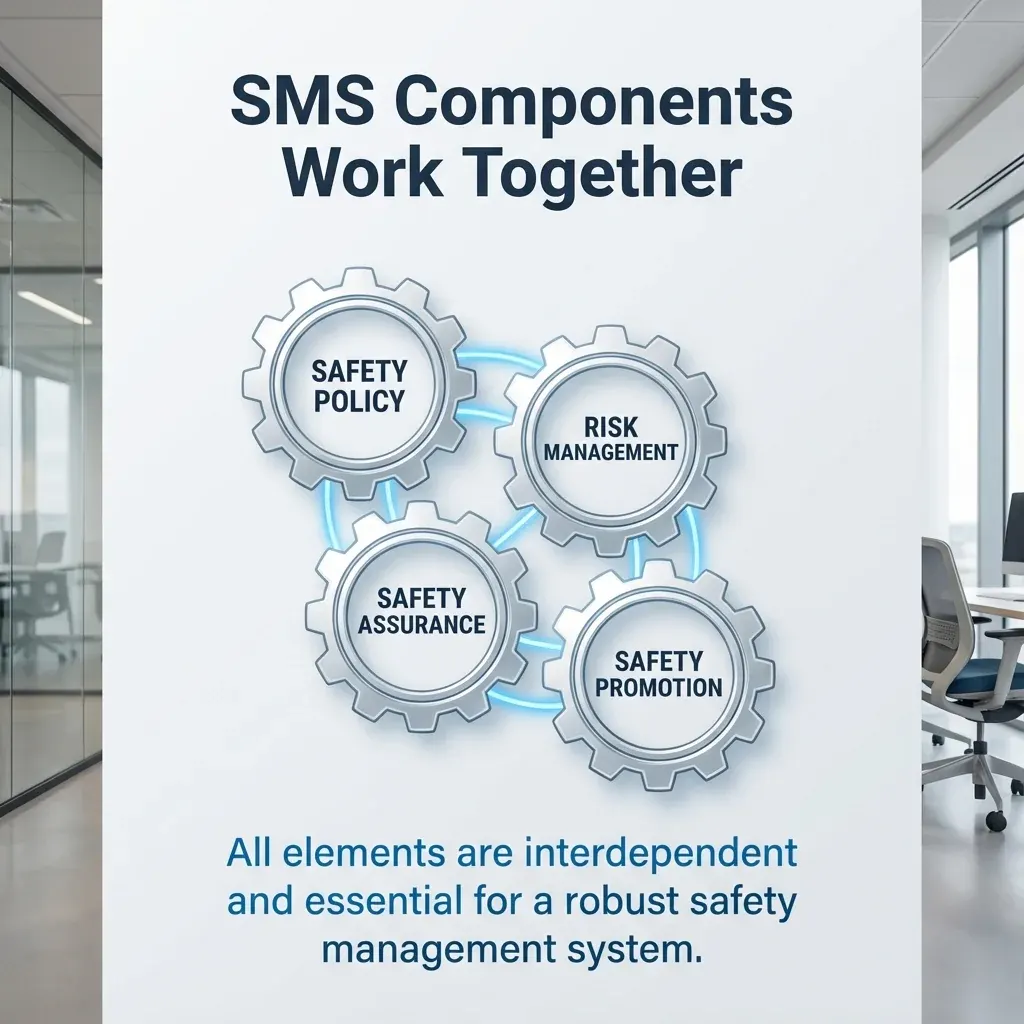
Every functional Safety Management System contains four interconnected elements working in concert:
- Safety policy establishes the framework and commitment
- Risk management processes identify and control hazards systematically
- Safety assurance validates that controls work as intended
- Safety promotion builds the culture needed for sustained improvement
These components must operate together to prevent cascading failures. Weakness in one area creates breakdowns throughout the system. When troubleshooting SMS implementation issues, examine each component individually, then assess how they interact.
Why sequential implementation creates gaps
Organisations often implement these components sequentially when they should develop simultaneously. A safety policy without assurance, or risk management without promotion, leaves gaps that enforcement activity or audit pressure will eventually expose.
Implementing a safety management system requires parallel development of policy, processes, assurance mechanisms, and cultural elements. Each component reinforces the others, and none can deliver results in isolation.
Warning Signs Your SMS Is Breaking Down
Recognise problems early before they become entrenched
Most SMS failures develop gradually through accumulated small breakdowns rather than sudden catastrophic collapse. Several indicators reveal implementation problems before complete system failure occurs. Watch for these warning signs:
- Declining hazard report submissions, signalling eroding trust
- Repeated near-misses in similar scenarios, indicating ineffective risk controls
- Growing gaps between documented procedures and actual practices
- Management disengagement through missed safety meetings and delayed action items
- Training attendance dropping when employees perceive minimal value
- Safety performance metrics plateauing or declining despite system presence
Matching warning signs to root causes
Each indicator points to a different root cause — trust issues, control failures, implementation disconnects, or leadership gaps. Recognising these warning signs allows early intervention, and each requires a specific corrective response rather than a blanket fix.
Leadership Commitment and Executive Support Failures
The single biggest factor in SMS success or failure

Leadership commitment determines SMS success more than any other factor. When executives treat safety management as a delegated responsibility rather than a core business function, implementation inevitably falters. True leadership commitment extends beyond policy endorsements and budget approvals — it requires visible participation, resource prioritisation, and accountability enforcement that demonstrates safety's strategic importance.
Identifying genuine leadership engagement
Assess leadership commitment through actions rather than statements. Executives with genuine commitment attend safety meetings regularly and participate actively. They allocate qualified personnel to safety roles rather than assigning collateral duties. Budget requests for safety resources receive priority consideration comparable to operational needs. Leaders respond promptly to safety concerns raised by frontline staff, acknowledge safety performance in regular business reviews, and modify operational decisions when safety implications arise.
Insufficient leadership support creates immediate implementation barriers. Safety managers lack authority to implement necessary changes, resource requests stall in approval processes, and operational priorities consistently override safety considerations.
Building executive buy-in
Management buy-in develops through clear demonstration of business value rather than regulatory necessity alone. Present SMS benefits in operational terms executives understand:
- Reduced incidents lower insurance costs and minimise business disruption
- Improved safety culture enhances workforce retention and productivity
- Systematic risk management prevents costly emergency responses
Develop executive briefings that connect safety performance to business outcomes. Show how SMS implementation improves operational efficiency alongside safety results. Schedule regular executive engagement with safety processes, including senior leaders in serious incident reviews and safety audits. For operators preparing for upcoming regulatory change, the HVNL 2026 changes and CoR training readiness guide outlines how executive engagement ties directly to future compliance expectations.
Training and Employee Awareness Deficiencies
The most frequent SMS weakness across industries
Inadequate training represents the most frequent SMS implementation weakness across industries. Organisations often deliver generic safety content that fails to address role-specific requirements or practical application needs. Safety training programs must go beyond initial orientation sessions — they require ongoing competency development, role-specific education, and practical scenario training that prepares employees for real operational situations.
Assessing training program effectiveness
Evaluate your training approach through outcome measurement rather than completion tracking. Effective programs produce observable behaviour changes and improved safety performance. Employees demonstrate competency applying SMS procedures in their daily work, and hazard identification quality improves measurably.
Training inadequacy manifests through several observable patterns:
- Employees cannot explain how SMS procedures apply to their roles
- Hazard reports lack specificity or actionable detail
- Incident investigations reveal fundamental knowledge gaps about risk management processes
Developing targeted training solutions
Design training programs that address identified competency gaps rather than delivering standardised content. Conduct needs assessments that reveal specific knowledge deficiencies across different workforce segments. Create role-specific modules — operations staff need different SMS knowledge than maintenance personnel or management teams.
Practical Chain of Responsibility training can reinforce how SMS procedures connect to each party's legal duties under the Heavy Vehicle National Law, where the principle of shared responsibility means every party in the chain has a role in managing risk.
- Conduct annual competency assessments to identify emerging training needs
- Develop scenario-based exercises that simulate realistic safety situations
- Create quick-reference guides that support knowledge retention after training
- Establish mentoring programs pairing experienced staff with new employees
- Schedule refresher training at intervals based on role complexity and turnover
Fixing Communication Breakdowns and Reporting Culture
When information stops flowing, the SMS stops working
Communication failures undermine SMS effectiveness more subtly than leadership or training deficiencies, but with equally destructive results. Information does not flow appropriately between organisational levels. Feedback loops fail to close. Employees stop reporting hazards when they perceive no response or action.
Building a robust reporting culture requires demonstrable non-punitive approaches and visible follow-through on reported concerns. Organisations must show that hazard reporting produces meaningful improvements rather than bureaucratic processing.
Diagnosing communication failures
Poor communication manifests through specific patterns within SMS operations:
- Hazard reports receive delayed acknowledgment or no response
- Investigation findings never reach frontline staff who submitted concerns
- Safety meetings occur infrequently or with limited workforce representation
- Information silos develop when departments operate independently without cross-functional safety coordination
- Management receives filtered safety information that obscures emerging problems
- Employees learn about safety changes through informal channels rather than structured communication
Establishing effective safety communication systems
Implement structured communication protocols that ensure information reaches appropriate audiences promptly. Define response timeframes for hazard reports based on risk severity. Establish escalation procedures when initial responses prove inadequate. Create feedback mechanisms that close the loop on reported concerns — every report should receive acknowledgment, a status update, and a final resolution communication.
If communication breakdowns are part of a broader CoR gap, a structured CoR consulting review can help identify where reporting structures and SMS expectations are misaligned across your operation. For ongoing insights on transport compliance and safety management, browse the MAEZ insights library.
How MAEZ works
Find the gaps. Fix the system. Prove the controls.
MAEZ helps transport operators deal with the compliance risk they already know is there. We help get the Safety Management System in order, protect NHVAS accreditation, reduce fine exposure, and connect training, evidence, and CoRGuard workflows where software is needed.
Find
Identify what is exposed before an auditor or regulator does.
Fix
Build the SMS controls around how the transport business actually runs.
Prove
Use CoRGuard where records, reminders, diaries, audits, and evidence need structure.
From advice to evidence
From MAEZ advice to a working Safety Management System
Advisory work should leave a practical implementation trail. These examples show how CoRGuard supports records, fatigue and driver diary checks, maintenance, audits, document control, inductions, corrective actions, and evidence review after MAEZ identifies the gaps.
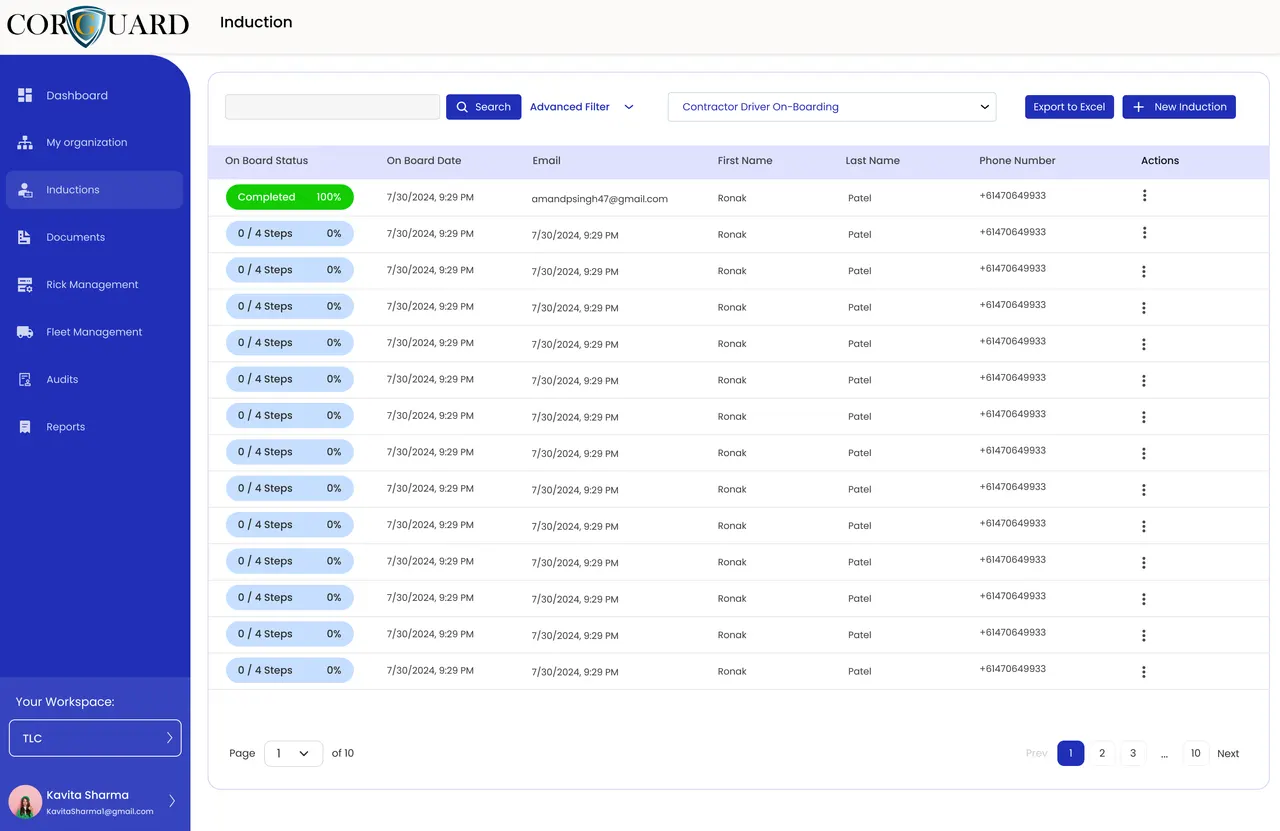
Training records
Connect training completion from cortraining.com.au to evidence and follow-up.
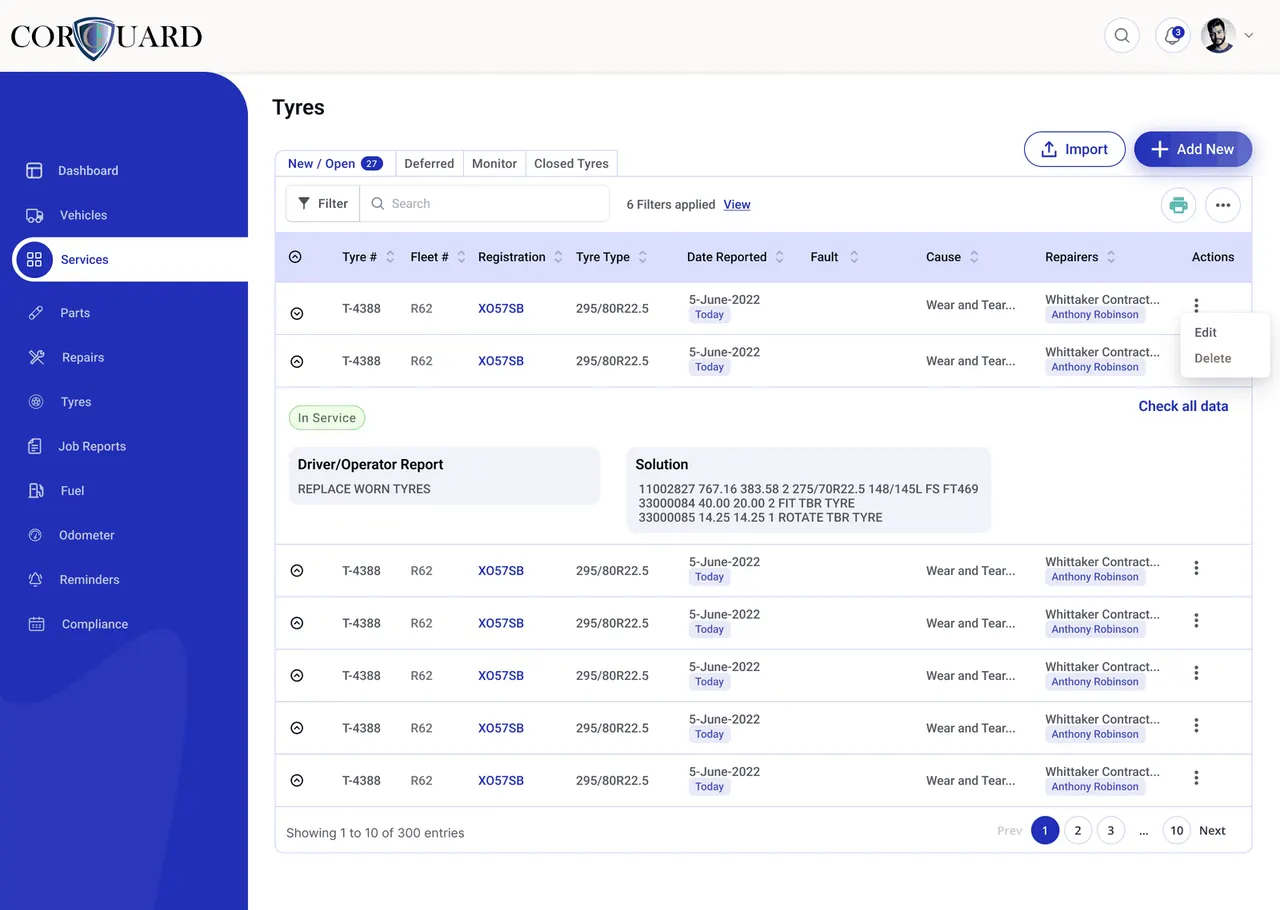
Driver diary checks
Connect fatigue and driver diary review back to manager visibility.
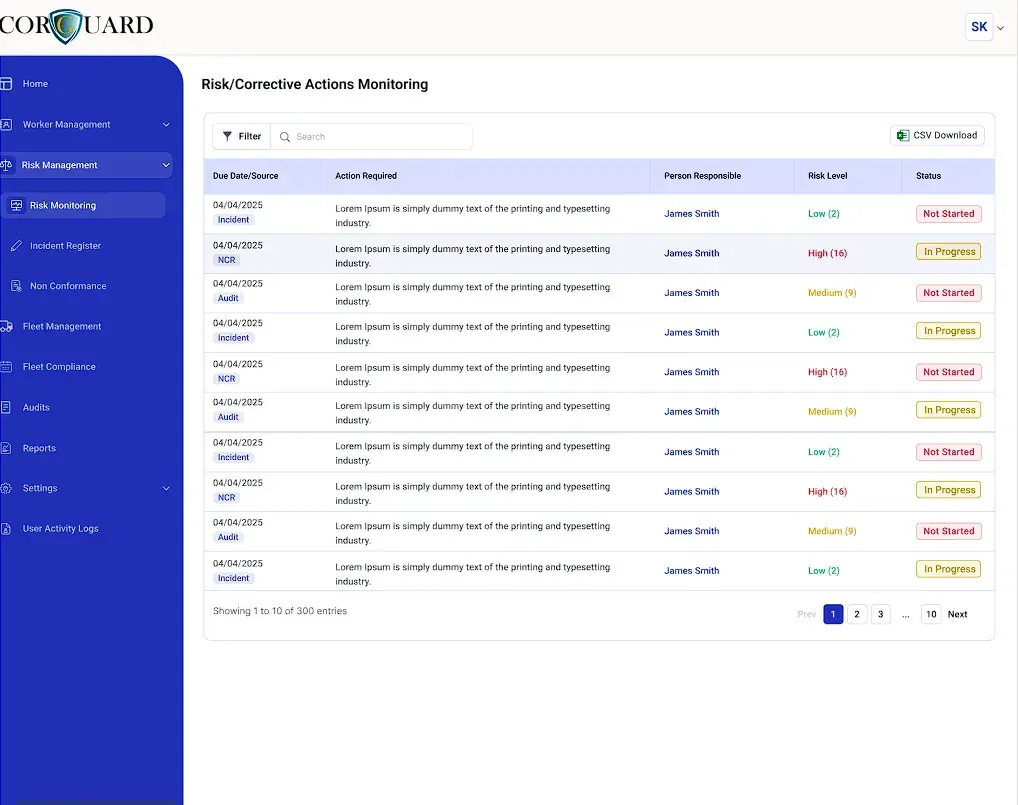
Corrective actions
Turn audit findings, hazards and incidents into tracked actions.
Keep exploring
Related Chain of Responsibility reading
MAEZ insight
Top Transport Safety Best Practices for a Safer Future
Discover top best practices in transport safety that can enhance safety standards, lower costs, and ensure compliance. Learn how to protect your operations today.
MAEZ insight
Effective Strategies for Implementing COR Training
Discover effective strategies on how to implement COR training, enhancing your agency’s acquisition capabilities with structured certification pathways.
MAEZ insight
Understanding CoR Compliance: A Beginner’s Guide
Learn the essentials of CoR compliance with our beginner’s guide. Discover how to protect your business and supply chain effectively.
MAEZ insight
Decoding CoR Compliance: Key Requirements Explained
Unlock the essentials of understanding CoR compliance requirements under Australia’s Heavy Vehicle National Law, crucial for transport safety.
MAEZ insight
Essential CoR Compliance Checklist for Transport Safety
Ensure transport safety with our essential CoR compliance checklist. Manage obligations effectively under the Heavy Vehicle National Law.
MAEZ insight
Mastering Chain of Responsibility: Top Best Practices
Discover top chain of responsibility best practices to streamline your processing pipelines. Learn how to manage handlers for effective design pattern use.
Frequently asked questions
Questions people ask about this topic
Why do most Safety Management System implementations fail?
Most SMS implementations fail because leadership treats the system as a compliance exercise rather than operational improvement, training focuses on paperwork instead of practical application, and communication structures fail to support genuine hazard reporting and feedback. These organisational dynamics undermine even well-designed safety frameworks.
What are the four core components of an effective SMS?
An effective SMS contains four interconnected elements: safety policy that establishes the framework and commitment, risk management processes that identify and control hazards, safety assurance that validates controls work as intended, and safety promotion that builds a culture for sustained improvement. All four must develop simultaneously rather than sequentially.
What warning signs indicate an SMS is breaking down?
Warning signs include declining hazard report submissions, repeated near-misses in similar scenarios, growing gaps between documented procedures and actual practices, management disengagement through missed safety meetings, dropping training attendance, and safety performance metrics plateauing or declining. Each indicator points to a different root cause requiring a specific corrective response.
How can transport operators build executive buy-in for SMS implementation?
Build executive buy-in by presenting SMS benefits in operational terms: reduced incidents lower insurance costs, improved safety culture enhances workforce retention and productivity, and systematic risk management prevents costly emergency responses. Develop briefings connecting safety performance to business outcomes and include senior leaders in serious incident reviews and safety audits.
How does SMS training connect to Chain of Responsibility obligations?
SMS training reinforces how safety procedures connect to each party's legal duties under the Heavy Vehicle National Law, where the principle of shared responsibility means every party in the chain has a role in managing risk. Role-specific training ensures employees understand how SMS procedures apply to their specific CoR obligations.