
The Heavy Vehicle National Law (HVNL) governs every truck over 4.5 tonnes in six Australian states and territories. It’s the rulebook for road safety, fatigue limits, vehicle standards, and loading requirements.
This isn’t red tape for the sake of it. The NHVR’s Heavy Vehicle Productivity Plan aligns regulatory and productivity work with national road safety strategies that seek to reduce road trauma and work towards long‑term ‘Vision Zero’ objectives, including zero deaths and serious injuries by 2050.
After 25 years working across supply chains in Australia and the UK, I’ve seen HVNL transform from legislation into operational reality. The businesses that succeed aren’t those treating compliance as a checklist exercise. They’re the ones building safety systems into daily operations.
This guide walks through HVNL’s core framework. You’ll learn who the law applies to, how Chain of Responsibility works, what the five key regulations demand, and how to build practical compliance systems.
Most importantly, you’ll understand how HVNL compliance strengthens operations beyond avoiding penalties. When safety becomes systematic rather than reactive, efficiency follows.
What is the Heavy Vehicle National Law (HVNL)?
The Heavy Vehicle National Law (HVNL) is a harmonised national framework that regulates heavy vehicles over 4.5 tonnes GVM in participating Australian states and territories. It replaced multiple state-based systems with consistent rules across jurisdictions.
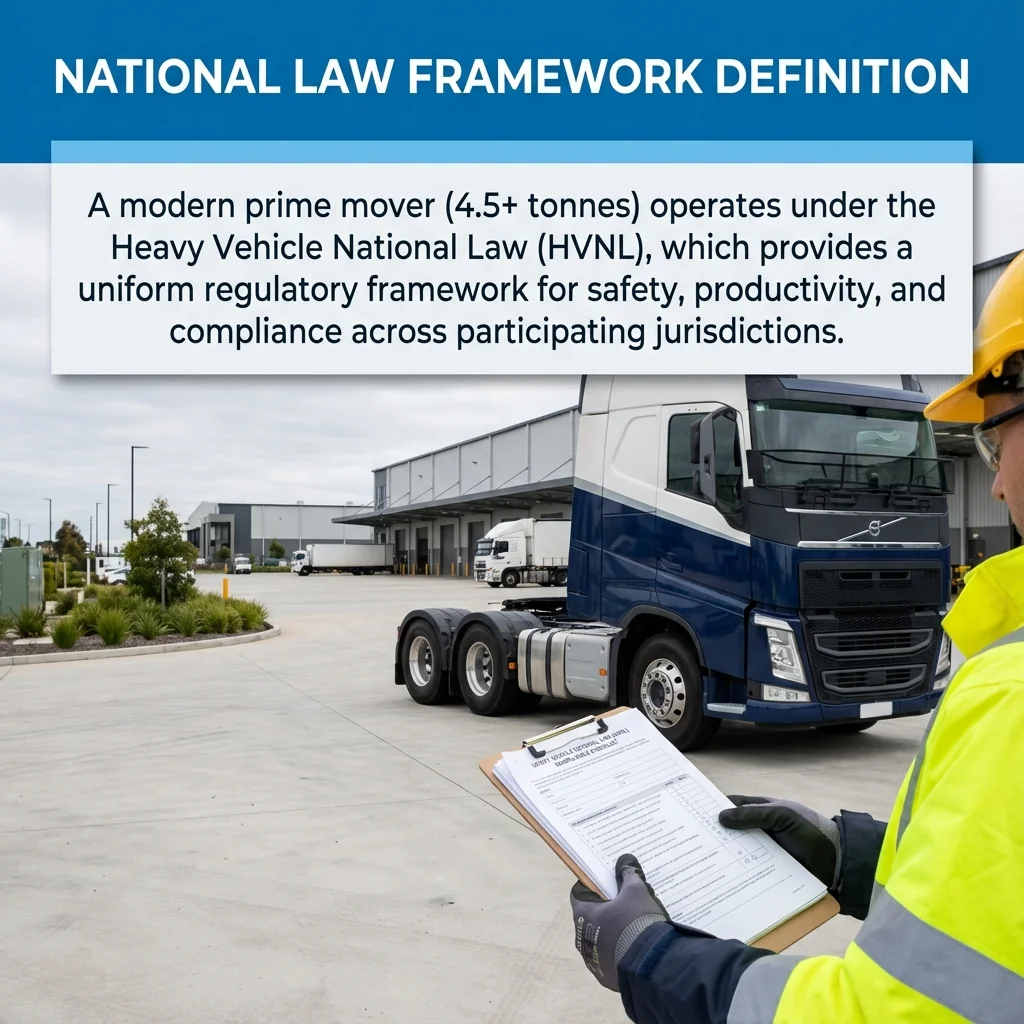
The law took effect in 2014. It brought together road transport regulations from ACT, NSW, QLD, SA, TAS, and VIC under one legislative umbrella administered by the National Heavy Vehicle Regulator (NHVR).
HVNL covers five critical operational areas through specific regulations. Each addresses distinct safety risks in heavy vehicle transport.
| Regulation Type | Primary Focus | Key Requirement |
|---|---|---|
| General Heavy Vehicle Regulation | Overarching framework | Chain of Responsibility duties |
| Fatigue Management | Driver rest and work hours | Work diary compliance |
| Mass, Dimension and Loading | Vehicle weight and load security | Weighbridge certification |
| Vehicle Registration | Vehicle identification and tracking | Current registration display |
| Vehicle Standards | Roadworthiness and maintenance | Regular safety inspections |
The law applies whether you drive the truck, schedule the journey, load the cargo, or pay for the transport. Everyone in the supply chain shares responsibility for safe, compliant heavy vehicle operations.
The Role of the National Heavy Vehicle Regulator
The NHVR administers HVNL across participating jurisdictions. It issues permits, monitors compliance, conducts enforcement, and provides industry education.
The regulator operates independently from state road authorities. It maintains consistent standards while working with state and territory agencies on enforcement activities.
NHVR develops guidance materials, registers industry codes of practice, and manages access schemes for heavy vehicles requiring special permits. It’s the central authority for heavy vehicle compliance questions.
Participating Jurisdictions and Coverage
Six Australian jurisdictions participate in HVNL: Australian Capital Territory, New South Wales, Queensland, South Australia, Tasmania, and Victoria. Western Australia and the Northern Territory maintain separate heavy vehicle legislation.
For transport operators working across state borders, HVNL eliminates regulatory variations. One set of rules applies whether you’re hauling freight from Sydney to Brisbane or Melbourne to Adelaide.
This national approach reduces compliance complexity for businesses operating fleets across multiple states. It creates consistent obligations for operators, drivers, schedulers, consignors, and loaders throughout the supply chain.
Background and Purpose of HVNL
Before HVNL, Australia’s heavy vehicle transport operated under eight different state and territory regulatory systems. Each jurisdiction had distinct rules for fatigue management, loading requirements, and vehicle standards.
This fragmentation created operational headaches for national transport businesses. Drivers crossing state borders navigated different work hour limits. Load restraint requirements varied. Vehicle modification approvals valid in one state weren’t recognized in another.
The Council of Australian Governments initiated reform to address these inefficiencies. The goal was creating a single national law reducing compliance costs while improving road safety outcomes.
Road Safety and Productivity Objectives
HVNL balances two sometimes competing priorities: safety and productivity. The legislation aims to reduce road trauma while enabling efficient freight movement across the country.
Safety comes through clear accountability, enforceable standards, and systematic risk management. Productivity comes through consistent rules, streamlined access arrangements, and performance-based standards allowing operators to demonstrate equivalent safety through alternative approaches.
The law recognizes that improved safety often enhances productivity. Well-maintained vehicles break down less. Properly rested drivers make better decisions. Secure loads don’t require mid-journey stops for re-restraint.
Evolution from State-Based Systems
State-based systems developed independently over decades. Each jurisdiction responded to local incidents, industry lobbying, and political pressures with distinct regulatory approaches.
This created barriers to efficient interstate freight movement. National operators maintained separate compliance systems for each state. Driver training addressed multiple rulebooks. Fleet specifications varied based on where vehicles operated.
HVNL implementation required significant legislative effort across participating jurisdictions. Each state passed mirror legislation adopting the national law. The transition period involved extensive industry consultation and education programs.
Understanding HVNL compliance now requires grasping a unified framework rather than navigating six different regulatory approaches. This represents substantial progress toward regulatory efficiency.
Who Does HVNL Apply To?
HVNL applies to every person involved in heavy vehicle transport activities. This extends far beyond drivers and transport companies.
The 4.5 tonnes gross vehicle mass threshold determines coverage. Any vehicle with a GVM exceeding 4.5 tonnes falls under HVNL when operating in participating jurisdictions.
This includes prime movers, rigid trucks, buses, and trailers. It covers vehicles registered for road use and those operating under temporary permits.
Primary Parties in the Supply Chain
HVNL identifies specific parties with direct compliance obligations. Each party has defined responsibilities based on their role in the transport task.
| Party Type | Typical Role | Primary Responsibilities |
|---|---|---|
| Operators | Fleet ownership and management | Vehicle maintenance, driver management, compliance systems |
| Drivers | Vehicle operation | Work hour compliance, vehicle inspection, load security verification |
| Schedulers | Journey planning and coordination | Reasonable timeframes, fatigue management consideration |
| Consignors | Goods dispatch and documentation | Accurate load information, reasonable delivery expectations |
| Loaders | Cargo placement and restraint | Load restraint, weight distribution, dimensional compliance |
These aren’t isolated obligations. Each party’s actions affect others in the supply chain. When schedulers set unrealistic timeframes, drivers face pressure to breach fatigue limits. When consignors provide inaccurate weights, loaders cannot properly secure cargo.
Executive Officer Duties
Company directors and senior managers carry specific obligations under HVNL. Executive officers must exercise due diligence to ensure their organization complies with the law.
Due diligence includes acquiring knowledge about HVNL requirements, understanding operations, ensuring appropriate resources for compliance, implementing verification processes, and establishing incident reporting systems.
These duties apply whether executives have direct operational involvement or not. Board members and managing directors cannot delegate their due diligence obligations to compliance managers or external consultants.
This executive accountability ensures compliance isn’t treated as an operational issue alone. It requires leadership engagement with safety systems and resource allocation for proper risk management.
Understanding Chain of Responsibility (CoR)
Chain of Responsibility represents HVNL’s foundational principle. It distributes legal accountability across every party influencing safe, compliant heavy vehicle operations.
CoR recognizes that breaches rarely result from driver decisions alone. Systemic pressures throughout the supply chain contribute to unsafe practices. Schedulers setting tight timeframes, consignors demanding unrealistic delivery windows, and operators maintaining inadequate vehicles all influence driver behavior.
The law addresses this by making each party accountable for their contribution to breaches. You can face prosecution even if you never touched the truck or met the driver.
Primary Duty and Reasonably Practicable Measures
Every party in the CoR carries a primary duty to ensure their transport activities don’t cause or contribute to breaches. This applies to mass, dimension, loading, speed, fatigue, and vehicle standards requirements.
The primary duty requires taking reasonably practicable measures to eliminate or minimize safety risks. What’s reasonably practicable considers available knowledge, likelihood and severity of harm, cost versus risk reduction benefit, and ways of eliminating or minimizing risk.
This isn’t a tick-box compliance exercise. It demands genuine risk assessment and implementation of control measures appropriate to identified hazards.
For a Category 1 primary safety duty offence, an individual can face a maximum penalty of $424,794 and/or up to 5 years’ imprisonment. Courts treat serious breaches as criminal matters, not administrative violations.

Shared Liability Across the Supply Chain
Multiple parties can face prosecution for the same breach. When an overloaded truck gets intercepted, enforcement agencies investigate who contributed to the overload.
The loader who secured the cargo, the consignor who provided weight information, the scheduler who set pickup times, and the operator who failed to verify weights might all share liability.
This shared accountability changes how businesses approach compliance. Contractual terms pushing all responsibility onto drivers or subcontractors don’t eliminate liability under HVNL.
Effective CoR management requires documented systems demonstrating reasonable steps to prevent breaches. These include written procedures, training records, verification processes, and incident investigation protocols.
Positive Duty to Ensure Compliance
CoR imposes a positive duty, not merely an obligation to avoid breaches. Parties must actively prevent contraventions rather than simply refraining from direct violations.
This means implementing systems before problems occur. Waiting until a breach happens, then claiming ignorance of how it occurred, doesn’t satisfy the primary duty.
Positive duty requires monitoring compliance, conducting regular audits, investigating near-misses, updating procedures based on incidents, and verifying that control measures remain effective.
Documentation proves you’ve met this positive duty. When facing investigation, your compliance systems evidence becomes critical. Without documented procedures and verification records, demonstrating reasonably practicable steps becomes difficult.
For detailed guidance on building these systems, understanding the Heavy Vehicle National Law framework helps identify specific obligations for each party type.
Key Components of HVNL Regulations
HVNL operates through five subordinate regulations addressing specific operational aspects. Each regulation contains detailed requirements for maintaining safe, legal heavy vehicle operations.
These regulations work together as an integrated system. Compliance in one area often depends on controls in another. Vehicle standards affect load capacity. Fatigue management influences journey scheduling. Mass limits impact route planning.
Understanding how regulations interconnect helps build holistic compliance systems rather than fragmented approaches addressing each requirement in isolation.
Heavy Vehicle (General) Regulation
The General Regulation establishes the overarching compliance framework. It defines party responsibilities, outlines enforcement provisions, and sets administrative requirements.
This regulation articulates the primary duty, specifies what constitutes reasonably practicable measures, and describes due diligence obligations for executive officers. It creates the legal foundation for Chain of Responsibility accountability.
The General Regulation also covers accreditation schemes allowing operators to demonstrate systematic compliance management. Accredited operators gain benefits including extended maintenance intervals, streamlined access approvals, and reduced enforcement attention.
Heavy Vehicle (Fatigue Management) Regulation
Fatigue management rules control driver work and rest hours. The regulation recognizes fatigue as a major safety risk requiring systematic control.
Standard work hours allow 12 hours driving in 24-hour period, with specific rest breaks. Operators can access alternative schemes including Basic Fatigue Management (BFM) and Advanced Fatigue Management (AFM) offering increased flexibility with enhanced controls.
Drivers must maintain work diaries recording work and rest times. Electronic work diaries are becoming increasingly common, offering automated recording and reduced administrative burden.
Schedulers carry specific obligations to ensure journey timeframes allow drivers to complete work without breaching fatigue limits. Consignors must provide accurate information enabling realistic scheduling.
Heavy Vehicle (Mass, Dimension and Loading) Regulation
This regulation governs vehicle weights, dimensions, and load restraint. The National Transport Commission has commenced consultation on proposed Mass, Dimension and Loading amendments that would increase General Mass Limits (GML) to the limits that currently apply under Concessional Mass Limits (CML).
Current rules specify maximum weights for axle groups, overall vehicle combinations, and individual components. Dimension limits cover height, width, and length for various vehicle configurations.
Load restraint requirements demand cargo is secured to prevent movement during normal transport conditions. The regulation references the Load Restraint Guide providing detailed securing methods for different load types.
Loaders must ensure loads are properly restrained. Consignors must provide accurate weight information. Operators must maintain vehicles capable of safely carrying intended loads. Drivers must verify loads remain secure during transit.
Heavy Vehicle (Registration) and (Vehicle Standards) Regulations
Registration requirements ensure vehicles are identifiable and tracked through national systems. Vehicles must display current registration labels and maintain registration information accuracy.
Vehicle Standards regulations mandate minimum safety specifications. These cover structural integrity, braking systems, lighting, steering, tires, and other safety-critical components.
Vehicles must undergo regular inspections demonstrating ongoing compliance with standards. Operators carry responsibility for maintaining roadworthy vehicles. Drivers must conduct pre-journey inspections and report defects.
These standards are not static. Technology advances drive periodic updates. Recent focus areas include electronic stability control, lane departure warnings, and automated emergency braking systems.
Fatigue Management Requirements
Fatigue causes impairment comparable to alcohol intoxication. Drivers awake for 17 hours demonstrate performance equivalent to 0.05% blood alcohol concentration. After 24 hours without sleep, impairment matches 0.1% BAC.

HVNL addresses fatigue through prescriptive work hour limits combined with operator management systems. The approach recognizes that individual fatigue varies based on sleep quality, circadian rhythms, workload intensity, and cumulative effects.
Compliance requires both following hour limits and implementing systems identifying and managing fatigue risks beyond minimum regulatory requirements.
Standard Hours and Work Diary Requirements
Standard hours set basic limits for drivers not operating under alternative schemes. Maximum driving time is 12 hours in any 24-hour period. Rest breaks must include at least 7 continuous hours in each 24-hour period.
Drivers cannot work more than 72 hours in any 7-day period. After 144 hours worked in 14 days, drivers must take at least 24 continuous hours rest.
Work diaries record these hours. Drivers must complete entries showing start and finish times for work and rest periods. Entries must be legible, accurate, and available for inspection.
Electronic work diaries automate recording through GPS and vehicle systems integration. They reduce administrative burden while improving accuracy and compliance verification.
Alternative Fatigue Management Schemes
Basic Fatigue Management (BFM) allows extended work hours with additional rest requirements. Drivers can work up to 14 hours in 24-hour period with appropriate rest breaks and fatigue management training.
Advanced Fatigue Management (AFM) provides further flexibility for operators implementing comprehensive fatigue management systems. These systems include risk assessment, fatigue awareness training, incident monitoring, and regular review processes.
Access to alternative schemes requires accreditation. Operators must demonstrate systematic compliance capacity and maintain detailed records proving scheme requirements are met.
Scheduler and Consignor Responsibilities
Schedulers must ensure transport tasks can be completed without breaching fatigue limits. This requires understanding applicable work hours, accounting for rest breaks, and building contingency for delays.
Setting unrealistic timeframes pressures drivers to breach limits. Even without explicit direction to exceed hours, tight scheduling creates systemic pressure toward non-compliance.
Consignors contribute by providing accurate delivery windows and reasonable expectations. Demanding immediate collection or inflexible delivery slots without considering journey time and required breaks creates fatigue risks.
Both parties must document how they’ve assessed whether journey timeframes allow compliant completion. This documentation demonstrates meeting primary duty obligations.
Effective practice involves schedulers and consignors communicating directly about realistic timeframes. When consignors understand transport time requirements, unrealistic demands reduce. When schedulers explain constraints clearly, consignors adjust expectations.
Mass, Dimension, and Loading Compliance
Overloading damages roads, reduces vehicle control, increases braking distances, and accelerates component wear. Excessive dimensions cause bridge strikes, overhead wire damage, and traffic disruptions.
Mass and dimension compliance protects infrastructure investment and public safety. The regulations balance freight efficiency with safety and infrastructure protection.
Understanding Weight Limits and Load Distribution
Weight limits apply at multiple levels. Individual axles have maximum loads. Axle groups carrying multiple axles have combined limits. Overall vehicle combinations have gross weight maximums.
Proper load distribution matters as much as total weight. Concentrating weight over single axle groups while other axles carry minimal load breaches regulations even if gross weight stays within limits.
General Mass Limits (GML) apply to standard vehicle configurations. Concessional Mass Limits (CML) allow increased weights for specific vehicle types meeting additional requirements. Higher Mass Limits (HML) permit further increases for vehicles in approved access schemes on designated routes.
Operators must know which limits apply to their vehicles and routes. This requires understanding vehicle configuration, axle spacing, road network approvals, and load characteristics.
Load Restraint Obligations
Cargo must be secured to prevent movement during normal transport conditions. This includes acceleration, braking, cornering, and typical road surface irregularities.
Load restraint methods vary by cargo type. The Load Restraint Guide details appropriate securing methods for common loads including containers, pallets, steel products, logs, and bulk materials.
Restraint adequacy depends on cargo weight, friction coefficient between cargo and deck, transport conditions, and restraint component strength. Loaders must calculate required restraint force and verify selected methods provide adequate security.
Drivers share responsibility for verifying loads remain secure throughout journeys. Pre-journey inspections must check restraint integrity. Regular stops during transport allow checking for movement or restraint loosening.
Weighbridge and Measurement Obligations
Operators must verify vehicle weights before journeys when loads approach limits. Weighbridge certificates provide evidence of compliant weights.
Certified weighbridges must be used for legal weight verification. These weighbridges undergo regular testing ensuring measurement accuracy. Operators should maintain weighbridge certificate records demonstrating verification occurred.
Dimension measurements require similar diligence. Height, width, and length must be measured and verified against applicable limits. High loads require particular attention given bridge strike risks.
Consignors providing weight information must ensure accuracy. Estimating weights without verification doesn’t satisfy duty of care obligations. When providing cargo weight to operators, consignors should obtain and provide actual weighbridge certificates.
For practical implementation steps, this HVNL guide for transport operators provides detailed weight verification protocols.
Vehicle Standards and Maintenance
Vehicle standards ensure heavy vehicles meet minimum safety specifications. These standards cover structural integrity, mechanical systems, safety equipment, and emissions controls.
Maintenance obligations require keeping vehicles in roadworthy condition throughout their service life. Initial compliance at manufacture doesn’t satisfy ongoing obligations. Regular inspection, preventive maintenance, and defect rectification maintain continued compliance.
Roadworthiness Requirements
Roadworthy vehicles are safe for their intended purpose. Critical systems must function correctly. Structural components must maintain integrity. Safety equipment must operate as designed.
Key systems requiring regular attention include brakes, steering, suspension, tires, lights, and coupling devices. Failure in any system creates immediate safety risks and potential breaches.
Operators must establish maintenance schedules based on manufacturer recommendations, vehicle usage patterns, and operational conditions. Heavy-duty operations require more frequent inspection and component replacement than lighter-duty applications.
Maintenance records document compliance with vehicle standards. These records should show scheduled maintenance completion, defect identification and rectification, and inspection outcomes.
Pre-Journey Inspections and Defect Reporting
Drivers must conduct pre-journey inspections checking critical safety systems. These inspections identify defects developing between scheduled maintenance.
Inspection scope includes visual checks of tires, lights, mirrors, coupling devices, and load security. Operational checks verify brakes, steering, and warning systems function correctly.
Identified defects must be reported to operators. Minor defects require rectification before next journey. Major defects require immediate vehicle removal from service.
Defect reporting systems should be simple and accessible. Drivers need clear guidance about what constitutes reportable defects and how to communicate issues.
Operator Maintenance Obligations
Operators bear primary responsibility for maintaining roadworthy vehicles. This includes establishing maintenance systems, scheduling regular services, responding to defect reports, and keeping maintenance records.
Effective maintenance systems are proactive rather than reactive. Waiting for breakdowns before conducting maintenance increases costs, causes operational disruptions, and creates safety risks.
Accredited operators must demonstrate systematic maintenance management. This includes documented procedures, qualified maintenance personnel, parts quality standards, and regular system audits.
NHVR trailer and towing guidance stresses that a combination’s towing capacity is limited by the lowest-rated component. This highlights the interconnected nature of vehicle standards compliance.
Building Practical Compliance Systems
Regulatory knowledge alone doesn’t create compliance. Effective systems translate legal requirements into daily operational practices.
Practical compliance systems have clear procedures, defined responsibilities, regular monitoring, and continuous improvement mechanisms. They integrate into normal business processes rather than operating as separate compliance activities.
Developing Written Procedures and Documentation
Written procedures provide consistent guidance for recurring activities. They reduce reliance on individual knowledge and ensure uniform standards across teams.
Procedures should cover high-risk activities including journey scheduling, load verification, fatigue management, vehicle inspection, and defect reporting. Each procedure should specify who does what, when, and how.
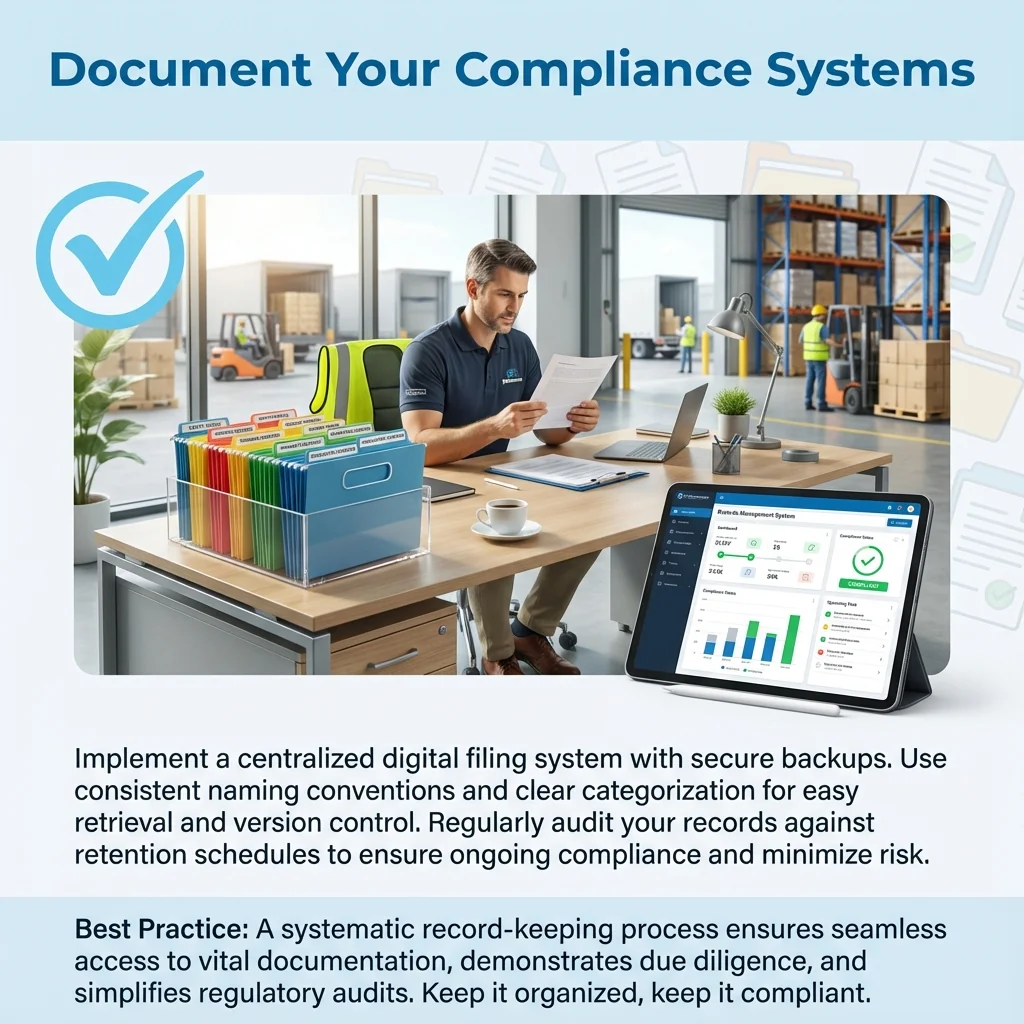
Documentation proves procedures are followed. Key records include work diaries, weighbridge certificates, maintenance logs, inspection checklists, and training records.
Create a documentation retention schedule specifying how long records must be kept. HVNL investigations often examine historical records. Missing documentation makes demonstrating compliance difficult.
Training and Competency Development
People deliver compliance through their daily decisions. Training builds understanding of requirements and capability to meet them.
Training needs vary by role. Drivers need detailed fatigue rules, inspection procedures, and defect reporting processes. Schedulers need journey planning methodologies and fatigue management principles. Executives need due diligence obligations and risk management frameworks.
Competency assessment verifies training effectiveness. Testing knowledge through written assessments, observing practical application, and reviewing work outputs confirms learning.
Training records demonstrate compliance with due diligence obligations. They show operators have taken reasonable steps to ensure personnel understand their responsibilities.
For structured training approaches, review Chain of Responsibility training requirements covering all party types.
Regular Audits and Continuous Improvement
Compliance systems require regular verification. Audits identify gaps between documented procedures and actual practices.
Internal audits should occur at least annually. More frequent audits suit higher-risk operations or businesses with compliance history concerns.
Audit scope covers procedure adequacy, implementation effectiveness, documentation completeness, and incident investigation quality. Findings should drive corrective actions and system improvements.
Continuous improvement treats compliance as evolving rather than static. As operations change, vehicles are added, or new routes are established, compliance systems must adapt.
Regular management reviews assess system performance. Key metrics include breach rates, defect identification trends, training completion rates, and audit finding closure times.
Penalties, Enforcement, and Legal Consequences
HVNL breaches carry serious consequences. Penalties range from infringement notices to criminal prosecution depending on breach severity and risk created.
Understanding enforcement approaches and penalty frameworks helps appreciate compliance importance. The regulator uses escalating responses matching enforcement action to breach seriousness.
Penalty Levels and Court Outcomes
Minor breaches result in infringement notices. These fixed penalties resolve matters without court proceedings. Amounts vary based on breach type and party involved.
Serious breaches proceed to prosecution. Courts can impose substantial fines, vehicle impoundment, license disqualification, and imprisonment for the most severe offenses.
Penalty considerations include breach severity, risk created, compliance history, cooperation with investigation, and steps taken toward future compliance. Repeat offenders face increased penalties.
Beyond direct penalties, breaches create indirect costs. Insurance premiums increase. Customer contracts may be terminated. Accreditation can be suspended. Reputational damage affects business relationships.
Compliance Interventions and Improvement Notices
The NHVR uses compliance interventions before formal enforcement. These interventions educate and encourage improvement without immediate penalties.
Improvement notices require specific actions within set timeframes. They identify breaches and mandate corrective steps. Failure to comply with improvement notices escalates to prosecution.
These interventions suit situations where operators demonstrate willingness to improve but need direction. They recognize compliance as a journey requiring capability development.
Defenses and Due Diligence Evidence
Defendants can raise defenses showing they took reasonable steps to prevent breaches. Due diligence evidence demonstrates systematic compliance efforts.
Successful defenses require documented evidence of procedures, training, monitoring, and corrective actions. Claimed systems without supporting records rarely succeed.
Early legal advice when facing investigation is critical. Understanding obligations, evidence requirements, and defense options shapes response strategies.
For detailed penalty information, this guide on HVNL breach penalties explains court approaches and penalty calculation.
Moving Forward with HVNL Compliance
HVNL creates a clear framework for safe heavy vehicle operations. Its Chain of Responsibility principle distributes accountability across everyone influencing transport safety.
Compliance demands more than regulatory knowledge. It requires systems translating requirements into operational reality. Written procedures, trained personnel, regular monitoring, and continuous improvement transform legal obligations into business practices.
Start with understanding your role in the supply chain. Whether you operate vehicles, schedule journeys, load cargo, or control transport contracts, you carry specific responsibilities. Document how you’re meeting them.
Build systems proportionate to your risk. High-volume operators need sophisticated management systems. Occasional users of heavy vehicles still need documented procedures, but at simpler levels.
The businesses succeeding with HVNL treat compliance as operational advantage rather than regulatory burden. Systematic safety management reduces incidents, lowers insurance costs, improves efficiency, and strengthens customer relationships.
Focus first on your highest risks. If fatigue breaches occur regularly, prioritize scheduling and work hour systems. If loading issues dominate, strengthen weight verification and restraint procedures.
Compliance isn’t achieved once then forgotten. Regular reviews ensure systems remain effective as operations evolve. Treat it as ongoing risk management integrated into business operations.
The path forward involves assessment, documentation, training, monitoring, and improvement. Each step builds toward systematic compliance reducing your risk while protecting road users.