
Supply chain risk mitigation requires structured frameworks that identify vulnerabilities, assess supplier reliability, and address operational threats before they escalate into business disruptions. The most effective strategies combine structured risk assessment frameworks for identifying potential threats and evaluating supplier reliability with technology-enabled visibility tools, diversified supplier networks, and collaborative planning processes that share forecasts and compliance requirements across the supply chain.
Organizations that implement robust mitigation strategies achieve operational benefits beyond risk reduction. They build supply chain resilience that delivers enhanced efficiency, reduced insurance costs, and strengthened business relationships.
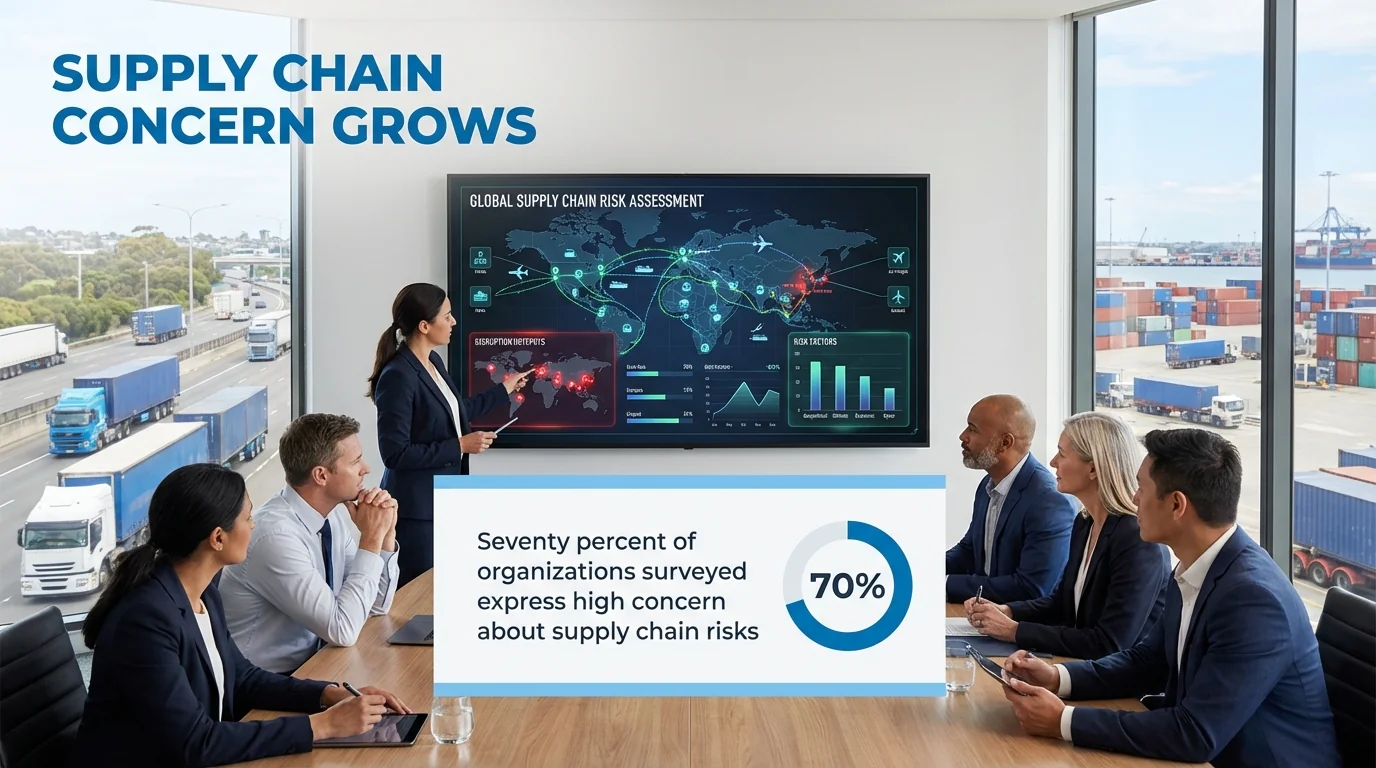
Seventy percent of organizations surveyed express high concern about supply chain risks, reflecting the substantial challenges facing modern enterprises. These concerns span supplier failures, transportation disruptions, geopolitical instability, and cybersecurity threats.
This guide provides detailed strategies for managing supply chain risks systematically. You’ll discover how to build risk assessment frameworks, implement supplier diversification programs, leverage technology for visibility, and develop collaborative relationships that reduce surprises during disruptions.
Understanding Supply Chain Risk Management Fundamentals
Supply chain risk management (SCRM) represents a systematic approach to identifying, assessing, and addressing vulnerabilities across your supply network. It transforms reactive crisis management into proactive risk identification and mitigation.
The discipline extends beyond Tier 1 supplier relationships. Effective SCRM requires visibility into sub-tier suppliers, transportation networks, and geopolitical factors that influence material availability and delivery reliability.
Core Components of Supply Chain Risk Management
SCRM frameworks include several interconnected elements that work together to protect operational continuity.
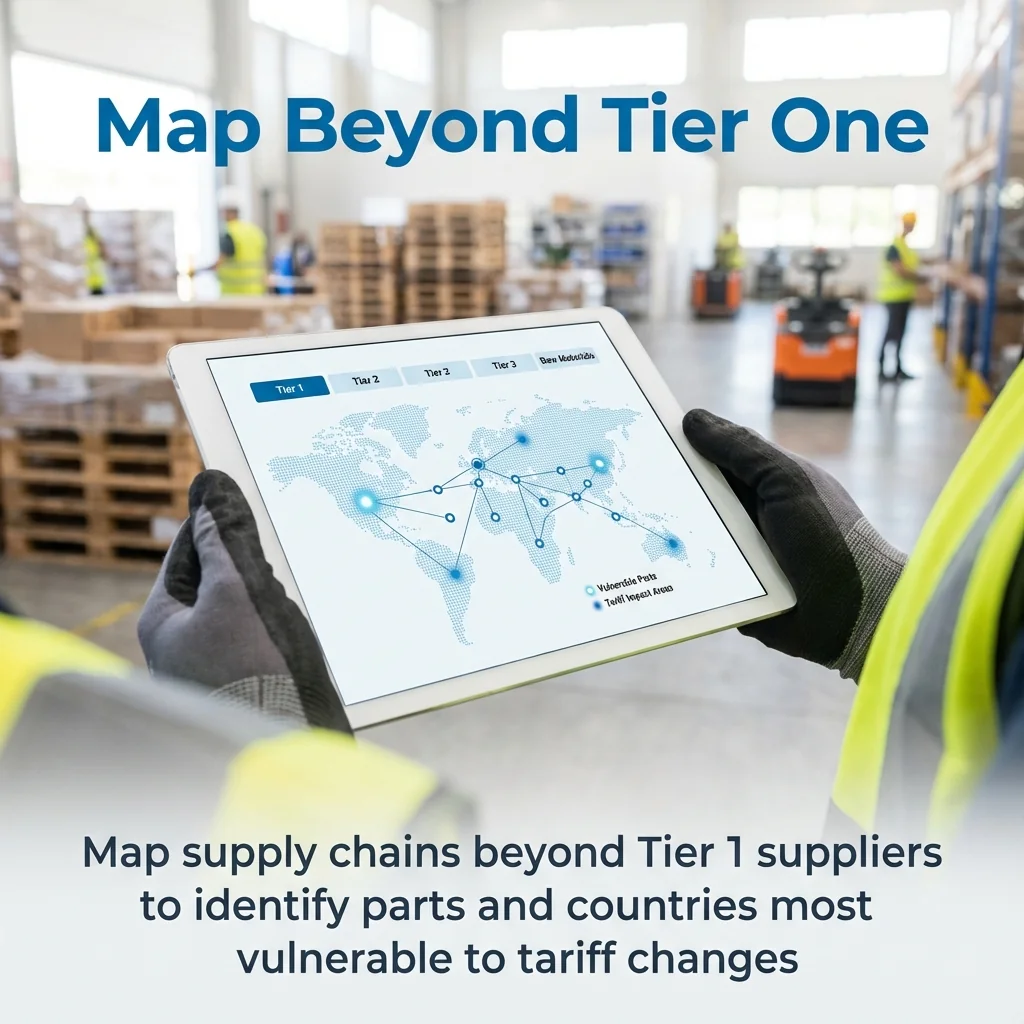
Risk identification involves mapping your supply chain to understand dependencies, single points of failure, and geographic concentrations. Mapping supply chains beyond Tier 1 suppliers helps organizations identify parts and countries most vulnerable to tariff changes or trade restrictions, enabling more targeted mitigation efforts.
Risk assessment evaluates the probability and potential impact of identified threats. This requires analyzing supplier financial stability, production capacity, quality systems, and business continuity plans.
Risk mitigation implements specific strategies to reduce vulnerability or impact. These strategies range from supplier diversification to inventory buffering to contractual risk-sharing arrangements.
Risk monitoring tracks emerging threats and validates that mitigation strategies remain effective as conditions change. This ongoing surveillance enables organizations to adapt strategies before disruptions materialize.
Why Supply Chain Risk Management Matters in 2025
The operating environment for supply chains has grown substantially more complex. Geopolitical tensions create trade restrictions and tariff uncertainty. Climate change drives increased frequency of natural disasters. Cybersecurity threats target supply chain vulnerabilities.
Revenue preservation and risk mitigation are recognized as key strategic values that supply chain professionals bring to enterprises, elevating SCRM from operational function to strategic priority.
Organizations without structured risk management face business continuity threats that cascade through their operations. Production delays, quality failures, and delivery disruptions damage customer relationships and market position.
The financial implications extend beyond immediate disruption costs. Unmanaged supply chain risks increase insurance premiums, reduce credit ratings, and create regulatory compliance exposures.
Categories of Supply Chain Risks
Supply chain risks fall into distinct categories that require different mitigation approaches. Understanding these categories helps organizations allocate resources effectively and develop targeted strategies.
Supplier-Related Risks
Supplier risks originate from the financial stability, operational capability, or performance reliability of organizations providing materials, components, or services.
Financial instability threatens supplier continuity. Organizations monitoring supplier financial health can identify warning signs before disruptions occur. Credit reports, financial statements, and payment pattern analysis reveal deteriorating conditions.
Capacity constraints create delivery delays when demand exceeds supplier production capability. This risk increases during market expansions or when suppliers allocate limited capacity across competing customers.
Quality failures introduce defective materials or components that require rework, create warranty claims, or damage brand reputation. Systematic quality audits and performance monitoring help identify quality risks before they impact production.
Geographic concentration amplifies risk when multiple suppliers operate in the same region vulnerable to natural disasters, political instability, or infrastructure failures.
Operational and Logistical Risks
Operational risks emerge from internal processes, systems, and decisions that affect supply chain performance.
Inventory management decisions balance holding costs against stockout risks. Organizations using just-in-time methodologies reduce inventory costs but increase vulnerability to supply disruptions. Buffer stock strategies provide resilience but increase carrying costs.
Transportation risks include carrier reliability, route availability, and infrastructure adequacy. Multi-modal transportation strategies and carrier diversification reduce dependence on single logistics providers or routes.
Production planning errors create material shortages or excess inventory when demand forecasts prove inaccurate. Collaborative planning with customers and suppliers improves forecast accuracy and reduces planning errors.
External and Environmental Risks
External risks originate outside organizational control but significantly impact supply chain operations.
Natural disasters disrupt production facilities, transportation infrastructure, and supplier operations. Organizations mapping supplier locations against natural disaster risk zones can diversify suppliers proactively rather than reactively after disruptions occur.
Geopolitical tensions create trade barriers, tariff changes, and cross-border movement restrictions. Companies with global supply chains need strategies for adapting to rapidly changing trade policies and regulations.
Cybersecurity threats target supply chain vulnerabilities through supplier networks, logistics systems, and data exchanges. Comprehensive cybersecurity programs extend beyond internal systems to include supplier security assessments and secure data exchange protocols.
Regulatory changes introduce compliance requirements affecting supplier selection, material specifications, or reporting obligations. Monitoring regulatory developments enables proactive compliance rather than reactive scrambling.
Building Structured Risk Assessment Frameworks
Systematic risk assessment provides the foundation for effective mitigation strategies. Without structured assessment, organizations react to visible threats while missing less obvious but equally dangerous vulnerabilities.
Implementing Risk Identification Processes
Risk identification begins with supply chain mapping that documents all suppliers, sub-tier relationships, geographic locations, and material flows. This visibility reveals dependencies and concentration risks.
Create detailed supplier profiles capturing financial information, production capabilities, quality certifications, business continuity plans, and alternative capacity. These profiles enable rapid assessment when evaluating potential disruptions.
Conduct vulnerability assessments examining single points of failure, geographic concentrations, and dependencies on specific suppliers or transportation routes. Map these vulnerabilities against potential threat scenarios including natural disasters, political instability, and economic disruptions.
Establish cross-functional risk identification processes involving procurement, operations, quality, and logistics teams. Different functions bring unique perspectives on potential vulnerabilities.
Evaluating Risk Probability and Impact
Once identified, risks require evaluation to prioritize mitigation efforts effectively.
Assess probability by analyzing historical patterns, supplier performance data, and external threat intelligence. Some risks occur frequently with minor impact. Others occur rarely but create catastrophic consequences.
Evaluate impact by modeling disruption scenarios. Calculate potential revenue loss, customer relationship damage, regulatory penalties, and recovery costs for each risk scenario.
Create risk matrices plotting probability against impact to identify high-priority risks requiring immediate mitigation. This visualization helps leadership teams allocate resources to the most significant threats.
Quantify financial exposure where possible. Converting risks to monetary terms enables cost-benefit analysis of mitigation investments and facilitates executive decision-making.
Conducting Supplier Due Diligence
Supplier assessment represents a critical component of risk identification and evaluation.
Financial due diligence examines supplier creditworthiness, cash flow stability, debt levels, and financial trend analysis. Request financial statements and credit reports for critical suppliers.
Operational assessments evaluate production capacity, quality systems, technology infrastructure, and workforce stability. On-site audits provide insights impossible to obtain through documentation review alone.
Business continuity reviews examine supplier disaster recovery plans, backup facilities, and crisis management capabilities. Suppliers without documented business continuity plans represent higher risk during disruptions.
Compliance verification confirms supplier adherence to regulatory requirements, industry standards, and contractual obligations. This includes labor practices, environmental regulations, and product safety requirements.
Ten Proven Supply Chain Risk Mitigation Strategies
Effective risk mitigation requires multiple complementary strategies that address different vulnerability types. Organizations implementing comprehensive programs combine these approaches based on their specific risk profiles.
Strategy 1: Supplier Diversification and Multi-Sourcing
Supplier diversification reduces dependence on single sources for critical materials or components.
Identify components or materials with single-source dependencies. Evaluate whether technical specifications, tooling investments, or proprietary designs create barriers to multi-sourcing.
Develop qualified alternative suppliers for critical items. This requires investment in supplier development, tooling, and qualification processes but provides insurance against primary supplier disruptions.
Implement active multi-sourcing for highest-risk items. Split purchase volumes across multiple suppliers to maintain relationships and capacity with alternative sources.
Balance diversification costs against risk reduction benefits. Some low-value items may not justify multi-sourcing investments despite single-source dependency.
Strategy 2: Geographic Distribution
Geographic diversification reduces vulnerability to regional disruptions from natural disasters, political instability, or infrastructure failures.
Map existing supplier locations and identify geographic concentrations. Particular attention to regions with high natural disaster frequency, political instability, or infrastructure limitations.
Develop suppliers in different geographic regions for critical items. Consider nearshoring strategies that bring production closer to end markets while maintaining global footprint diversification.
Evaluate trade-offs between geographic diversification costs and risk reduction benefits. Regional sourcing may increase logistics costs or limit supplier selection but provides resilience during localized disruptions.
Strategy 3: Strategic Inventory Buffering
Inventory strategies balance holding costs against supply continuity protection.
Identify critical items where supply disruptions would halt production or customer deliveries. These items justify higher inventory investments despite carrying costs.
Calculate optimal buffer stock levels based on supply lead times, demand variability, and supplier reliability history. Items with longer lead times or less reliable suppliers require larger buffers.
Implement safety stock for components with high supply risk or demand uncertainty. This inventory buffer provides production continuity during short-term supply interruptions.
Consider vendor-managed inventory arrangements where suppliers maintain inventory at your facilities or nearby distribution centers. This transfers inventory holding costs while maintaining supply availability.
Strategy 4: Collaborative Planning and Information Sharing
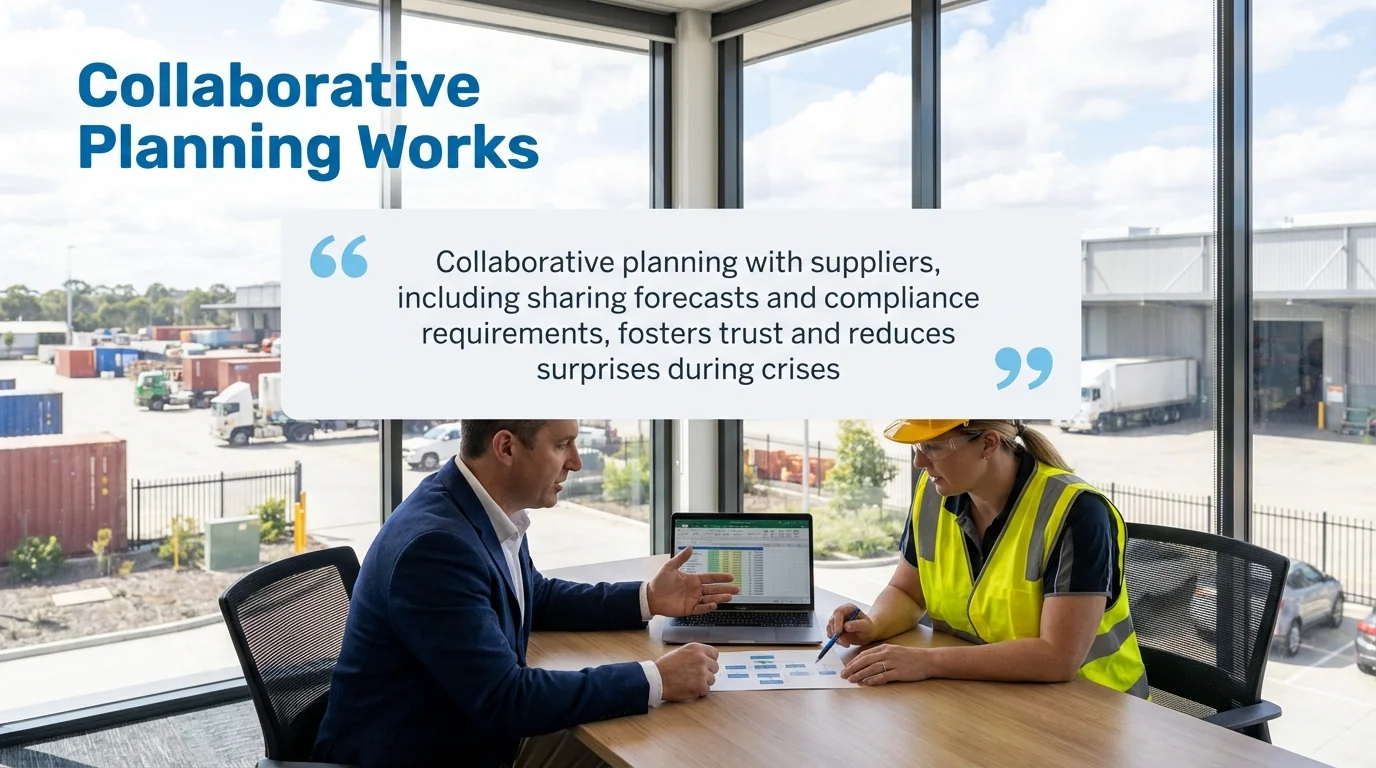
Collaborative planning with suppliers, including sharing forecasts and compliance requirements, fosters trust and reduces surprises during crises, creating partnership relationships that enable faster problem-solving when disruptions occur.
Establish regular planning meetings with critical suppliers sharing demand forecasts, new product introductions, and capacity requirements. This visibility enables suppliers to plan capacity and materials proactively.
Create information-sharing protocols for early warning signals. Suppliers should notify you immediately about potential disruptions including capacity constraints, quality issues, or material shortages.
Develop joint business continuity plans with critical suppliers. Understand their backup facilities, alternative materials, and recovery procedures.
Strategy 5: Contract Risk Management
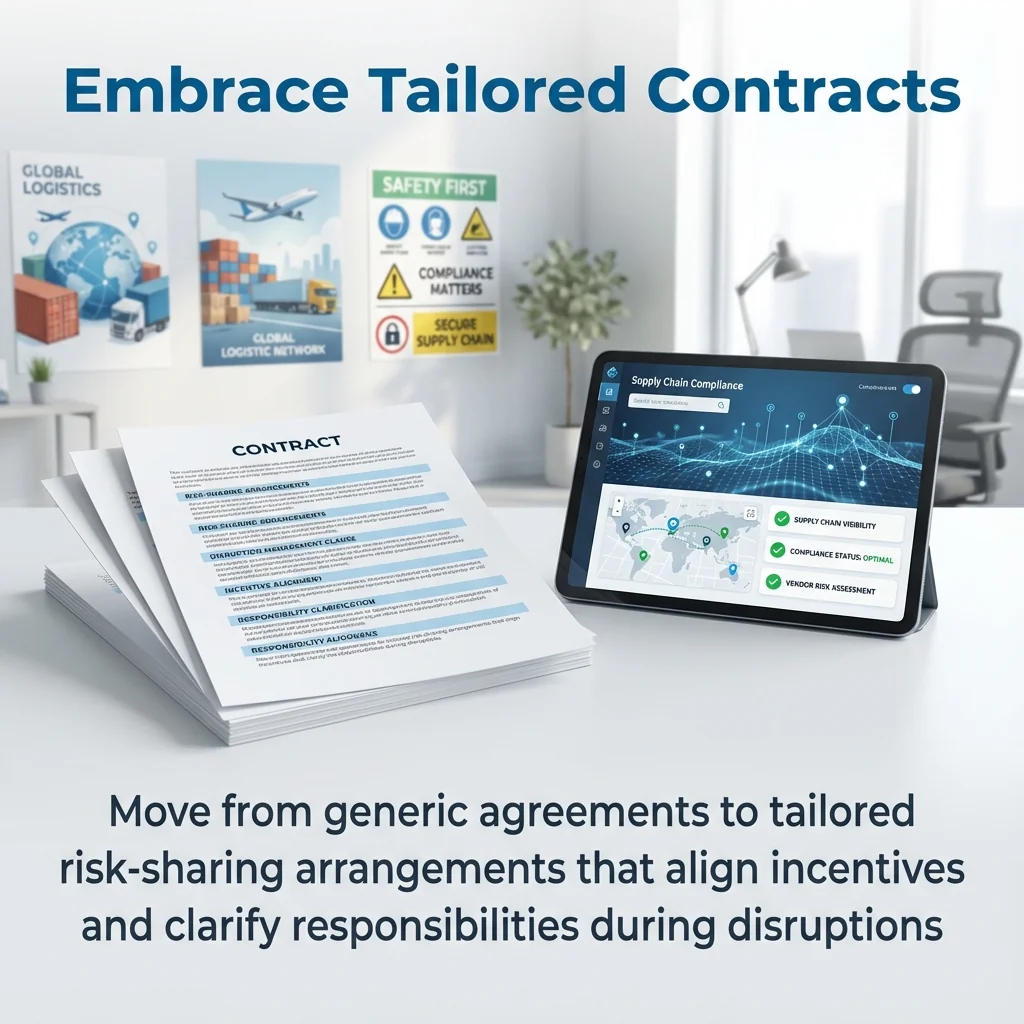
Thoughtful contract strategies that balance risks are emerging as best practices, moving away from generic agreements to more tailored risk-sharing arrangements that align incentives and clarify responsibilities during disruptions.
Include force majeure clauses that address natural disasters, political events, and other uncontrollable circumstances. Clearly define notification requirements, mitigation obligations, and consequences.
Establish service level agreements with performance metrics, monitoring procedures, and remedies for non-performance. Quantifiable standards enable objective performance evaluation.
Implement risk-sharing provisions that allocate responsibility for specific risk types between parties. Consider gain-sharing arrangements that align supplier and buyer interests.
Include business continuity requirements in supplier contracts. Specify minimum disaster recovery capabilities, backup facility availability, and crisis communication protocols.
Strategy 6: Technology-Enabled Visibility
Companies are adopting cloud-based platforms and AI-driven tools to improve real-time visibility, optimize inventory management, and enable faster responses to market fluctuations, transforming supply chain risk management from periodic assessment to continuous monitoring.
Implement supply chain visibility platforms that track supplier performance, inventory levels, and shipment status in real time. This transparency enables early problem detection.
Deploy predictive analytics tools that identify emerging risks based on pattern analysis. These systems can flag supplier financial deterioration, quality trends, or delivery performance declines before they create disruptions.
Establish automated alert systems for risk threshold breaches. Immediate notifications enable rapid response when metrics exceed acceptable ranges.
Integrate supplier systems with internal planning and execution systems. This connectivity enables collaborative planning and reduces manual coordination efforts.
Strategy 7: Supplier Development and Capability Building
Investing in supplier capabilities reduces risk by improving supplier resilience, quality, and reliability.
Provide technical assistance to suppliers improving their processes, quality systems, or business continuity planning. This investment strengthens supplier capability while reducing your supply risk.
Conduct joint continuous improvement programs addressing quality, delivery, or cost performance. Collaborative improvement builds stronger relationships and better supplier performance.
Support supplier technology adoption enabling better quality control, production planning, or business continuity. Financial assistance or expertise sharing accelerates supplier capability development.
Strategy 8: Demand Management and Flexibility
Demand-side strategies reduce supply chain stress and provide flexibility during disruptions.
Design products with flexible component specifications enabling supplier substitution. When components allow alternative sourcing, supply disruptions create fewer constraints.
Implement postponement strategies delaying final configuration until customer orders are received. This flexibility enables adaptation to supply availability.
Develop demand shaping capabilities including pricing strategies, promotion timing, and product mix optimization. These tools help balance demand against available supply during constrained periods.
Strategy 9: Risk Transfer Mechanisms
Insurance and financial instruments transfer certain risk types to third parties.
Evaluate supply chain disruption insurance covering losses from supplier failures, transportation delays, or property damage. These policies provide financial protection during specific disruption types.
Consider trade credit insurance protecting against customer or supplier insolvency. This coverage reduces financial exposure from payment defaults.
Implement currency hedging strategies for international supply chains exposed to exchange rate volatility. Financial instruments can stabilize costs despite currency fluctuations.
Strategy 10: Scenario Planning and Crisis Preparedness
Preparing for potential disruptions enables faster, more effective responses when crises occur.
Develop scenario plans for high-probability or high-impact risks. Document response procedures, decision authorities, and communication protocols for each scenario.
Conduct crisis simulation exercises testing response plans and identifying gaps. Tabletop exercises reveal coordination challenges and decision-making bottlenecks.
Establish crisis management teams with clear roles, responsibilities, and escalation procedures. Pre-designated teams respond faster than ad hoc groups formed during crises.
Create communication templates for internal and external stakeholders. Prepared communications enable faster, more consistent messaging during disruptions.
Implementing Systematic Risk Management Processes
Sustainable risk management requires embedded processes rather than one-time initiatives. Organizations building systematic approaches create ongoing capabilities that adapt as conditions change.
Establishing Governance Structures
Effective governance provides accountability, resources, and decision-making frameworks for risk management.
Create cross-functional risk management committees including procurement, operations, finance, quality, and logistics representatives. This diversity brings multiple perspectives to risk assessment and mitigation planning.
Assign executive sponsorship to risk management programs. Senior leadership involvement ensures adequate resources and elevates risk management priority across the organization.
Define clear roles and responsibilities for risk identification, assessment, mitigation, and monitoring. Accountability structures ensure tasks are completed and performance is measured.
Establish review cadences for risk assessments, mitigation strategy evaluation, and performance reporting. Regular reviews maintain focus and enable continuous improvement.
Developing Risk Monitoring Systems
Continuous monitoring enables early detection of emerging threats and validates mitigation strategy effectiveness.
Implement key risk indicators tracking supplier performance, inventory levels, lead times, quality metrics, and external threat signals. These metrics provide early warning when conditions deteriorate.
Create dashboards visualizing risk metrics and trends for different stakeholder groups. Executive dashboards focus on high-level risk exposure while operational dashboards provide detailed performance metrics.
Establish escalation procedures triggering action when metrics exceed thresholds. Automated alerts ensure rapid notification when intervention is required.
Conduct periodic risk reassessments evaluating whether risk profiles have changed. New products, market expansions, or supplier changes alter risk exposure requiring strategy updates.
Building Organizational Capabilities
Risk management capabilities require knowledge, skills, and cultural commitment across the organization.
Provide training on risk management concepts, tools, and procedures for procurement, operations, and logistics teams. Broad capability enables distributed risk identification and response.
Develop risk management expertise through certifications, professional development, and knowledge sharing. Specialized expertise improves risk assessment quality and mitigation strategy effectiveness.
Foster risk awareness culture where employees recognize and report potential threats. Cultural commitment to risk management amplifies formal processes and systems.
Share lessons learned from disruptions and near-misses. Post-incident reviews identify process improvements and build organizational knowledge.
Leveraging Technology for Supply Chain Risk Management
Technology platforms provide capabilities impossible through manual processes. Organizations investing strategically in risk management technology gain visibility, analytical power, and response speed advantages.
Cloud-Based Risk Management Platforms
Integrated platforms centralize risk data, automate monitoring, and enable collaboration across teams and organizations.
Cloud platforms provide accessibility from anywhere, enabling distributed teams to access current risk information and collaborate on mitigation planning. This accessibility proves particularly valuable during crisis response when team members may work remotely.
Platform integration with ERP systems, supplier portals, and logistics networks creates comprehensive visibility across the supply chain. Automated data flows reduce manual effort while improving data accuracy and timeliness.
Configurable dashboards and reporting tools enable different stakeholder groups to view relevant risk information in appropriate formats. Executives see high-level summaries while operational teams access detailed metrics.
Artificial Intelligence and Predictive Analytics
AI-powered tools identify patterns and predict emerging risks beyond human analytical capabilities.
Machine learning algorithms analyze supplier performance data identifying quality trends, delivery reliability patterns, or financial health deterioration. These insights enable proactive intervention before performance failures occur.
Natural language processing monitors news sources, social media, and other unstructured data for early warning signals. Automated monitoring detects emerging threats from political instability, natural disasters, or supplier financial distress.
Predictive models forecast demand volatility, supply disruptions, or transportation delays based on historical patterns and external variables. These forecasts inform inventory decisions and contingency planning.
Blockchain for Supply Chain Transparency
Blockchain technology creates immutable records of transactions and custody transfers across supply chains.
Distributed ledger systems provide transparency into product provenance, custody chains, and compliance documentation. This visibility helps verify supplier claims and detect counterfeit materials.
Smart contracts automate compliance verification and payment triggers based on predefined conditions. This automation reduces manual processes while ensuring contractual terms are enforced.
Blockchain-based systems enable trusted information sharing across organizations without requiring central databases. This architecture facilitates collaboration while protecting proprietary information.
Digital Twins and Simulation Tools
Digital twin technology creates virtual representations of physical supply chains enabling scenario testing and optimization.
Supply chain digital twins model material flows, production processes, and logistics networks. These models enable testing mitigation strategies before implementation, identifying optimal approaches without operational disruption.
Simulation tools model disruption scenarios evaluating potential impacts and response effectiveness. Organizations can test crisis response plans, evaluate inventory strategies, or assess supplier diversification options virtually.
Optimization algorithms identify ideal configurations balancing cost, service, and risk objectives. These tools help determine optimal supplier networks, inventory locations, and transportation strategies.
Developing Supply Chain Resilience Through Culture and Collaboration
Technology and processes provide necessary infrastructure, but organizational culture and collaborative relationships determine risk management program effectiveness.
Building Risk-Aware Culture
Cultural commitment to risk awareness amplifies formal risk management systems.
Leadership must model risk awareness through their decisions and communications. When executives prioritize risk consideration in strategic decisions, the organization follows their example.
Recognize and reward employees who identify risks or improve mitigation strategies. Positive reinforcement encourages ongoing engagement with risk management.
Include risk management objectives in performance evaluations and incentive structures. Formal accountability mechanisms ensure risk management receives appropriate attention.
Share risk management successes and failures transparently. Organizations learning from both positive and negative experiences build stronger capabilities over time.
Strengthening Supplier Relationships
Collaborative supplier relationships enable better information sharing, joint problem-solving, and mutual support during disruptions.
Move beyond transactional purchasing relationships to strategic partnerships with critical suppliers. Partnership approaches include shared planning, joint investments, and collaborative improvement programs.
Establish regular executive engagement between organizations. Senior leadership relationships facilitate rapid problem escalation and resolution during crises.
Create win-win arrangements aligning supplier and buyer interests. Fair pricing, reasonable payment terms, and volume stability encourage supplier investment in capabilities benefiting both parties.
Support supplier sustainability and resilience through technical assistance, financial support, or business planning collaboration. Stronger suppliers create more resilient supply chains.
Engaging Industry Collaboration
Industry-level collaboration addresses common risks and shares best practices.
Participate in industry consortia focused on supply chain risk management. These groups share threat intelligence, develop common standards, and coordinate responses to industry-wide challenges.
Engage with regulatory bodies and policy makers shaping requirements affecting supply chain operations. Proactive engagement enables organizations to influence regulations while preparing for implementation.
Share non-competitive information about risks and mitigation approaches. Industry knowledge sharing accelerates learning and improves collective preparedness.
Measuring Risk Management Performance
Performance measurement validates whether risk management investments deliver expected benefits and identifies improvement opportunities.
Key Performance Indicators
Comprehensive measurement includes leading indicators predicting potential problems and lagging indicators measuring actual performance.
Leading indicators include supplier assessment completion rates, mitigation strategy implementation progress, and risk monitoring coverage. These metrics predict future performance based on current activities.
Lagging indicators measure disruption frequency, disruption costs, supply continuity, and customer service impacts. These outcomes demonstrate whether risk management strategies effectively protect operations.
| Metric Category | Example Metrics | Purpose |
|---|---|---|
| Supplier Performance | On-time delivery rate, quality defect rate, financial stability score | Monitor supplier reliability and identify emerging problems |
| Disruption Impact | Disruption frequency, average recovery time, revenue impact | Quantify operational and financial consequences of supply chain disruptions |
| Mitigation Effectiveness | Multi-source percentage, buffer stock adequacy, visibility coverage | Assess whether mitigation strategies provide intended protection |
| Risk Coverage | Critical suppliers assessed, risk scenarios documented, monitoring coverage | Ensure comprehensive risk identification and assessment |
Benchmarking and Continuous Improvement
Comparing performance against industry standards and historical performance identifies improvement opportunities.
Participate in industry benchmarking studies measuring supply chain risk management maturity, disruption frequency, and recovery performance. External comparisons reveal performance gaps and best practice opportunities.
Track performance trends over time identifying improvement or deterioration. Trend analysis reveals whether risk management programs are strengthening organizational resilience.
Conduct regular program assessments evaluating process effectiveness, technology utilization, and organizational capabilities. Structured assessments provide roadmaps for capability development.
Implement continuous improvement processes systematically addressing identified gaps and implementing best practices. Sustained improvement requires dedicated resources and management attention.
Key Questions About Supply Chain Risk Mitigation
What are the 7 C’s of supply chain management?
The 7 C’s are Customer, Cost, Capacity, Control, Collaboration, Compliance, and Continuity. These principles guide organizations in meeting customer needs while managing costs and ensuring operational capacity. They emphasize maintaining control, fostering collaboration, complying with regulations, and ensuring business continuity during disruptions.
What are the 7 different types of supply chain risks?
The 7 types include demand risk, supply risk, environmental risk, business risk, logistical risk, quality risk, and financial risk. These categories cover disruptions from market changes, supplier failures, natural disasters, operational issues, transportation problems, product defects, and economic instability that threaten supply chain continuity.
What are the 5 C’s of supply chain management?
The 5 C’s are Customer, Cost, Capacity, Control, and Collaboration. These core elements focus on meeting customer demands, optimizing costs, managing operational capacity, maintaining process control, and encouraging collaboration across the supply chain to achieve efficient operations.
Building Sustainable Risk Management Capabilities
Effective supply chain risk management transforms from project to program through sustained commitment, continuous improvement, and organizational capability development.
Organizations achieving supply chain resilience implement structured risk mitigation strategies addressing multiple vulnerability types. They combine supplier diversification, geographic distribution, strategic inventory, collaborative planning, and technology-enabled visibility into cohesive programs.
Technology platforms including supply chain risk management software provide capabilities enabling continuous monitoring, predictive analytics, and rapid response. These tools amplify human expertise rather than replacing it.
The most resilient organizations integrate risk management into logistics management and operational planning. Risk consideration becomes embedded in daily decisions rather than separate initiatives.
Success requires sustained executive commitment, adequate resources, and cultural emphasis on risk awareness. Organizations treating risk management as compliance exercise rather than strategic capability miss opportunities for operational advantages.
Start by mapping your current supply chain identifying critical dependencies and vulnerability concentrations. Prioritize mitigation efforts based on risk assessment combining probability and impact analysis. Implement strategies systematically building capabilities over time rather than attempting everything simultaneously.
Supply chain risk management delivers value beyond disruption avoidance. Organizations with robust programs achieve operational efficiency, cost optimization, and competitive advantages through superior supply chain resilience.