
ISO 45001 delivers measurable improvements across five core dimensions that directly impact your operations and bottom line. Organizations implementing this occupational health and safety management system framework typically reduce workplace incidents, improve regulatory compliance, enhance employee engagement, lower operational costs, and strengthen their market position through demonstrated safety commitment.
The framework’s structured approach to managing workplace health and safety risks creates systematic improvements rather than reactive fixes. This matters because ISO 45001 helps organizations proactively manage workplace risks and foster a culture of continuous safety improvement.
Based on 25 years working across supply chain environments in Australia and the UK, I’ve seen how proper safety management systems transform organizations beyond simple compliance checkbox activities. The difference lies in implementation quality and leadership commitment.
We’ll examine what ISO 45001 actually provides, why it matters for your operations, the specific benefits you can expect, and how these advantages translate into real operational improvements. You’ll understand the practical value this standard delivers when implemented correctly.
What ISO 45001 Actually Means for Your Operations
ISO 45001 represents the international benchmark for occupational health and safety management systems. It establishes requirements organizations must meet to effectively manage workplace health and safety risks.
The standard applies to organizations of any size across all sectors. Manufacturing, logistics, construction, and service industries all use this framework to manage worker safety systematically.
Think of ISO 45001 as your operational blueprint for safety management. It outlines how to identify hazards, assess risks, implement controls, and continuously improve safety performance through structured processes.
Core Framework Components
The standard operates on a Plan-Do-Check-Act cycle. You plan your safety objectives, implement controls, check performance, and act on improvement opportunities.
Leadership commitment sits at the framework’s center. Management must actively participate in the OH&S management system, not just delegate it to safety officers.
Worker participation matters equally. Employees at all levels contribute to hazard identification and safety improvement processes. Their ground-level insights prove invaluable.
How ISO 45001 Differs from Previous Standards
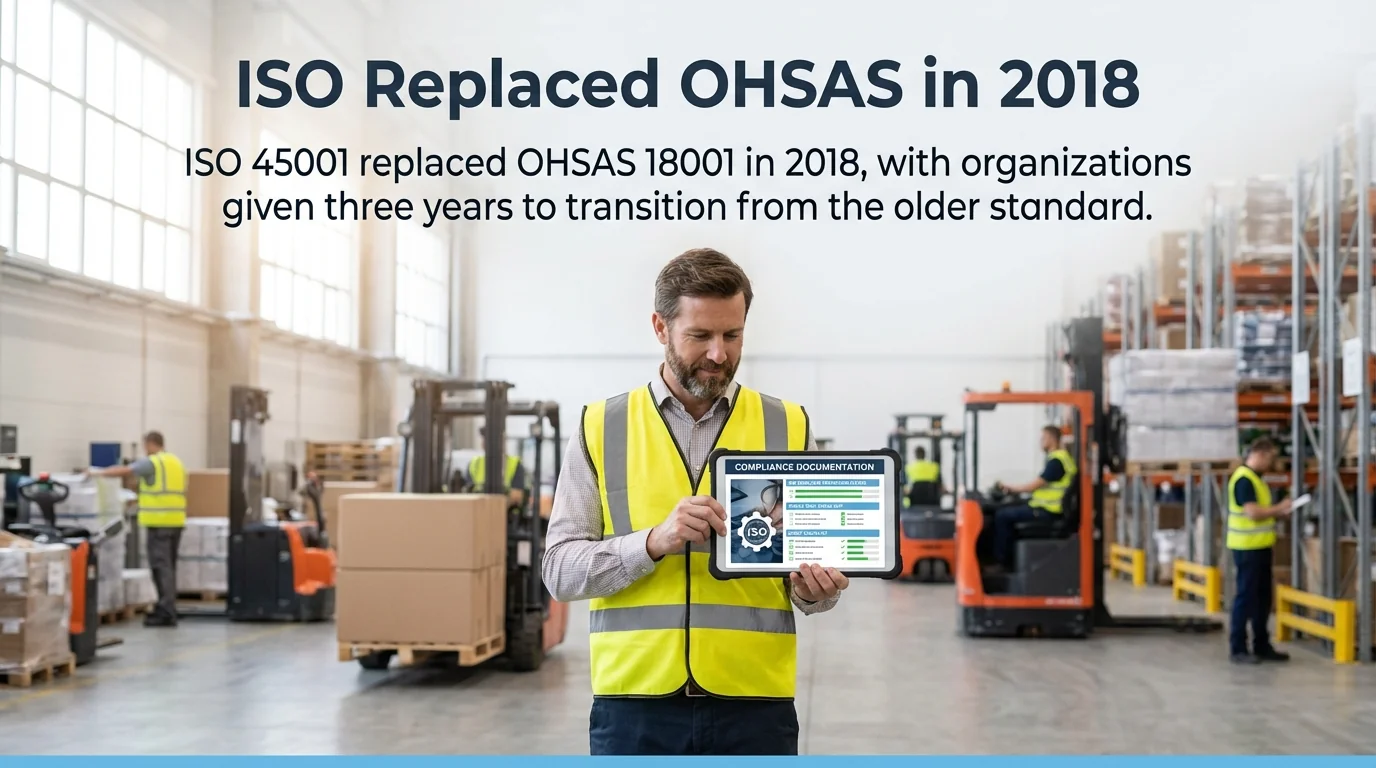
ISO 45001 replaced OHSAS 18001 in 2018. Organizations had three years to transition from the older standard.
The newer framework emphasizes organizational context more heavily. You must understand internal and external factors affecting your occupational health and safety management system.
Risk-based thinking permeates ISO 45001 more thoroughly than OHSAS 18001. You proactively address risks and opportunities rather than just responding to incidents.
Integration Capabilities
ISO 45001 shares its high-level structure with ISO 9001 (quality) and ISO 14001 (environment). This design choice matters for practical implementation.
Organizations managing multiple management systems can integrate them efficiently. You reduce documentation duplication and streamline audit processes.
Integrated management systems create operational synergies. Quality, environmental, and safety objectives align naturally when managed through compatible frameworks.
Why Safety Management System Certification Matters
Certification demonstrates your commitment to worker health and safety through independent verification. Third-party auditors confirm your OH&S management system meets ISO 45001 requirements.
The certification process involves several stages. Initial gap analysis identifies improvement areas. Implementation phase builds required systems. Certification audit verifies compliance.
Accredited certification bodies conduct these audits. In Australia, look for UKAS or JAS-ANZ accreditation to ensure auditor competence and certification validity.
Legal and Regulatory Context
Organizations face extensive occupational health and safety regulations. Work Health and Safety Acts impose legal duties on businesses across Australia.
ISO 45001 certification helps organizations meet international standards and avoid legal or regulatory penalties. The framework aligns with regulatory requirements across jurisdictions.

Regulatory compliance reduces organizational liability. Demonstrating systematic safety management strengthens your legal position if incidents occur.
Stakeholder Expectations
Clients increasingly require OH&S certification from suppliers. Major retailers, manufacturers, and construction firms mandate safety standards throughout their supply chains.
Insurers consider safety management systems when setting premiums. Certified organizations often negotiate better terms based on reduced risk profiles.
Investors and shareholders evaluate safety performance as material risk. Poor safety records impact company valuations and stakeholder confidence.
Reduced Workplace Incidents and Injuries
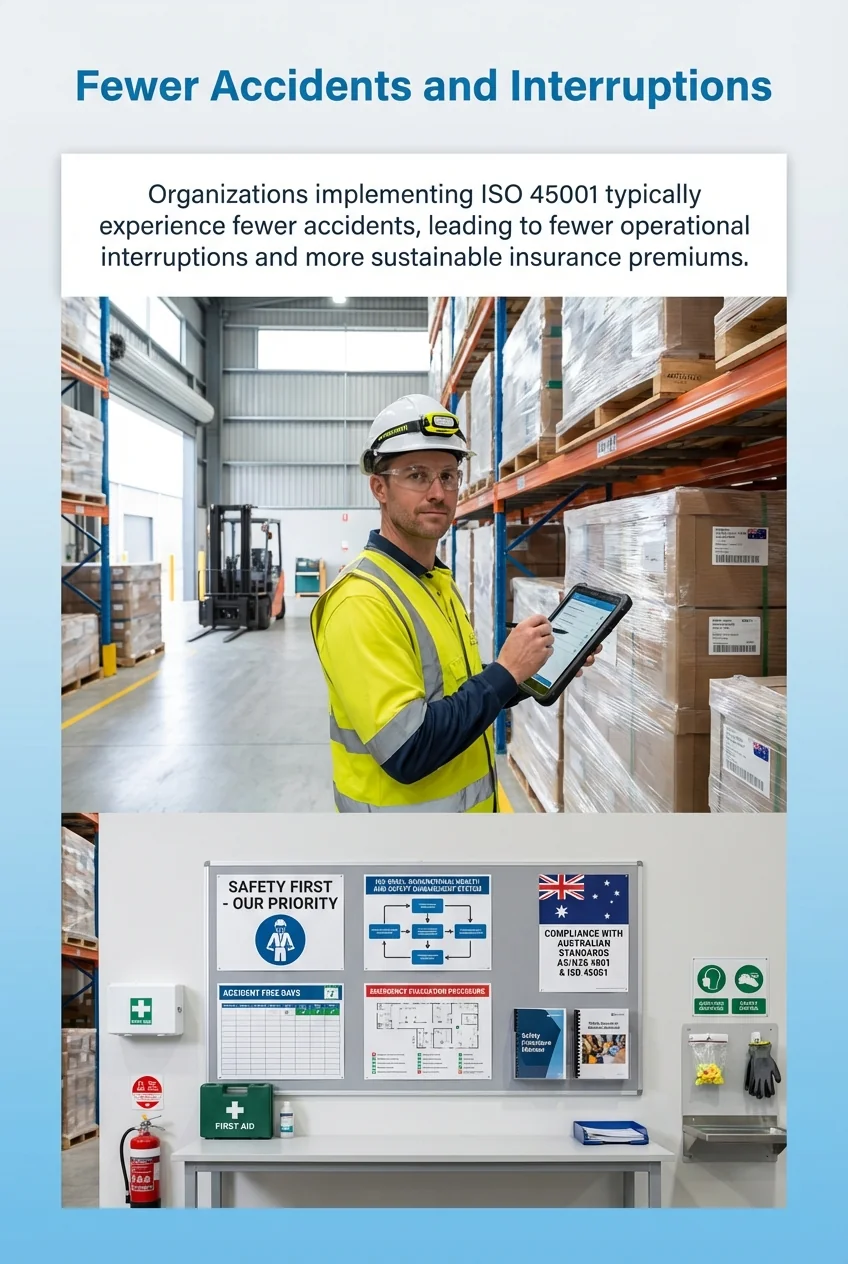
Safety improvements deliver the most visible ISO 45001 benefits. Organizations implementing ISO 45001 typically experience fewer accidents, leading to fewer operational interruptions and more sustainable insurance premiums.
The reduction stems from systematic hazard identification and risk assessment processes. You identify potential dangers before they cause harm.
Control measures become standardized rather than inconsistent. Every worker follows established procedures for managing identified risks.
Systematic Hazard Management
ISO 45001 requires structured hazard identification processes. You systematically examine all work activities for potential health and safety risks.
Risk assessment follows identification. Evaluate each hazard’s likelihood and potential severity. Prioritize controls based on this assessment.
Implement control hierarchy principles. Eliminate hazards where possible. Use engineering controls next. Administrative controls and personal protective equipment come last.
Incident Investigation and Learning
The standard mandates thorough incident investigation. Understanding root causes prevents recurrence more effectively than addressing symptoms.
Document investigation findings and corrective actions. Track implementation to ensure controls actually get put in place.
Share lessons learned across the organization. One department’s incident provides learning opportunities for all areas.
Performance Monitoring
Establish leading and lagging safety indicators. Leading indicators predict future performance. Lagging indicators measure past outcomes.
Track near-miss reports as leading indicators. High near-miss reporting suggests strong safety culture and hazard awareness.
Monitor injury frequency rates as lagging indicators. Compare performance against industry benchmarks and internal targets.
Enhanced Legal Compliance and Reduced Regulatory Risk
Regulatory compliance represents a fundamental ISO 45001 benefit. The management system framework helps organizations systematically meet legal OH&S requirements.
Identify applicable legal requirements during system implementation. Maintain a compliance register covering all relevant regulations.
Evaluate compliance regularly through internal audits. Address gaps before external inspectors or incidents expose them.
Compliance Management Process
Establish processes for identifying new legal requirements. Regulations change frequently across jurisdictions.
Assign responsibility for monitoring regulatory changes. Someone must track updates and assess their impact on your operations.
Communicate new requirements to affected personnel. Workers need timely information to maintain compliance.
Documentation and Evidence
Maintain comprehensive safety documentation. Records demonstrate compliance during regulatory inspections or legal proceedings.
Document risk assessments, training records, incident reports, and corrective actions. Complete records support your due diligence defense.
Implement version control for safety procedures. Current documents must be readily accessible to all workers.
Audit and Review Processes
Conduct regular internal audits of your OH&S management system. Identify compliance gaps before external audits or inspections.
Schedule management reviews to assess system effectiveness. Leadership must evaluate whether the management system achieves intended outcomes.
Address non-conformances promptly. Corrective action processes must be robust and timely.
Improved Employee Wellbeing and Organizational Culture
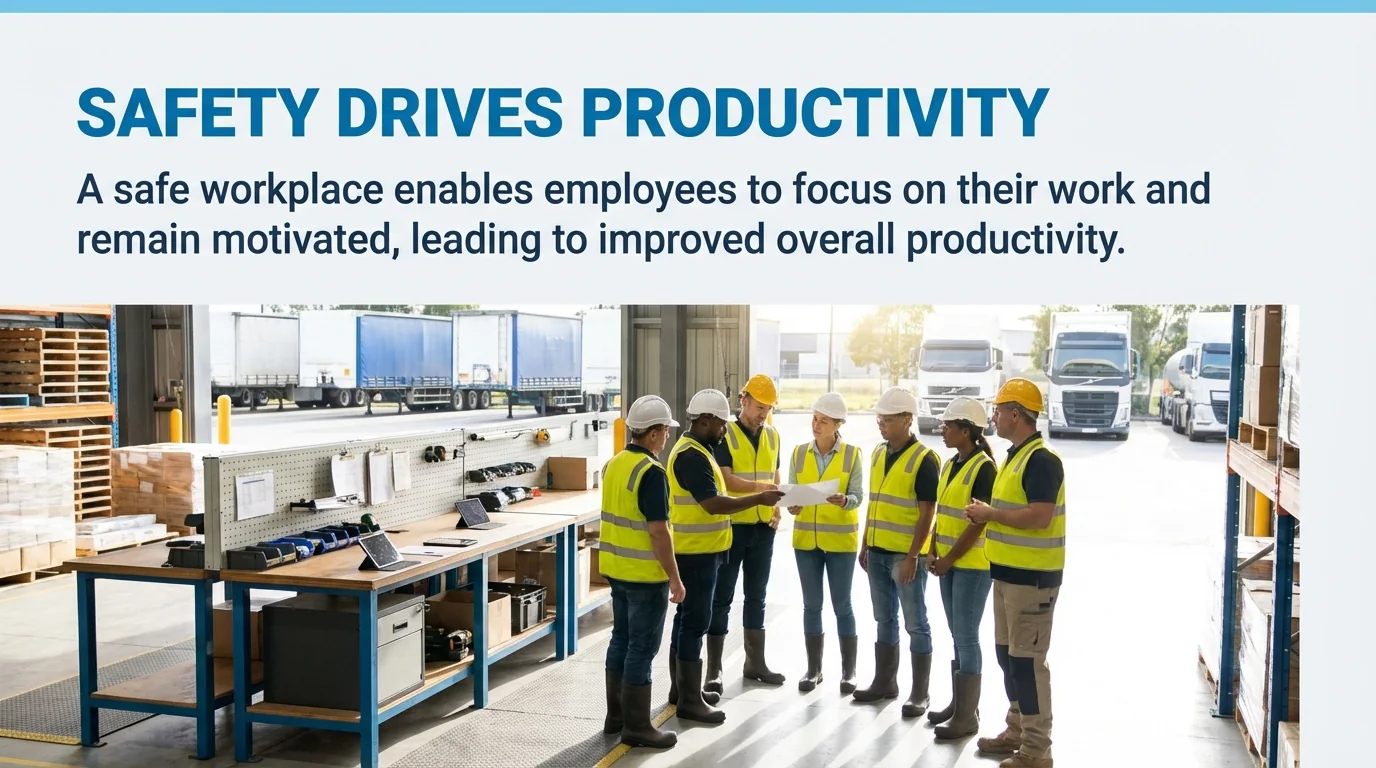
A safe workplace enables employees to focus on their work and remain motivated, leading to improved overall productivity. This connection between safety and performance drives substantial organizational benefits.
Workers in safe environments experience less stress and anxiety. They trust their employer values their wellbeing.
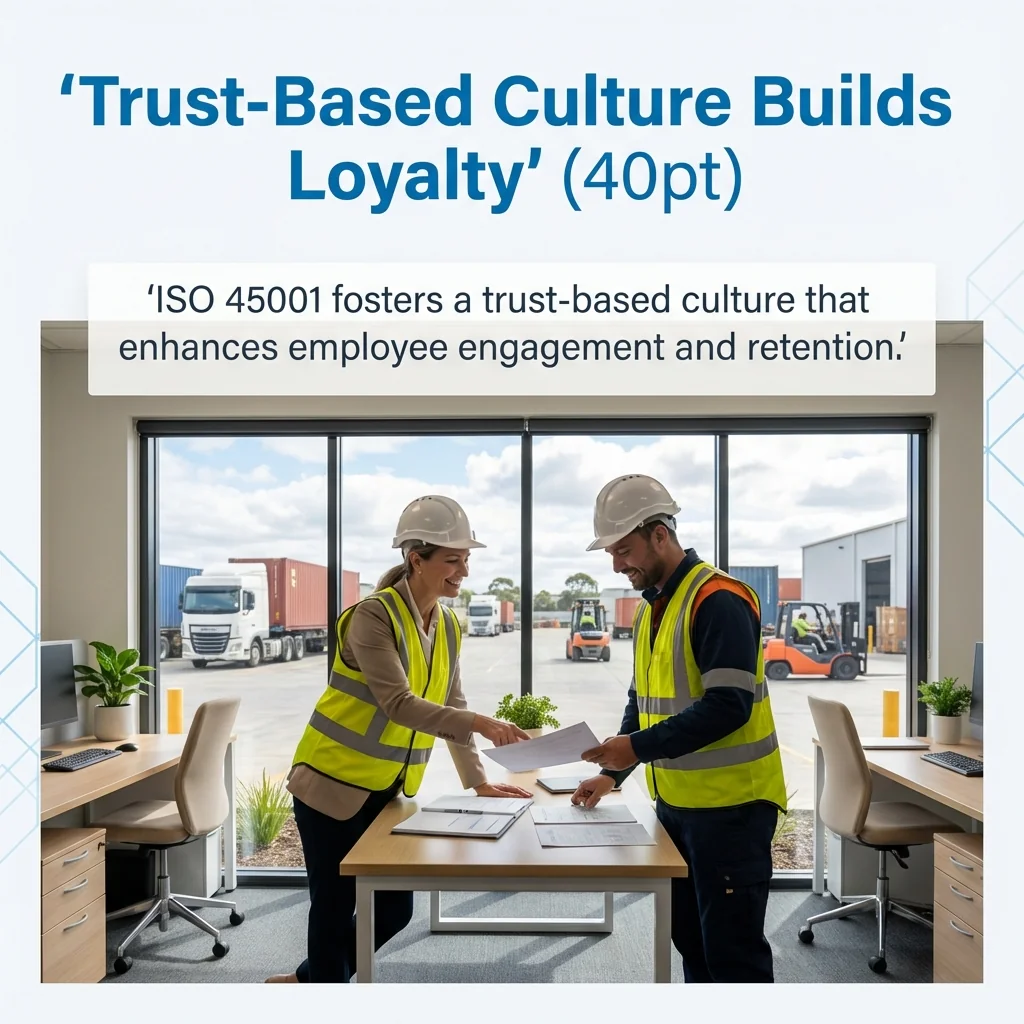
ISO 45001 fosters a trust-based culture that enhances employee engagement and retention. Staff loyalty increases when organizations demonstrate genuine safety commitment.
Worker Participation and Consultation
ISO 45001 mandates meaningful worker participation. Employees must have opportunities to contribute to safety decision-making.
Establish safety committees with worker representatives. Give these committees real authority to influence safety improvements.
Implement suggestion systems for safety improvements. Reward employees who identify hazards or propose solutions.
Training and Competence Development
Systematic training ensures workers understand workplace hazards and controls. Competent employees work more safely and effectively.
Identify training needs through job analysis and risk assessment. Different roles require specific safety knowledge and skills.
Verify training effectiveness through assessment. Confirm workers can apply safety knowledge in their actual work.
Health and Wellbeing Programs
Modern OH&S management extends beyond injury prevention. Consider broader health factors affecting worker wellbeing.
Address psychosocial hazards like work stress, bullying, and fatigue. These factors significantly impact employee health.
Implement health promotion initiatives aligned with your safety management system. Physical and mental health programs demonstrate holistic worker care.
Measurable Cost Savings and Financial Benefits
Research shows that management system standards like ISO 45001 consistently deliver measurable cost savings and operational efficiencies. These financial benefits extend across multiple cost categories.
Direct injury costs decrease as incidents reduce. Medical expenses, compensation claims, and legal fees all decline.
Indirect costs fall equally dramatically. Lost productivity, equipment damage, investigation time, and replacement worker costs all diminish with fewer incidents.
Insurance Premium Reductions
Workers’ compensation premiums reflect claims history. Organizations with fewer incidents pay lower premiums over time.
Some insurers offer immediate discounts for ISO 45001 certification. The certification demonstrates proactive risk management.
General liability insurance costs also decrease. Certified organizations present lower risk profiles to underwriters.
Productivity and Efficiency Gains
Safe workplaces operate more efficiently. Incidents disrupt operations, delay projects, and reduce output.
Worker absenteeism decreases in safer environments. Fewer injuries mean fewer lost work days.
Employee morale improvements boost productivity. Engaged workers in safe environments perform better.
Avoided Costs and Risk Mitigation
Regulatory penalties for safety violations can be substantial. Proactive compliance avoids these fines.
Reputational damage from serious incidents carries enormous costs. Certification helps prevent incidents that generate negative publicity.
Legal defense costs escalate quickly after serious injuries. Prevention costs far less than litigation and settlements.
Strengthened Market Position and Competitive Advantage
ISO 45001 certification differentiates your organization in competitive markets. Clients increasingly evaluate suppliers based on safety performance.
Tender requirements often specify OH&S certification. Organizations without certification get excluded from consideration.
Certification demonstrates professionalism and organizational maturity. It signals you take workplace safety seriously.
Supply Chain Requirements
Major organizations mandate safety standards throughout their supply chains. Certification opens doors to contracts with these clients.
Prequalification processes favor certified suppliers. You advance through tender evaluation stages more easily.
Ongoing supplier audits become simpler. ISO 45001 certification satisfies many client safety requirements.
Brand Reputation and Trust
Safety performance impacts brand perception. Organizations known for protecting workers build stronger reputations.
Certification provides third-party validation of safety commitment. It offers credible evidence beyond marketing claims.
Positive safety culture attracts quality employees. Top talent seeks employers who demonstrate genuine worker care.
Market Access and Growth Opportunities
Some markets require OH&S certification for market entry. International clients often expect ISO 45001 compliance.
Certification facilitates geographic expansion. It demonstrates capability to meet safety standards across jurisdictions.
Growth opportunities increase as certification opens new client relationships. The investment in certification generates business development returns.
Integration with Quality and Environmental Systems
ISO 45001’s structure enables efficient integration with other management systems. Organizations managing multiple ISO standards benefit from this compatibility.
The high-level structure framework applies across ISO 9001, ISO 14001, and ISO 45001. Common elements include context, leadership, planning, support, operation, performance evaluation, and improvement.
Integrated management systems reduce documentation burden. You maintain one set of core procedures covering multiple standards.
Streamlined Implementation and Auditing
Organizations with existing ISO 9001 or ISO 14001 systems implement ISO 45001 more easily. Much of the required infrastructure already exists.
Combined audits assess multiple management systems simultaneously. This approach saves time and reduces audit disruption.
Internal audit programs cover all standards efficiently. One audit team evaluates quality, environmental, and safety performance together.
Holistic Risk Management
Integrated systems provide comprehensive risk oversight. You identify connections between quality, environmental, and safety risks.
Common risk assessment processes work across all three areas. Similar methodologies apply regardless of risk category.
Integrated risk treatment addresses multiple concerns simultaneously. One control measure might reduce quality, environmental, and safety risks together.
Operational Synergies
Management review processes combine multiple standards efficiently. Leadership evaluates all management systems in single review meetings.
Document control systems manage all procedures through one platform. Workers access integrated procedures covering all operational requirements.
Training programs address multiple standards simultaneously. Employees learn integrated approaches rather than separate, siloed systems.
Technology and Digital Transformation Support
Digital tools enhance OH&S management system effectiveness. Software platforms streamline documentation, reporting, and analysis.
Management systems software provides centralized access to safety procedures, risk assessments, and training records. Workers access current information from any location.
Data-Driven Safety Management
Digital systems capture rich safety data. Analytics reveal patterns invisible in manual systems.
Leading indicator tracking becomes practical at scale. Software monitors activities across multiple sites simultaneously.
Predictive analytics identify emerging risks. Data trends highlight areas requiring attention before incidents occur.
Mobile and Field Solutions
Mobile applications bring safety management to the work site. Workers conduct risk assessments and report hazards on-site.
Digital permit-to-work systems improve control over high-risk activities. Real-time visibility shows which permits are active.
Inspection applications standardize observation processes. Digital checklists ensure consistent, thorough inspections.
Continuous Improvement Through Technology
Software platforms support Plan-Do-Check-Act cycles. Automated workflows move corrective actions through completion.
Dashboard reporting provides real-time performance visibility. Management monitors safety metrics without waiting for monthly reports.
Integration with other business systems creates seamless information flow. Safety data connects with operations, HR, and maintenance systems.
Key Questions About ISO 45001 Implementation
What are the benefits of ISO 45001 management system?
ISO 45001 provides organizations with a structured framework to improve workplace safety, reduce risks, and ensure compliance with international health and safety standards. Organizations typically experience fewer workplace accidents, lower insurance costs, improved employee morale, enhanced reputation, increased productivity, and support for continuous safety improvement.
What is one benefit of ISO 45001 related to integration with other management systems?
ISO 45001 is designed for integration with other management system standards, such as ISO 9001 for quality and ISO 14001 for environmental management. This allows organizations to streamline processes, reduce duplication, and manage multiple compliance requirements within a unified framework.
Is ISO 45001 a management system?
Yes, ISO 45001 is an internationally recognized occupational health and safety management system standard. It specifies requirements for organizations to manage workplace health and safety risks and improve safety performance through systematic processes and continuous improvement.
Moving Forward with Your Safety Management System
ISO 45001 implementation delivers substantial benefits across safety performance, regulatory compliance, employee wellbeing, financial outcomes, and competitive positioning. The framework provides structured processes that transform safety from reactive crisis management to proactive risk control.
Start by assessing your current safety management approach against ISO 45001 requirements. Identify gaps between existing practices and standard requirements.
Secure leadership commitment before beginning implementation. Management support determines whether your OH&S management system delivers real improvements or becomes another compliance exercise.
Consider engaging qualified consultants for guidance through implementation. Experienced advisors help you avoid common pitfalls and build sustainable systems.
For organizations already implementing safety management systems, implementing a safety management system requires understanding core components and systematic approaches. The certification process represents an investment in worker safety and organizational capability that delivers returns across multiple dimensions.