
The Heavy Vehicle National Law (HVNL) operates as Australia’s principal regulatory framework for managing road safety risks across the heavy vehicle transport sector. It establishes clear responsibilities throughout the supply chain, mandates fatigue management protocols, and sets enforceable standards for vehicle operations.
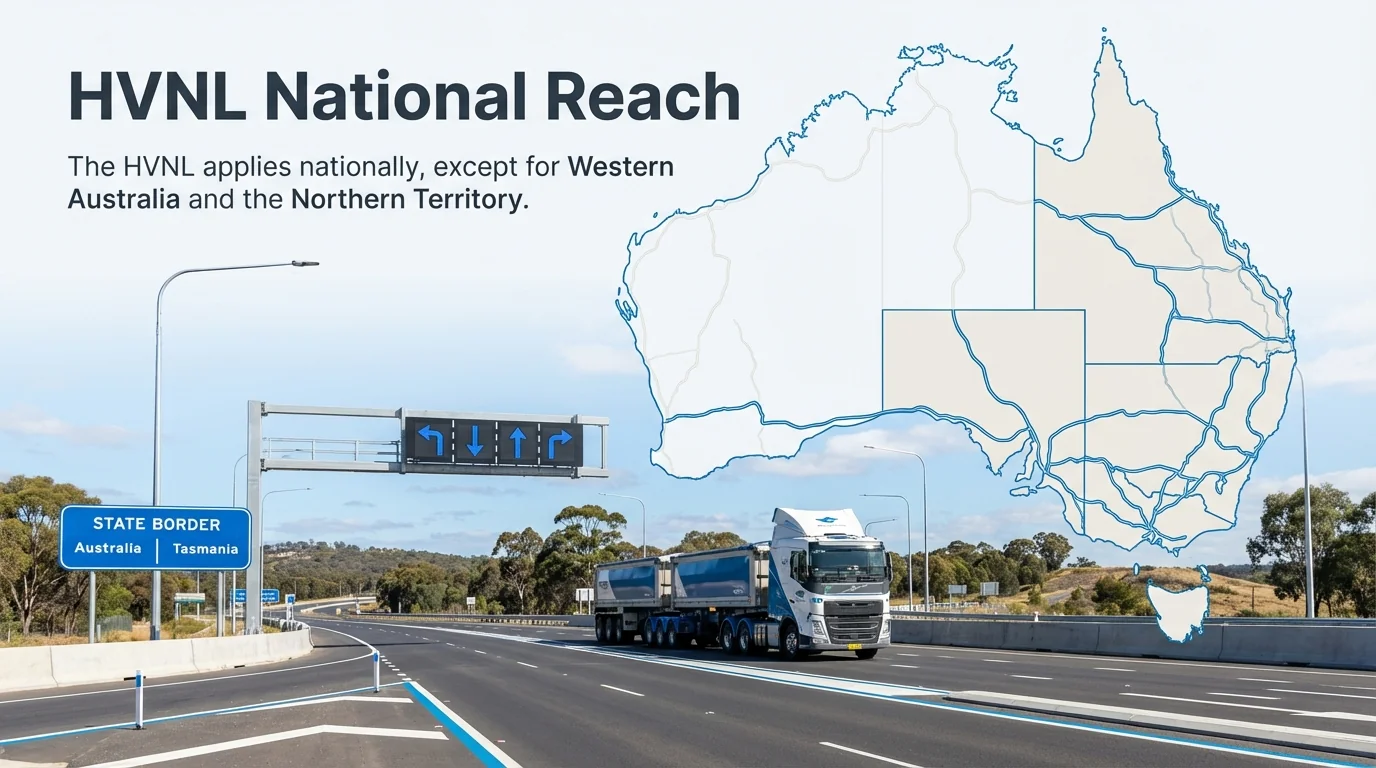
This framework applies nationally to vehicles with a gross vehicle mass exceeding 4.5 tonnes. The HVNL applies nationally, except for Western Australia and the Northern Territory.
Understanding these requirements isn’t about avoiding penalties. It’s about building operational systems that protect your people, enhance efficiency, and create sustainable competitive advantages.
The National Heavy Vehicle Regulator (NHVR) administers this law, conducting compliance audits and enforcing standards across participating jurisdictions. Your obligations extend beyond your drivers to encompass every party influencing vehicle operations.
This guide breaks down the complete HVNL framework. You’ll understand who holds responsibility under Chain of Responsibility principles, what fatigue management requires in practice, and how mass and dimension regulations affect daily operations.
What is the Heavy Vehicle National Law (HVNL)?
The Heavy Vehicle National Law establishes uniform national regulations for heavy vehicle operations throughout Australia. It replaced multiple state-based systems with a single, consistent regulatory framework.
The HVNL covers vehicles exceeding 4.5 tonnes gross vehicle mass. This threshold captures everything from medium-sized delivery trucks to B-double configurations and road trains.
The law’s core purpose centers on road safety. It aims to reduce crashes, injuries, and fatalities involving heavy vehicles while maintaining productive freight movements.
Key regulatory areas include:
- Chain of Responsibility obligations for all supply chain parties
- Fatigue management requirements for drivers and schedulers
- Mass, dimension, and loading standards for vehicles
- Vehicle standards and maintenance obligations
- Speed compliance and journey management
The HVNL harmonizes safety requirements across states and territories. Operators working across jurisdictional boundaries now follow consistent rules rather than navigating different state regulations.
This national approach creates efficiency gains for businesses operating interstate routes. You don’t need separate compliance systems for different regions.
Legislative Framework and Administration
The NHVR operates as the independent regulator responsible for HVNL enforcement. This single agency replaced multiple state-based regulators in participating jurisdictions.
Queensland legislation serves as the host jurisdiction. Other participating states and territories apply the law through application legislation in their own parliaments.
The Heavy Vehicle National Law Amendment Bill 2025 was passed by Queensland Parliament on 18 November 2025. This represents the most significant compliance reform since the HVNL’s original introduction.
The amendments strengthen Chain of Responsibility obligations and introduce mandatory Safety Management Systems. These changes become effective from January 2026 across all participating jurisdictions.
Application and Scope
The HVNL applies to heavy vehicles operating on public roads within participating jurisdictions. Private property operations generally fall outside its scope unless the vehicle subsequently uses public roads.
You’re subject to these requirements if you operate, schedule, load, or otherwise influence heavy vehicle operations. This extends well beyond just holding a truck license.
The law captures business premises where loading occurs, routes you specify for drivers, and timeframes you set for deliveries. Your commercial decisions create compliance obligations even if you never touch a steering wheel.
Understanding Chain of Responsibility (CoR)
Chain of Responsibility represents the HVNL’s most distinctive compliance principle. It distributes legal accountability across every party who can influence safe heavy vehicle operations.
Traditional road transport regulation focused primarily on drivers and vehicle owners. CoR expands responsibility throughout the entire supply chain.
This approach recognizes that drivers often face pressure from other parties to breach safety regulations. Tight delivery schedules, unrealistic timeframes, and commercial incentives can create situations where compliance becomes difficult.
CoR addresses this reality by making all contributing parties legally responsible. If your actions or inactions contribute to a breach, you face potential prosecution regardless of your position in the supply chain.
Parties in the Chain of Responsibility
The HVNL defines specific parties who hold CoR obligations. These include:
| Party | Role | Key Obligations |
|---|---|---|
| Consignors | Send goods via heavy vehicle | Ensure loading doesn’t breach mass limits, provide accurate delivery timeframes |
| Consignees | Receive goods via heavy vehicle | Manage unloading schedules to prevent fatigue breaches, maintain safe site access |
| Packers | Pack or assemble goods for transport | Apply proper load restraint, ensure weight distribution compliance |
| Loading Managers | Supervise or control loading activities | Verify mass compliance before vehicle departure, document loading procedures |
| Schedulers | Plan or arrange transport tasks | Create schedules allowing legal rest breaks, factor in realistic travel times |
| Operators | Control or direct heavy vehicle use | Maintain vehicles, monitor driver hours, implement safety systems |
Executive officers of companies involved in heavy vehicle operations also carry personal liability. You must exercise due diligence to ensure your organization maintains compliance.
This obligation requires active engagement. You can’t delegate responsibility through corporate structures or claim ignorance of operational realities.
Reasonable Steps and Due Diligence
CoR obligations require you to take reasonable steps to prevent breaches. The law doesn’t demand perfection, but it does require proactive risk management.
Reasonable steps vary based on your role and capacity to influence outcomes. A multinational retailer faces different expectations than a small local consignor.
Due diligence for executive officers includes:
- Acquiring and maintaining knowledge of HVNL requirements relevant to your business
- Understanding your organization’s heavy vehicle operations and associated risks
- Ensuring appropriate resources exist for HVNL compliance
- Implementing processes to receive and respond to compliance information
- Verifying that your organization implements and maintains appropriate systems
Documentation proves essential for demonstrating reasonable steps. Written procedures, training records, and audit findings provide evidence of your compliance efforts.

Understanding the full scope of Chain of Responsibility helps you identify where your business intersects with heavy vehicle operations and what specific obligations you hold.
The Role of the National Heavy Vehicle Regulator (NHVR)
The NHVR administers and enforces the Heavy Vehicle National Law across participating jurisdictions. This independent statutory body provides consistent regulation replacing the previous state-based approach.
The regulator’s functions extend well beyond enforcement. It provides guidance, issues permits and exemptions, and works with industry to improve safety outcomes.
Regulatory Functions and Responsibilities
The NHVR manages several core regulatory activities:
- Conducting roadside inspections and compliance audits
- Investigating alleged HVNL breaches and gathering evidence
- Issuing improvement notices, infringement notices, and prosecuting serious offenses
- Processing access permit applications for oversize or overmass vehicles
- Managing operator accreditation schemes
The regulator takes a risk-based approach to compliance activities. High-risk operators and routes receive more intensive oversight than lower-risk operations.
Serious breaches trigger investigation and potential prosecution. The NHVR can pursue criminal charges through state magistrates’ courts for significant offenses.
Accreditation Schemes and Incentives
The NHVR administers voluntary accreditation schemes recognizing operators with strong safety systems. Accredited operators gain access to various regulatory concessions.
Benefits include:
- Reduced roadside inspection frequency
- Access to higher mass limits under the Performance Based Standards scheme
- Simplified fatigue management options
- Streamlined permit processes for oversize loads
Accreditation requires implementing audited safety management systems. You must demonstrate systematic approaches to managing mass, maintenance, and fatigue risks.
The compliance burden increases, but many operators find the operational benefits justify the investment. Reduced delays from inspections and improved productivity often outweigh additional administrative requirements.
Fatigue Management Requirements
Fatigue causes significant crash risks in heavy vehicle operations. Driver tiredness impairs reaction times, decision-making ability, and hazard perception similar to alcohol intoxication.
The HVNL establishes detailed fatigue management requirements controlling driver work and rest hours. These regulations apply to all parties in the Chain of Responsibility, not just drivers themselves.
Three main fatigue management options exist under the law. Each provides different flexibility levels with corresponding compliance requirements.
Standard Hours
Standard Hours represents the basic fatigue management framework. Most operators use this option as it requires minimal administrative burden.
Maximum work times under Standard Hours include:
| Period | Maximum Work Time | Minimum Rest Required |
|---|---|---|
| Single Day | 12 hours | 7 continuous hours |
| Any 7 Days | 72 hours | 24 continuous hours weekly |
| 14 Days | 144 hours | Not specified |
Work time includes all driving plus other work duties. Rest breaks must be genuinely available for sleeping, not merely off-duty periods at customer sites.
Drivers must maintain written work diaries recording all work and rest times. These diaries provide evidence of compliance during audits and investigations.
Basic Fatigue Management (BFM) and Advanced Fatigue Management (AFM)
BFM and AFM provide more flexible work hour arrangements. In exchange, you implement audited fatigue management systems.
BFM allows extended work hours compared to Standard Hours. You can schedule up to 14 hours work in a day under specific conditions.
AFM provides maximum flexibility through approved fatigue management plans. You design work schedules based on scientific fatigue modeling rather than prescriptive hour limits.
Both options require NHVR accreditation. Your safety management systems must demonstrate effective fatigue risk controls before approval.
Scheduler Responsibilities
Schedulers carry specific obligations under fatigue management laws. If you create rosters, plan delivery timeframes, or set operational schedules, these requirements apply to you.
You must ensure your schedules allow drivers to complete work within legal hour limits. This requires understanding travel distances, typical traffic conditions, and mandatory rest break timing.
Building buffer time into schedules creates compliance margins. Unexpected delays shouldn’t immediately force drivers into breach situations.
Many prosecutions target schedulers rather than drivers. The NHVR recognizes that commercial pressure from unrealistic schedules drives many hour breaches.
Effective fatigue management requires collaboration across your organization. Schedulers, dispatchers, and customer service teams all influence whether drivers can maintain compliance.
Mass, Dimension, and Loading Regulations
The HVNL establishes strict mass and dimension limits for heavy vehicles. These standards protect road infrastructure and maintain safety for all road users.
Mass limits apply at multiple levels. Your vehicle must comply with axle mass limits, axle group limits, and total gross vehicle mass restrictions.
Exceeding these limits damages road surfaces and bridges. Overloading also increases stopping distances and reduces vehicle stability during emergency maneuvers.
Mass Limit Categories
Several mass limit types apply simultaneously:
- Axle mass limits restrict weight on individual axles
- Axle group limits apply to closely spaced axle combinations
- Gross vehicle mass limits cap total vehicle weight including load
- Gross combination mass limits apply to truck-trailer combinations
The most restrictive limit always applies. You might comply with gross vehicle mass limits while breaching specific axle mass requirements.
Different vehicle configurations have different mass entitlements. A six-axle semi-trailer can legally carry more than a two-axle rigid truck.
Dimension Requirements
The HVNL sets maximum dimensions for heavy vehicles using public roads. Standard dimension limits include:
| Dimension | Standard Limit | Notes |
|---|---|---|
| Height | 4.3 meters | Measured from ground to highest point |
| Width | 2.5 meters | Excluding mirrors and specific safety equipment |
| Length | Varies by configuration | 19 meters for semi-trailers, 20 meters for B-doubles |
Exceeding standard dimensions requires permits from the NHVR. These assess whether your vehicle can safely navigate proposed routes considering bridge clearances, road widths, and intersection geometry.
Loading Responsibilities
Multiple Chain of Responsibility parties influence loading outcomes. Consignors specify what gets loaded, packers prepare goods for transport, and loading managers supervise physical loading activities.
Each party must take reasonable steps to prevent mass breaches. This includes:
- Obtaining accurate weights for goods before loading
- Understanding vehicle mass limits and current tare weight
- Verifying loaded weight before vehicle departure
- Maintaining records documenting your compliance efforts
Load restraint requirements ensure cargo remains secure during transport. Inadequate restraint creates serious safety risks through load shift or spillage.
The Load Restraint Guide provides detailed technical specifications. You must select appropriate restraint systems based on cargo characteristics and expected transport conditions.
Recent regulatory amendments have refined mass and loading requirements to address emerging operational issues.
Vehicle Standards and Maintenance Obligations
The HVNL requires heavy vehicles to meet specific safety standards. These cover vehicle condition, required equipment, and ongoing maintenance practices.
Operators carry primary responsibility for vehicle standards compliance. You must ensure vehicles remain roadworthy throughout their operational life.
Roadworthiness Requirements
Vehicles must maintain safe operating condition across all major systems:
- Braking systems must meet performance standards and respond appropriately
- Steering components must operate without excessive play or binding
- Tires must maintain legal tread depth and show no structural damage
- Lights and reflectors must function correctly for visibility
- Coupling devices must secure properly without excessive wear
Pre-operation inspections help identify defects before they cause breakdowns or crashes. Drivers should complete systematic vehicle checks at the start of each shift.
Many operators implement daily vehicle inspection checklists. These provide documented evidence of your maintenance oversight efforts.
Maintenance Systems
Systematic maintenance programs demonstrate reasonable steps for vehicle standards compliance. Scheduled servicing based on manufacturer recommendations forms the foundation.
Effective maintenance systems include:
- Service schedules aligned with vehicle usage and manufacturer specifications
- Defect reporting processes enabling drivers to communicate problems
- Documented repairs showing what work occurred and when
- Parts replacement policies ensuring critical components receive timely renewal
- Regular inspection of components subject to wear or fatigue
Maintenance records prove essential during investigations. The NHVR examines your maintenance documentation to assess whether you exercised due diligence.
Operators using accreditation schemes must meet prescribed maintenance management standards. These require more detailed systems than basic compliance approaches.
Modification and Engineering Requirements
Vehicle modifications require appropriate engineering approval. Structural changes, suspension modifications, or equipment additions can affect vehicle safety certification.
Illegal modifications create serious compliance risks. They may invalidate insurance coverage and create criminal liability if defects contribute to crashes.
Always obtain proper engineering documentation before modifying heavy vehicles. The cost of correct approval processes is minimal compared to potential penalties and consequences.
Who is Responsible Under HVNL?
HVNL responsibilities extend throughout organizational structures. Multiple parties often contribute to the same operational outcome, and each carries legal obligations.
Understanding your specific role within the Chain of Responsibility helps you identify relevant compliance requirements. Your duties depend on what functions you actually perform.
Operator Obligations
Operators control or direct how heavy vehicles get used in transport operations. This typically means the business holding operating authority or managing vehicle deployment.
Your operator obligations cover:
- Ensuring drivers hold appropriate licenses and medical clearances
- Implementing fatigue management systems and monitoring driver hours
- Maintaining vehicles to roadworthy standards
- Managing mass and loading compliance
- Providing drivers with necessary compliance information and support
Many operators implement comprehensive safety management systems. A structured compliance checklist helps ensure you address all regulatory requirements systematically.
Driver Responsibilities
Drivers carry frontline responsibility for immediate operational decisions. You must comply with fatigue requirements, observe mass limits, and maintain vehicles in safe condition.
Driver obligations include:
- Maintaining accurate work diary records of all work and rest times
- Refusing to drive when fatigued or when schedules breach legal limits
- Completing pre-start vehicle inspections and reporting defects
- Operating within speed limits and traffic laws
- Ensuring loads remain properly restrained during transport
Drivers often face conflicting pressures between compliance requirements and commercial demands. The CoR framework acknowledges this by making other parties responsible for creating compliant operating conditions.
Executive Officer Due Diligence
Company executives hold personal liability for HVNL compliance. Executive officers as duty holders must exercise due diligence ensuring their organization maintains appropriate systems.
This obligation applies to directors, company secretaries, and senior managers who make or participate in organizational decisions. Your position on an organizational chart determines whether these duties apply to you.
Due diligence requires:
- Acquiring knowledge about HVNL requirements relevant to your business
- Understanding your company’s operations and how they create compliance risks
- Ensuring adequate resources exist for compliance activities
- Implementing information systems to monitor compliance performance
- Verifying that appropriate processes operate effectively
Many executives treat HVNL compliance as a delegated operational issue. This approach creates personal prosecution risks if breaches occur.
Board meeting agendas should regularly address transport safety performance. Receiving compliance reports and asking informed questions demonstrates your due diligence efforts.
Penalties and Consequences for Non-Compliance
HVNL breaches carry significant penalties. The law provides for both criminal prosecution and infringement notices depending on offense severity.
Understanding potential consequences helps you assess compliance risks appropriately. Many businesses underestimate their exposure until facing actual enforcement action.
Penalty Categories
The HVNL establishes different penalty levels based on breach seriousness:
| Offense Type | Maximum Penalty | Common Examples |
|---|---|---|
| Severe Risk Breaches | $300,000 for corporations, $60,000 for individuals | Substantial mass exceedances, serious fatigue breaches |
| Substantial Risk Breaches | $150,000 for corporations, $30,000 for individuals | Moderate mass breaches, maintenance failures |
| Minor Risk Breaches | $30,000 for corporations, $6,000 for individuals | Administrative breaches, minor work diary errors |
Courts can impose additional penalties including vehicle impoundment and license suspensions. Repeat offenders face enhanced penalties reflecting their compliance history.
Enforcement Approaches
The NHVR uses several enforcement mechanisms depending on circumstances:
- Improvement notices require you to fix identified problems within specified timeframes
- Infringement notices provide fixed penalties for specific offenses without court proceedings
- Prosecutions pursue criminal convictions for serious breaches
- Public warning notices identify operators with poor compliance records
Enforcement targeting has intensified in recent years. Understanding penalties for HVNL breaches and reviewing prosecution case studies illustrates how regulators apply these provisions in practice.
Beyond Financial Penalties
HVNL breaches create consequences extending beyond direct financial penalties. Insurance implications, commercial relationships, and operational disruptions often prove more significant than fines.
Insurance policies typically exclude coverage for illegal operations. A serious crash occurring during an HVNL breach might leave you facing uninsured liability for damages and injuries.
Major customers increasingly require compliance evidence from transport suppliers. Losing a significant customer relationship due to compliance failures can threaten business viability.
Reputational damage affects your ability to attract quality staff and maintain customer confidence. Public warning notices and prosecution publicity create lasting commercial harm.
Compliance Systems and Practical Implementation
Effective HVNL compliance requires systematic approaches rather than reactive responses to individual situations. Well-designed compliance systems integrate safety requirements into normal business operations.
Your compliance framework should address all relevant HVNL requirements based on your specific business activities. A consignor needs different systems than a transport operator.
Building Your Compliance Framework
Start by identifying which Chain of Responsibility roles your business performs. This determines what specific obligations apply to your operations.
Document your compliance processes clearly. Written procedures help ensure consistent practices and provide evidence of your reasonable steps.
Key compliance system elements include:
- Risk assessment identifying HVNL breach opportunities in your operations
- Control measures preventing identified risks from materializing
- Monitoring processes confirming controls operate effectively
- Training programs ensuring personnel understand their obligations
- Record-keeping systems documenting your compliance efforts
- Review mechanisms identifying when updates become necessary
Compliance systems need regular testing and refinement. What works initially may need adjustment as your operations evolve.
Technology and Compliance Tools
Various technology solutions support HVNL compliance. Electronic work diaries, telematics systems, and mass management software help automate compliance monitoring.
Electronic work diaries replace paper logbooks with automated recording. GPS tracking and vehicle operation data populate driver work hours with minimal manual input.
Telematics platforms provide real-time visibility of vehicle locations and driving behaviors. You can identify potential fatigue breaches before they occur rather than discovering problems during audits.
Specialized compliance management platforms track obligations across multiple regulatory areas. These systems centralize evidence collection and audit preparation.
Technology improves compliance efficiency but doesn’t eliminate human judgment requirements. You still need personnel who understand HVNL requirements and can respond appropriately to system alerts.
Training and Capability Development
Personnel throughout your organization need HVNL knowledge appropriate to their roles. Drivers, schedulers, warehouse staff, and executives each require different training content.
Effective training programs cover:
- Relevant HVNL requirements for each role
- How your business systems address compliance obligations
- Individual responsibilities and decision-making authorities
- Reporting processes for compliance concerns
- Consequences of non-compliance for individuals and the business
Initial training establishes baseline knowledge. Regular refresher sessions address regulatory changes and reinforce key concepts.
Training records demonstrate your due diligence efforts during investigations. They prove you provided personnel with necessary compliance information.
Recent Amendments and Future Changes
The Heavy Vehicle National Law continues developing through periodic amendments. Recent reforms represent the most significant compliance changes since initial HVNL implementation.
The 2025 amendments introduce substantial new requirements taking effect from January 2026. These changes fundamentally alter compliance expectations for many businesses.
Safety Management System Requirements
Safety Management Systems (SMS) are being mandated across the supply chain as part of the 2025 amendments. Previously voluntary for most operators, documented safety systems now become legally required.
The amendments establish minimum SMS elements that all parties must implement. These include risk assessment processes, documented procedures, and regular review mechanisms.
This change affects businesses beyond traditional transport operators. Consignors, consignees, and other supply chain parties must develop formal safety management approaches.
Enhanced Chain of Responsibility Provisions
The 2025 amendments strengthen Chain of Responsibility enforcement mechanisms. New provisions clarify obligations and reduce defenses available to prosecuted parties.
Executive officer due diligence requirements now include specific expectations around safety system implementation and monitoring. General awareness of HVNL requirements no longer suffices.
The amendments also expand the definition of parties captured by CoR obligations. More businesses will find themselves subject to HVNL requirements than under previous provisions.
Technology and Data Requirements
Future amendments will likely address emerging technology applications in heavy vehicle operations. Electronic work diaries, telematics monitoring, and automated compliance systems create new regulatory considerations.
Data privacy issues intersect with compliance monitoring requirements. Balancing effective oversight with employee privacy rights presents ongoing regulatory challenges.
Automated vehicle technologies will eventually require HVNL updates addressing reduced driver involvement in vehicle control. The regulatory framework must adapt to these operational changes.
Preparing for Future Compliance
Stay informed about proposed amendments through NHVR communications and industry associations. Understanding changes early allows adequate preparation time.
Build flexible compliance systems capable of accommodating regulatory updates. Rigid processes become obsolete quickly when requirements change.
Engage with consultation processes when regulators seek industry feedback. Your operational experience provides valuable input for practical regulatory design.
Quick Answers to Common HVNL Questions
What vehicles are considered heavy?
Heavy vehicles include any vehicle or combination exceeding 4.5 tonnes gross vehicle mass. This captures box trucks, semi-trailers, B-doubles, and road trains. The classification depends on the vehicle’s rated capacity rather than its actual loaded weight at any given time.
What is the Heavy Vehicle National Law?
The HVNL establishes Australia’s national regulatory framework for heavy vehicle operations. It creates uniform safety standards across participating jurisdictions, covering Chain of Responsibility obligations, fatigue management, mass and dimension requirements, and vehicle standards. The law aims to improve road safety while maintaining efficient freight movement.
How do I demonstrate due diligence as an executive officer?
Executive officers must actively acquire HVNL knowledge, understand their organization’s operations, ensure adequate compliance resources exist, implement monitoring systems, and verify that safety processes operate effectively. Regular board reporting on transport safety performance and documented involvement in compliance oversight demonstrate due diligence.
Taking Control of Your HVNL Compliance
The Heavy Vehicle National Law creates detailed obligations across your entire supply chain. Understanding these requirements represents your first step toward sustainable compliance.
Start by identifying which Chain of Responsibility roles your business performs. This determines your specific regulatory obligations under the HVNL framework.
Document your current compliance processes. Written procedures demonstrate reasonable steps and provide foundation for systematic improvement.
Invest in personnel training appropriate to their roles. Compliance knowledge throughout your organization prevents breaches more effectively than relying on small specialized teams.
Review your systems regularly against evolving regulatory requirements. The 2025 amendments introduce significant changes requiring implementation before January 2026.
Effective HVNL compliance isn’t about avoiding penalties. It’s about building operational capability that protects your people, enhances efficiency, and creates sustainable competitive advantages.
The regulatory framework will continue developing as technology and operational practices change. Businesses that embrace systematic compliance approaches position themselves for long-term success regardless of specific requirement updates.
Your compliance journey doesn’t require perfection from day one. It requires commitment to continuous improvement and willingness to address identified gaps systematically.