
A Safety Management System (SMS) provides a structured framework for organisations to identify hazards, assess risks, implement controls, and continuously improve workplace safety performance. Across industries, effective SMS implementations share four core components: Safety Policy establishing leadership commitment and objectives, Safety Risk Management for hazard identification and mitigation, Safety Assurance ensuring controls work as intended, and Safety Promotion building a positive safety culture through training and communication.
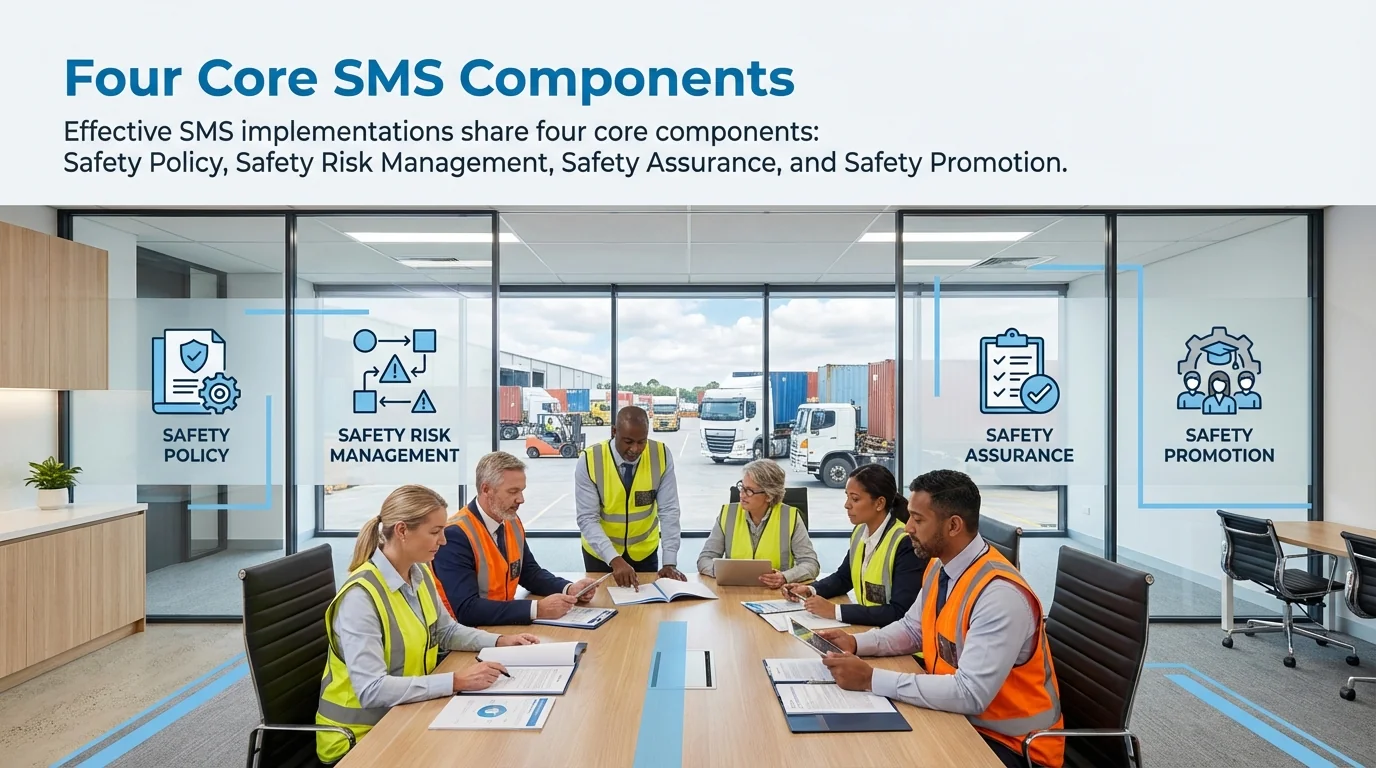
These systems transform safety from reactive incident response to proactive risk management. They integrate safety into daily operations rather than treating it as a separate compliance function.
Understanding how different sectors apply SMS principles helps organisations tailor frameworks to their specific operational contexts. Aviation, chemical manufacturing, construction, and transportation each face unique hazards requiring adapted approaches within the same foundational structure.
This guide examines proven SMS examples from multiple industries. You’ll see how organisations translate regulatory requirements into practical safety systems that protect workers and improve operational performance.
What Constitutes a Safety Management System
A Safety Management System represents a documented, systematic approach to managing safety risks within an organisation. Rather than isolated safety procedures, SMS integrates safety considerations into every business process and decision.
The ANSI/ASSP Z10 standard promotes integrating safety into overall business processes, applying risk-based thinking, and using a PDCA cycle to drive continuous improvement. This Plan-Do-Check-Act approach creates a repeating cycle where organisations establish policies, implement controls, monitor performance, and review results.
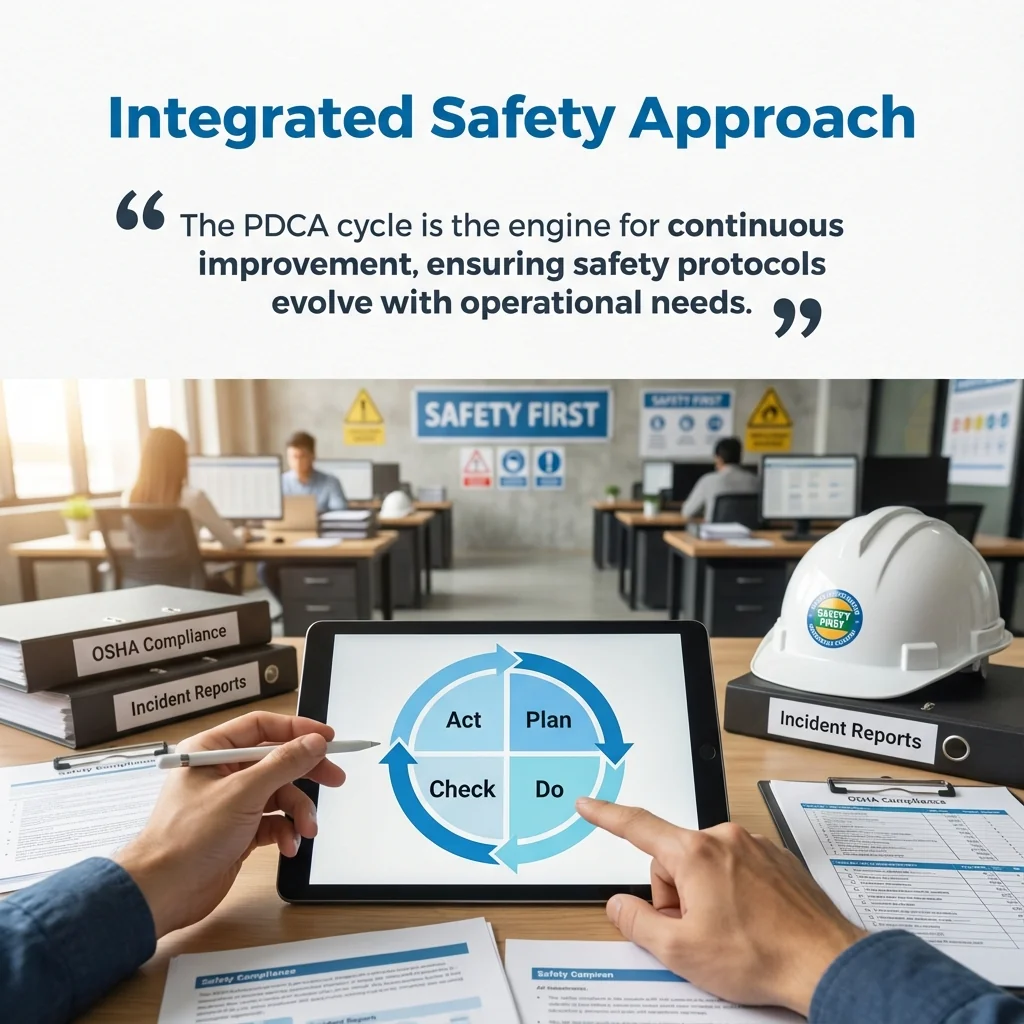
Management systems differ from traditional safety programs in their systematic nature. They require documented processes, defined responsibilities, performance metrics, and regular management review.
The documented aspect proves critical. Written procedures ensure consistency across shifts, locations, and personnel changes. Documentation also provides evidence of due diligence for regulatory compliance.
Core Characteristics of Effective Systems
Effective SMS implementations share several defining characteristics regardless of industry. Leadership commitment appears in every successful system, demonstrated through resource allocation and active participation in safety decisions.
Worker participation represents another universal element. Frontline employees often identify hazards management cannot see from their vantage point. Systems that encourage reporting and incorporate worker feedback consistently outperform top-down approaches.
Data-driven decision making separates mature systems from paper compliance exercises. Organisations track leading indicators like near-miss reports and audit findings alongside lagging indicators such as injury rates.
Continuous improvement distinguishes SMS from static safety programs. Regular reviews identify gaps, changing conditions, and emerging risks requiring updated controls.
Regulatory Foundations Across Sectors
Different industries operate under varying regulatory frameworks that shape SMS requirements. Aviation follows standards set by the International Civil Aviation Organization (ICAO) and national authorities like the FAA.
Chemical facilities must comply with Process Safety Management regulations under OSHA 29 CFR 1910.119. Construction faces different standards addressing mobile workplaces and changing site conditions.
Despite regulatory differences, all frameworks converge on similar principles. They require hazard identification, risk assessment, control implementation, performance monitoring, and management review.
Understanding your industry’s specific requirements provides the starting point for SMS development. The examples that follow illustrate how organisations meet these requirements while addressing sector-specific challenges.
The Four Pillars Supporting Every Safety Management System
Regardless of industry or organisation size, effective SMS frameworks rest on four interconnected components. These elements function as an integrated system rather than isolated activities.
Weakness in any single pillar undermines overall safety performance. Strong policy without rigorous assurance allows drift from stated commitments. Excellent risk management without promotion fails to engage the workforce in safety activities.
Safety Policy and Objectives
Safety policy establishes the organisation’s commitment to safety and sets the overall direction. This documented statement comes from senior leadership and communicates safety priorities to all personnel.
Effective policies move beyond generic commitments to include specific objectives. “We will reduce recordable injuries by 25% over 18 months” provides clearer direction than “We are committed to safety.”
The policy defines accountability at all organisational levels. It clarifies who makes safety decisions, who allocates resources, and who monitors performance.
Safety objectives should align with overall business goals. When leaders frame safety as integral to operational excellence rather than a separate concern, organisations achieve better outcomes.
| Policy Element | Purpose | Implementation Approach |
|---|---|---|
| Management Commitment Statement | Demonstrates leadership accountability | Signed by senior executive, reviewed annually |
| Measurable Objectives | Provides clear performance targets | Specific metrics with defined timeframes |
| Resource Allocation | Ensures adequate safety program funding | Dedicated budget line items for safety activities |
| Accountability Framework | Defines roles and responsibilities | Position descriptions include safety duties |
Policies require regular review and updating. As operations change, hazards evolve, and regulations update, your safety policy must adapt accordingly.
Safety Risk Management Processes
Safety Risk Management (SRM) forms the analytical core of any SMS. This systematic process identifies hazards, assesses risks, and implements controls to reduce risks to acceptable levels.
Hazard identification draws from multiple sources. Workplace inspections reveal physical hazards. Job safety analyses uncover procedural risks. Incident investigations identify system weaknesses.
Risk assessment evaluates both likelihood and severity of potential consequences. This analysis prioritizes which hazards require immediate attention and which present lower concern.
Control selection follows the hierarchy of controls principle. Elimination and substitution provide the most effective protection. Engineering controls offer the next level of protection, followed by administrative controls and personal protective equipment.
Safety Assurance Mechanisms
Safety Assurance (SA) verifies that implemented controls work as intended and that the SMS achieves its objectives. This pillar includes audits, inspections, and performance monitoring activities.
Regular audits examine both compliance and effectiveness. Compliance audits check whether procedures are followed. Effectiveness audits assess whether procedures actually reduce risks.
Performance monitoring tracks both leading and lagging indicators. Leading indicators like safety training completion rates predict future performance. Lagging indicators such as injury rates measure actual outcomes.
Management review meetings analyse assurance data and make system adjustments. These reviews identify trends, evaluate corrective action effectiveness, and allocate resources to address gaps.
Safety Promotion and Culture Building
Safety Promotion creates the human element connecting all other SMS components. This pillar encompasses training, communication, and culture development activities.
Training ensures personnel understand their safety responsibilities and possess necessary skills. Initial training introduces new employees to safety systems. Recurrent training reinforces concepts and addresses new hazards.
Communication flows in multiple directions. Leadership communicates expectations downward. Workers report hazards upward. Peer-to-peer communication shares lessons learned.
Culture development requires sustained effort over time. Organisations with strong safety cultures demonstrate that safety genuinely matters through consistent decisions, adequate resources, and recognition of safe behaviors.
Non-punitive reporting systems encourage hazard disclosure. When workers fear punishment for reporting near-misses, organisations lose valuable information about emerging risks.
Aviation Safety Management Systems: The ICAO Framework
Aviation pioneered formal SMS adoption, driven by the International Civil Aviation Organization’s standards. In aviation, SMS frameworks based on ICAO and adopted by the FAA are structured around four key components: Safety Policy, Safety Risk Management, Safety Assurance, and Safety Promotion.
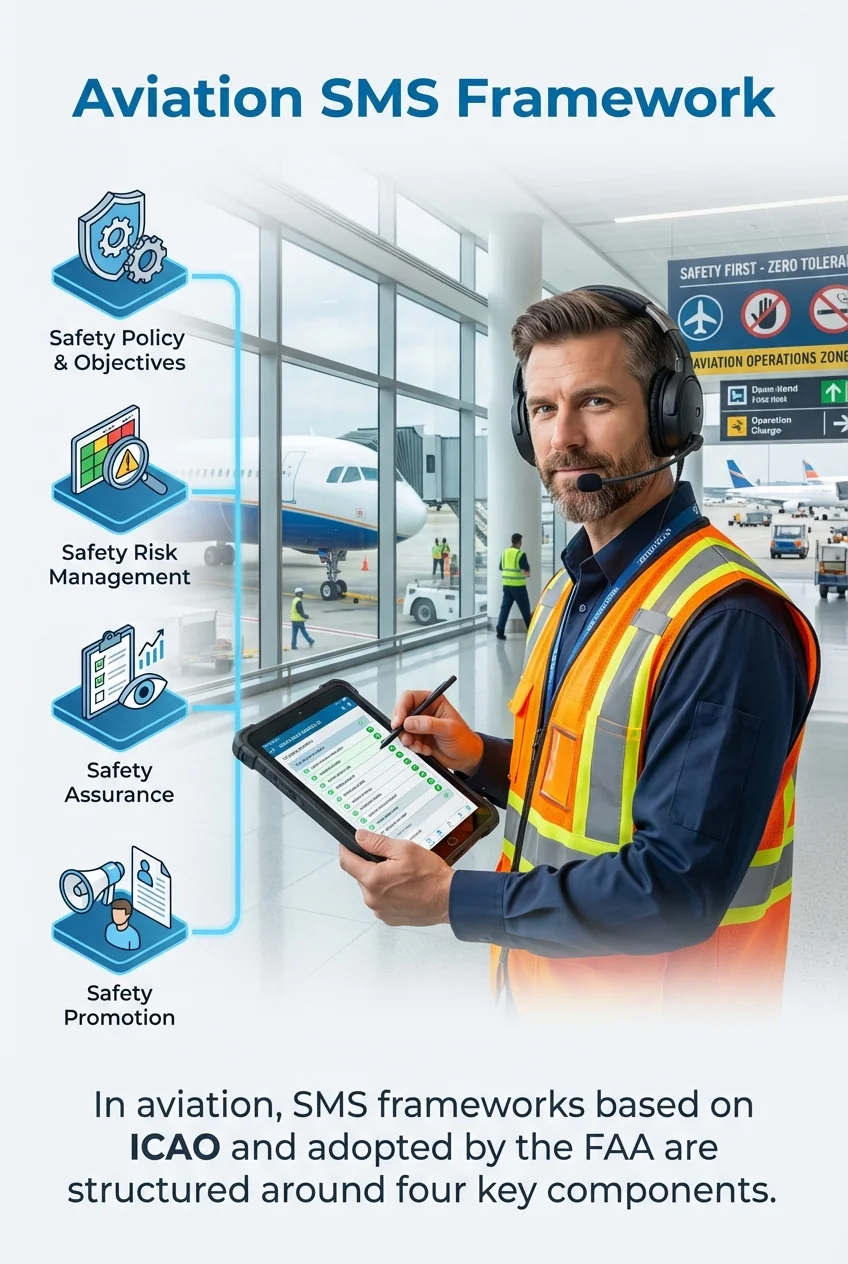
The aviation model influenced SMS development across other sectors. Its maturity and proven effectiveness make it a valuable reference point.
ICAO Standards and Recommended Practices
ICAO Annex 19 establishes international standards for SMS in aviation. These requirements apply to airlines, airports, air traffic services, and maintenance organisations.
The framework requires a documented SMS acceptable to the State authority. This system must include processes for hazard identification and risk management appropriate to the size and complexity of operations.
State authorities like the FAA, EASA, and CASA develop regulations implementing ICAO standards. These regulations specify documentation requirements, implementation timelines, and oversight processes.
Aviation SMS emphasizes safety risk management for operational hazards. Flight operations face constantly changing conditions requiring dynamic risk assessment and mitigation.
Airline SMS Implementation Example
Airlines implement SMS across all operational departments. Flight operations, maintenance, ground handling, and dispatch each maintain hazard registers and risk assessments.
Flight crews report safety concerns through confidential reporting systems. These reports feed into the airline’s safety database where analysts identify trends and emerging risks.
Airlines conduct regular safety audits examining both compliance and operational effectiveness. Audit findings generate corrective actions tracked through completion.
Safety promotion includes crew resource management training, safety bulletins, and regular safety meetings. Airlines foster open communication about safety concerns without fear of punitive action.
Aviation’s SMS success stems from regulatory requirements, industry collaboration through organizations like IATA, and a mature safety culture developed over decades.
Process Safety Management in Chemical Manufacturing
Chemical facilities face unique process safety risks requiring specialized SMS approaches. Process Safety Management (PSM) is an OSHA regulation (29 CFR 1910.119) that includes 14 elements such as process hazard analysis and operating procedures.
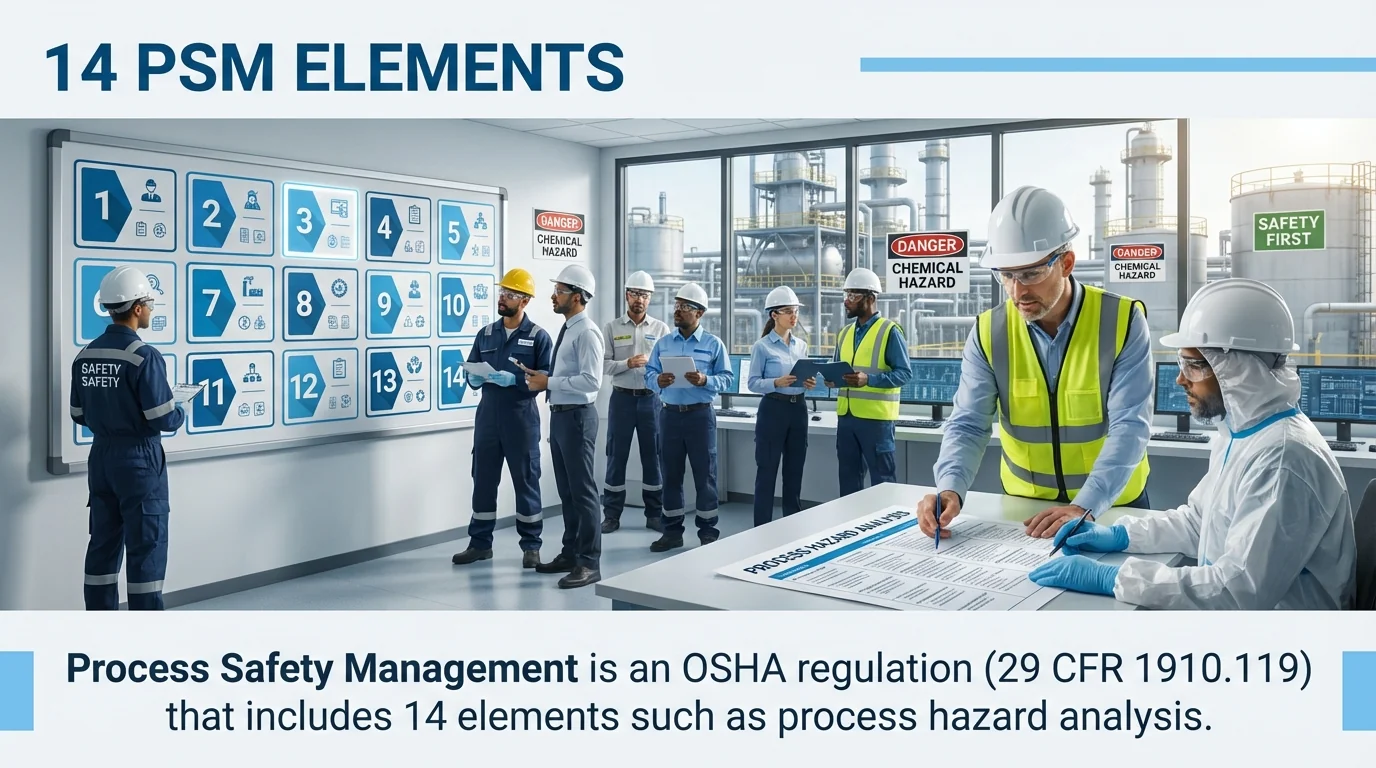
PSM focuses on preventing catastrophic releases of hazardous chemicals. Unlike occupational safety addressing worker injuries, process safety prevents major incidents affecting surrounding communities.
The 14 Elements of PSM
OSHA’s PSM standard requires 14 specific elements for covered processes. These elements include employee participation, process safety information, and process hazard analysis.
Process hazard analysis (PHA) systematically examines potential failure modes. Teams use methods like HAZOP (Hazard and Operability Study) or FMEA (Failure Modes and Effects Analysis) to identify scenarios leading to releases.
Operating procedures document each step for conducting activities safely. These procedures specify operating limits, safety systems, and emergency shutdown procedures.
Mechanical integrity programs ensure equipment reliability through inspection, testing, and maintenance schedules. Critical safety systems receive enhanced attention.
| PSM Element | Primary Function | Key Activities |
|---|---|---|
| Process Hazard Analysis | Identify release scenarios | HAZOP studies, What-if analysis, regular revalidation |
| Operating Procedures | Ensure consistent safe operation | Written procedures, operator training, procedure updates |
| Mechanical Integrity | Maintain equipment reliability | Inspection schedules, testing protocols, maintenance records |
| Management of Change | Control process modifications | Change review, authorization, documentation |
Industry Application Examples
Refineries implement comprehensive PSM programs covering crude processing, catalytic cracking, and product storage. Each process unit undergoes regular hazard analysis with findings tracked through resolution.
Chemical manufacturing plants maintain detailed process safety information including material properties, equipment specifications, and safe operating limits. This documentation supports both normal operations and emergency response.
Management of change procedures ensure modifications don’t introduce new hazards. Even seemingly minor changes undergo review before implementation.
Incident investigation procedures examine not just what happened but underlying system weaknesses. Investigations identify root causes and generate recommendations for system improvements.
ISO 45001 Occupational Health and Safety Standard
ISO 45001 provides an international framework for occupational health and safety management systems. This standard applies across all industries and organisation sizes.
Unlike prescriptive regulations specifying required activities, ISO 45001 establishes principles organisations adapt to their specific contexts. This flexibility enables application in diverse settings.
ISO 45001 Framework Structure
ISO 45001 follows the High-Level Structure common to all modern ISO management system standards. This consistent framework facilitates integration with quality and environmental management systems.
The standard emphasizes leadership involvement in safety management. Top management must demonstrate leadership and commitment through active participation and resource provision.
Context of the organisation receives explicit attention. Organisations must understand their internal and external issues affecting safety performance and the needs of interested parties.
Risk-based thinking permeates the standard. Organisations identify both risks and opportunities related to occupational health and safety performance.
Planning and Implementation Requirements
Planning requires identifying hazards and assessing risks for elimination or control. This process considers routine operations, non-routine activities, and reasonably foreseeable emergency situations.
Organisations must establish objectives for safety improvement and plan actions to achieve them. These objectives should be measurable, monitored, and communicated.
Resource requirements receive attention in the standard. Organisations must determine and provide resources needed for effective SMS operation.
Competence requirements ensure personnel possess necessary knowledge and skills. Training programs address identified gaps.
Performance Evaluation Under ISO 45001
Performance evaluation includes monitoring, measurement, analysis, and evaluation of safety performance. Organisations determine what needs monitoring, when to monitor, and who analyzes results.
Internal audits evaluate SMS effectiveness and conformity with requirements. Audit programs consider process importance and previous audit results.
Management review examines the SMS at planned intervals. These reviews consider audit results, performance data, and opportunities for improvement.
The standard requires a process for continual improvement. Organisations must enhance safety performance through corrective actions addressing nonconformities and audit findings.
Construction Industry Safety Management Approaches
Construction presents unique safety challenges due to constantly changing worksite conditions. Projects move through phases with different hazards emerging as work progresses.
Multiple contractors often work simultaneously, requiring coordination to prevent one trade’s work from creating hazards for others. This complexity demands robust safety management systems.
Project-Based Safety Planning
Construction SMS begins with project safety planning before work starts. Site-specific safety plans identify anticipated hazards and establish control measures.
Pre-construction meetings bring together all contractors to discuss safety responsibilities and coordination requirements. These meetings establish communication protocols and emergency procedures.
Daily toolbox talks keep safety awareness high as conditions change. Supervisors brief crews on the day’s hazards and required precautions.
Fall protection receives particular attention in construction. Working at heights represents a leading cause of construction fatalities, requiring comprehensive planning and equipment.
Multi-Employer Worksite Coordination
Construction sites with multiple employers require clear safety responsibility allocation. General contractors typically maintain overall site safety management while subcontractors manage their specific work activities.
Regular coordination meetings address interface hazards between trades. When electricians work below where structural steel is being erected, coordination prevents dropped objects from striking workers below.
Permit systems control high-hazard activities. Hot work permits ensure fire precautions are in place. Confined space entry permits verify atmospheric testing and rescue arrangements.
Inspection programs verify that planned controls are actually implemented. Site safety officers conduct walks identifying hazards and verifying compliance with safety plans.
Transportation and Logistics Safety Systems
Transportation organisations manage safety risks across dispersed operations. Drivers work independently across wide geographic areas, making traditional supervision approaches ineffective.
Fleet safety management systems address vehicle maintenance, driver qualification, fatigue management, and cargo securement. These elements combine to prevent crashes and cargo incidents.
Fleet Safety Management Components
Vehicle maintenance programs ensure trucks remain mechanically sound. Preventive maintenance schedules address brakes, tires, lights, and other safety-critical systems.
Pre-trip inspections conducted by drivers identify defects before departure. Organisations must have processes ensuring defects get repaired before vehicles operate.
Driver qualification programs verify that personnel possess appropriate licenses, training, and medical clearances. Regular checks ensure qualifications remain current.
Fatigue management addresses hours-of-service compliance and driver scheduling. Electronic logging devices provide accurate records of driving and rest time.
Chain of Responsibility Compliance
In jurisdictions with Chain of Responsibility legislation, SMS must address the entire supply chain. Parties beyond the driver share legal responsibility for road safety outcomes.
Schedulers must provide realistic timeframes preventing drivers from speeding or driving while fatigued. Loading personnel must ensure loads are properly secured and within weight limits.
Documentation systems demonstrate due diligence in meeting shared responsibilities. Organisations maintain records of delivery schedules, loading instructions, and vehicle maintenance.
Training extends beyond drivers to all parties in the supply chain. Warehouse staff, schedulers, and customer service personnel all receive training on their safety responsibilities.
For expert guidance on implementing Safety Management Systems tailored to transport operations, specialist consultants provide frameworks aligned with regulatory requirements.
Manufacturing Industry Safety System Models
Manufacturing facilities implement SMS addressing machine hazards, material handling risks, and process-specific dangers. The diversity of manufacturing operations requires adaptable safety management approaches.
Machine Safety and Lockout/Tagout Programs
Machine guarding programs protect workers from moving parts, flying debris, and contact hazards. Guards must remain in place during operation with regular inspections verifying integrity.
Lockout/tagout procedures prevent unexpected equipment startup during maintenance. OSHA’s widely used basic program model includes four core components of management leadership, worksite analysis, hazard prevention, and safety training.
Written procedures specify energy isolation steps for each machine. Workers receive training on these procedures and demonstrate competency before performing service work.
Periodic inspections verify that lockout/tagout procedures remain effective. As equipment modifications occur, procedures require updates reflecting new energy sources or isolation points.
Ergonomics and Material Handling Safety
Repetitive motion injuries represent significant concerns in manufacturing. Ergonomics programs assess job tasks and implement modifications reducing physical stress.
Material handling equipment selection influences injury rates. Powered equipment like forklifts and hoists eliminates manual lifting of heavy items.
Workstation design receives attention in ergonomics programs. Adjustable work surfaces, proper tool placement, and adequate lighting reduce strain.
Job rotation programs limit cumulative exposure to repetitive tasks. By varying work assignments, organisations reduce the risk of overuse injuries.
Implementing Your Safety Management System
Successful SMS implementation requires systematic planning and sustained commitment. Organisations that treat implementation as a project with defined phases achieve better outcomes than those attempting everything simultaneously.
Understanding the benefits of Safety Management Systems helps secure leadership commitment and resource allocation for implementation efforts.
Gap Analysis and Planning
Begin by assessing your current safety program against SMS requirements. This gap analysis identifies existing strengths and areas needing development.

Document what you already do well. Many organisations have effective safety activities but lack the systematic structure and documentation that SMS provides.
Prioritize gaps based on risk and regulatory requirements. Address high-risk areas and legal mandates first, then work through remaining gaps systematically.
Develop an implementation plan with realistic timelines. Building an effective SMS takes months to years depending on organisation size and complexity.
Documentation Development
SMS requires documented policies, procedures, and records. Documentation ensures consistency and provides evidence of your safety management approach.
Start with high-level policy documents establishing your safety management philosophy and objectives. These documents communicate leadership commitment organisation-wide.
Develop procedures for each SMS component. Hazard identification procedures specify when assessments occur and who participates. Audit procedures define frequency, scope, and reporting requirements.
Keep documentation practical and usable. Overly complex procedures gather dust rather than guiding actual work. Involve the people who will use procedures in their development.
Consider leveraging Safety Management System software to streamline documentation and tracking activities.
Training and Competency Building
Personnel throughout the organisation need training on their SMS responsibilities. Training requirements vary by role and involvement in safety management activities.
Leadership training addresses management’s role in SMS. Executives learn how their decisions impact safety performance and how to provide effective oversight.
Supervisors receive training on hazard recognition, incident investigation, and safety coaching. They serve as the critical link between management systems and frontline workers.
Worker training covers hazard reporting, participation in safety activities, and specific job hazards. Engaged workers are essential for SMS effectiveness.
Assess competency beyond attendance records. Practical demonstrations and assessments verify that training translates into capability.
Continuous Improvement Mechanisms
SMS operates as a continuous improvement cycle rather than a static program. Regular review and adjustment keeps the system effective as conditions change.
Management review meetings examine SMS performance at planned intervals. These reviews consider audit results, incident data, and progress toward safety objectives.
Corrective action processes address identified deficiencies. Track actions through completion and verify effectiveness after implementation.
When addressing common SMS implementation challenges, organisations benefit from structured troubleshooting approaches and expert guidance.
Celebrate successes and recognize improvement. Acknowledging progress maintains momentum and reinforces that safety management efforts produce results.
Measuring Safety Management System Performance
Effective measurement demonstrates whether your SMS achieves intended outcomes. Performance monitoring guides improvement efforts and provides accountability for safety objectives.
Leading and Lagging Indicators
Lagging indicators measure outcomes after they occur. Injury rates, lost workdays, and incident frequency provide historical performance data.
While important, lagging indicators don’t predict future performance or identify emerging problems. They tell you where you’ve been, not where you’re heading.
Leading indicators predict future performance by measuring activities that prevent incidents. Hazard identification rates, audit completion, and training participation represent leading indicators.
A balanced measurement approach includes both indicator types. Lagging indicators show overall results. Leading indicators reveal whether your safety activities are actually occurring.
| Indicator Type | Example Metrics | Use in Decision Making |
|---|---|---|
| Lagging Indicators | Recordable injury rate, lost-time incidents, workers compensation costs | Track overall safety performance trends, set improvement targets |
| Leading Indicators | Safety observations completed, near-miss reports submitted, audit findings closed | Identify process gaps, verify control implementation, predict future outcomes |
| Process Metrics | Training completion rate, inspection schedule adherence, risk assessment currency | Ensure SMS activities occur as planned, identify resource needs |
Audit and Inspection Programs
Internal audits evaluate SMS effectiveness and identify improvement opportunities. Well-designed audit programs examine both compliance and performance outcomes.
Compliance audits verify that procedures are followed. Do inspections occur on schedule? Are incident investigations completed per requirements? Is training documented?
Performance audits assess whether procedures achieve intended results. Do inspections actually identify hazards? Do investigations reveal root causes? Does training improve worker capability?
Audit frequencies should reflect risk levels and system maturity. High-risk areas and new SMS components warrant more frequent evaluation.
Auditor competency matters as much as audit frequency. Trained auditors identify substantive issues rather than minor documentation gaps.
Management Review and Decision Making
Management review meetings analyze performance data and make strategic safety decisions. These reviews occur at planned intervals with senior leadership participation.
Review agendas should cover performance against objectives, audit findings, incident trends, and resource adequacy. This comprehensive view enables informed decision making.
Effective reviews result in action items with assigned responsibility and completion dates. Without follow-through, review meetings become perfunctory exercises.
Management review demonstrates leadership engagement in safety management. When senior leaders actively participate and make evidence-based decisions, the entire organisation recognizes safety’s importance.
Understanding why an SMS matters helps maintain leadership commitment to systematic safety management over time.
Key Questions About Safety Management Systems
What is the basic safety management system?
A basic safety management system is a structured, documented approach integrating safety into overall management through leadership commitment, worker participation, risk assessment, hazard control, training, and performance monitoring. It generally follows a Plan-Do-Check-Act cycle: establishing policy and objectives, implementing controls and training, measuring performance, and reviewing results to drive continual improvement in health and safety outcomes.
What are the four basic elements of a safety management system?
According to OSHA guidance, effective systems rest on four elements. First, visible management commitment and employee involvement in safety decisions. Second, ongoing worksite analysis to detect existing and potential hazards. Third, hazard prevention and control measures based on that analysis. Fourth, safety and health training so workers and supervisors can recognize and manage risks. These four elements function as an integrated system where weaknesses in any area can undermine overall safety performance.
How does ISO 45001 differ from industry-specific SMS requirements?
ISO 45001 provides a principles-based framework adaptable to any industry or organisation size. Industry-specific requirements like aviation SMS or Process Safety Management include prescriptive elements addressing sector-specific hazards. Organisations can implement ISO 45001 while meeting industry-specific regulatory requirements, as the standard’s flexible structure accommodates additional elements.