
Chain of Responsibility training programs fail at an alarming rate. Not because the content lacks substance, but because businesses struggle with three persistent obstacles: securing genuine buy-in from participants, managing the logistical complexity of meaningful training delivery, and maintaining engagement through extended learning periods that actually create lasting change.
The gap between awareness and application remains wide across Australian supply chains.
Most organisations approach CoR training as a compliance exercise. They schedule a workshop, tick the box, and wonder why behaviour doesn’t shift when NHVL auditors arrive or incidents occur. The problem isn’t the standards themselves. The challenge lies in how we prepare people to apply them consistently under pressure.
This analysis examines the real barriers preventing effective Chain of Responsibility training programs across Australian supply chains. You’ll discover why traditional delivery methods consistently fall short, what research reveals about creating lasting behavioural change, and practical frameworks for building training that actually works when your people need it most.
The path to sustainable compliance becomes clearer when you understand the specific obstacles ahead.
The Preparedness Gap: Why Initial Training Falls Short
Most CoR training programs operate under a dangerous assumption. Organisations believe that awareness equals competence, that understanding the Heavy Vehicle National Law automatically translates into correct decision-making during operational pressure.
This assumption collapses quickly when tested.
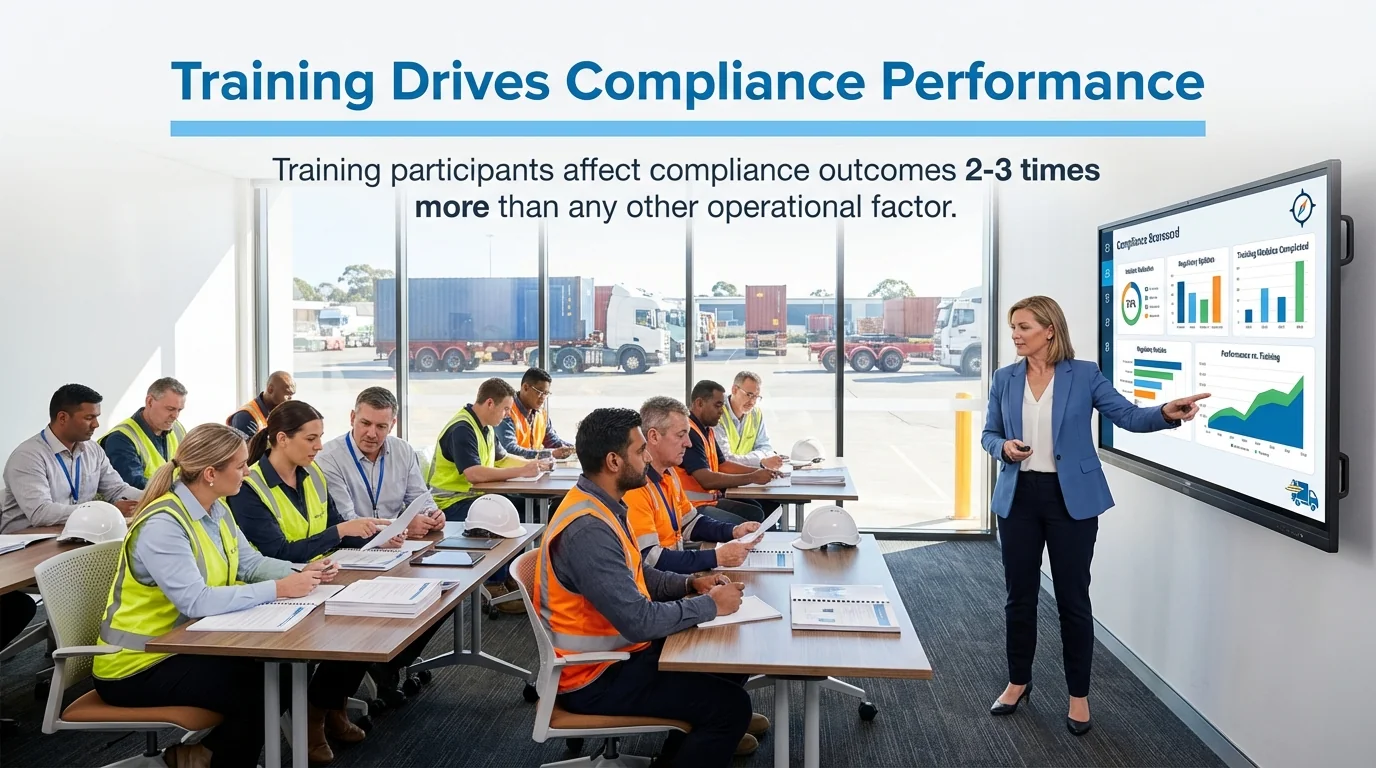
Training participants have a profound impact on organisational performance, affecting compliance outcomes 2-3 times more than any other operational factor. Yet organisations consistently underinvest in preparing these same people for the complex scenarios they’ll face daily.
The preparedness gap manifests in three specific ways across supply chains.
Surface Knowledge Without Application Skills
Participants leave training sessions understanding CoR principles conceptually. They can recite the duty categories. They recognise the risk categories outlined in HVNL legislation.
Then operational reality arrives with its messy complexity.
A scheduler faces pressure to meet delivery deadlines when weather delays create time conflicts. A warehouse supervisor needs to decide whether a vehicle with a minor mechanical issue should complete its run. A procurement manager must choose between compliant carriers who cost more and faster operators with questionable practices.
These decisions demand more than conceptual awareness. They require judgment built through practice with realistic scenarios.
Confidence Gaps in High-Stakes Decisions
Training programs rarely prepare participants for the social pressure accompanying compliance decisions. People understand what they should do according to HVNL requirements. They lack confidence pushing back against managers who prioritize delivery over safety, or challenging established practices that create liability.
This confidence gap creates the most dangerous compliance failures.
Someone knows a loading practice violates mass management requirements but stays silent because they’re new to the role. A logistics coordinator recognizes fatigue management concerns but doesn’t escalate because previous complaints went nowhere. These scenarios play out daily across Australian supply chains.
Understanding what Chain of Responsibility actually means provides the foundation, but application under pressure requires different preparation entirely.
The Complexity of Disadvantaged Operational Contexts
Some operational environments present significantly more challenging CoR implementation contexts than others. Regional operations with limited resources face different obstacles than metropolitan distribution centres. Small transport operators working with tight margins encounter pressures that large fleet operators can absorb more easily.
Training programs that ignore these contextual differences produce poor outcomes.
A scheduler working for a small regional carrier needs different decision-making frameworks than someone at a national logistics provider with dedicated compliance teams. The core HVNL principles remain consistent. The practical application varies substantially based on available resources, operational complexity, and organisational maturity.
Research across educational contexts reveals similar patterns. Participants facing more challenging operational environments require more intensive preparation, more follow-up support, and more practice with context-specific scenarios before they demonstrate consistent application.
Professional Development Quality: The 50-Hour Reality
Most organisations approach CoR training as a one-day event. A consultant delivers content, participants complete an assessment, certificates get issued. Everyone returns to work expecting different outcomes from the same preparation that failed previously.
This approach ignores fundamental realities about skill development.
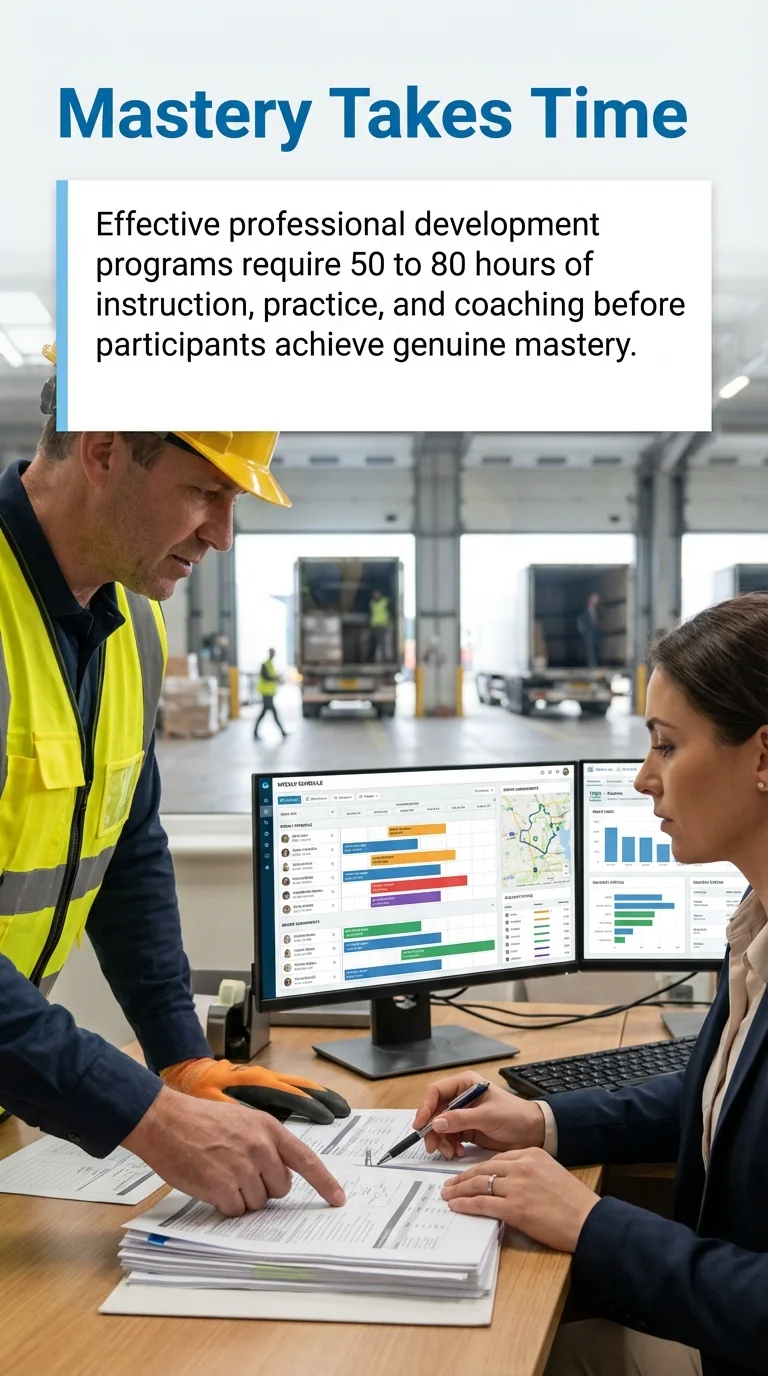
Effective professional development programs require 50 to 80 hours of instruction, practice, and coaching before participants achieve genuine mastery. Not awareness. Not basic understanding. Actual mastery that produces consistent correct decisions under operational pressure.
The gap between typical training duration and effective learning requirements creates predictable problems.
One-Day Workshops Create False Confidence
Single-day training events serve valuable purposes. They build awareness. They introduce concepts. They satisfy minimum compliance requirements for training records.
They don’t create lasting behavioural change.
Participants leave these sessions feeling prepared. They’ve seen the content. They’ve passed the assessment. They understand the principles conceptually. Then operational reality introduces complexity their limited preparation didn’t address.
This false confidence becomes dangerous when people believe their one-day training equipped them for all scenarios they’ll encounter.
The Missing Middle: Practice and Application
Traditional training delivers information effectively. It fails completely at the practice and application phases where actual learning occurs. Someone might understand how fatigue management regulations work after a workshop. They haven’t practiced identifying fatigue risks in realistic scheduling scenarios or role-played difficult conversations with drivers pushing boundaries.
The definitive aspects of Chain of Responsibility compliance extend far beyond information transfer to practical application under pressure.
Quality professional development includes multiple practice cycles with feedback. Participants encounter realistic scenarios, make decisions, experience consequences, receive coaching, and try again with better judgment. This cycle repeats until correct responses become automatic rather than effortful.
Most organisations skip this entire phase due to time constraints and budget pressures.
No Follow-Up Means No Retention
Even well-designed initial training loses effectiveness without systematic follow-up. Research shows significant skill degradation within weeks when participants return to environments that don’t reinforce new learning.
The old patterns reassert themselves quickly.
Effective programs include structured follow-up at intervals after initial training. Refresher sessions address common mistakes. Group discussions solve new scenarios that emerged during application. Coaching sessions provide individual support for specific challenges people encountered.
This ongoing support system determines whether training investment produces lasting change or temporary awareness.
Implementation Obstacles: Budget, Time, and Buy-In
Understanding what effective CoR training requires creates an immediate problem. The gap between ideal preparation and practical constraints feels insurmountable for many organisations.
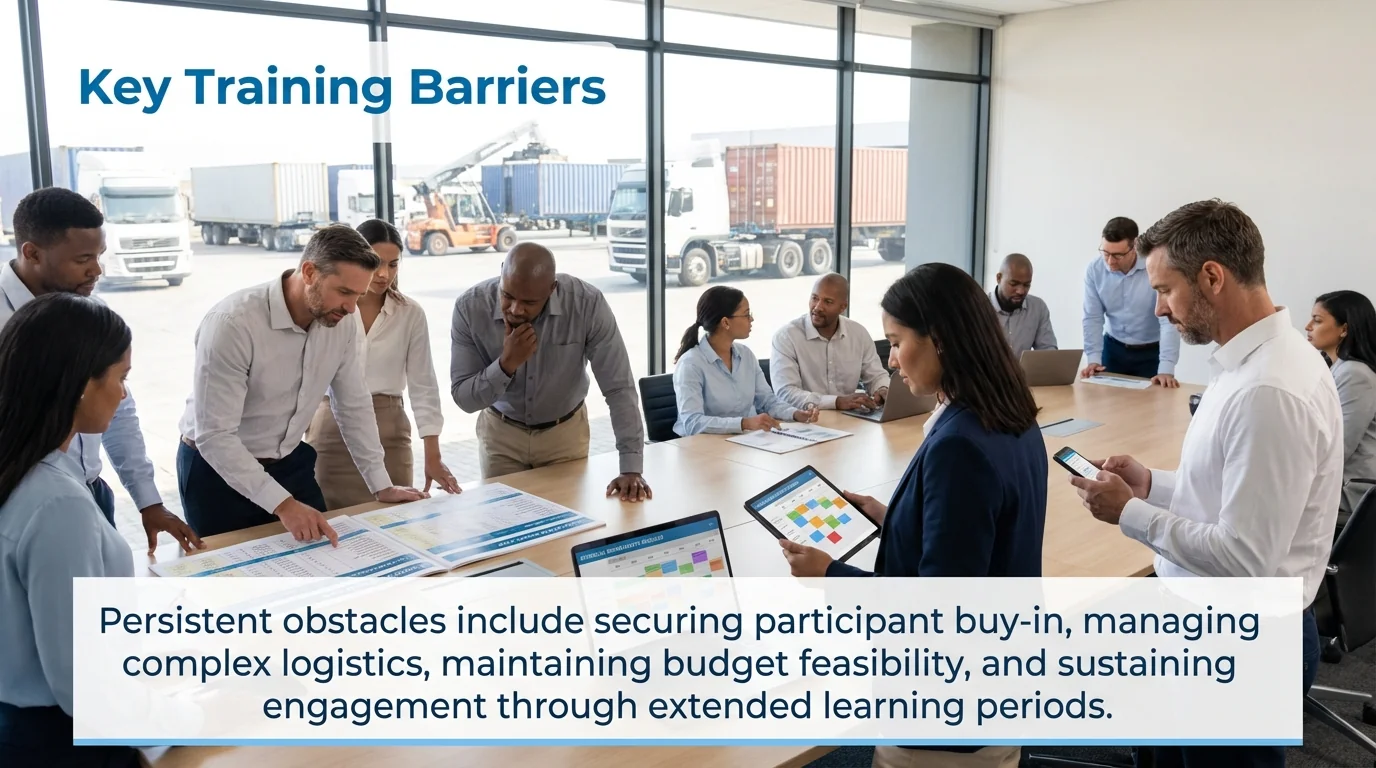
Persistent obstacles including securing participant buy-in, managing complex logistics, maintaining budget feasibility, and sustaining engagement through extended learning periods prevent organisations from delivering training that matches research-backed best practices.
These barriers deserve examination because they’re solvable with different approaches.
Budget Constraints and ROI Uncertainty
Extended training programs cost substantially more than single-day workshops. Organisations face difficult decisions allocating scarce resources between competing priorities. The return on training investment remains uncertain until incidents don’t happen, a negative proof that’s hard to quantify.
This creates predictable budget pressure.
Finance teams question why compliance training needs 50 hours when competitors appear to manage with eight-hour sessions. Operations teams resist extended participant time away from productive work. Executives struggle justifying premium training costs without clear metrics demonstrating value.
The case for quality training investment requires framing beyond compliance alone. Effective CoR preparation produces operational benefits including reduced insurance premiums, fewer vehicle defects, improved driver retention, stronger customer relationships, and enhanced competitive positioning. These tangible outcomes justify higher initial investment.
Time Scarcity Across Supply Chains
Supply chain operations run perpetually short-staffed. Scheduling multiple people away for extended training creates operational disruption. Small organisations lack redundancy to cover absent roles. Large organisations struggle coordinating training across dispersed locations and shift patterns.
These logistical challenges often override good intentions about quality preparation.
Practical solutions exist but require creativity. Modular delivery spreads learning across multiple shorter sessions rather than consecutive days. Job-embedded approaches integrate practice into normal workflows. Digital tools enable asynchronous learning that participants complete around operational demands.
Understanding systematic implementation approaches for Chain of Responsibility helps organisations design training that fits their operational reality while maintaining effectiveness.
Securing Genuine Participant Buy-In
People resist training they perceive as bureaucratic compliance theatre. Experienced transport professionals particularly resist external consultants telling them how to do jobs they’ve performed for decades. This resistance undermines learning before programs even begin.
Effective training starts with genuine respect for participant experience.
The best programs acknowledge the deep operational knowledge participants bring. They position CoR training not as correction but as enhancement, adding legal and regulatory context to existing expertise. They use realistic scenarios drawn from actual supply chain challenges rather than sanitized textbook examples.
This approach transforms the emotional dynamic from defensive resistance to collaborative problem-solving.
Teaching Complex Concepts: The Heavy Vehicle Law Challenge
Chain of Responsibility legislation presents unique instructional challenges. The Heavy Vehicle National Law encompasses complex interactions between multiple duty categories, risk factors, compliance evidence requirements, and reasonable steps expectations.
This complexity defeats simplified training approaches.
Duty Holder Concepts Require Concrete Examples
Abstract duty categories confuse participants when introduced theoretically. Someone hears they have duties in the “consignor party” category. They nod along during the presentation. They have no clear understanding what specific actions satisfy those duties in their actual job.
Concrete examples transform abstract concepts into practical understanding.
A warehouse supervisor needs specific guidance about what consignor duties mean when they’re directing forklift operators loading vehicles. What documentation do they need? What vehicle condition checks fall under their responsibility? When do they need to question driver instructions that create loading risks?
These concrete scenarios create understanding that abstract duty definitions cannot achieve alone.
Reasonable Steps Documentation Creates Confusion
The “reasonable steps” defense represents one of the most challenging concepts in CoR training. Participants understand they need evidence demonstrating reasonable precautions. They struggle determining what specific evidence satisfies this requirement across different scenarios.
This ambiguity creates analysis paralysis.
Effective training provides clear documentation frameworks rather than leaving participants to determine evidence requirements through trial and error. What records demonstrate reasonable steps in mass management? How do you document fatigue management compliance across different operational models? When does verbal instruction need written confirmation?
The Chain of Responsibility safety system components provide structured approaches to evidence requirements that reduce uncertainty for participants trying to implement compliance practically.
Risk Assessment Methodology Needs Practice
HVNL compliance requires ongoing risk identification and management. Training programs introduce risk assessment concepts effectively. They rarely provide sufficient practice for participants to develop competent risk analysis skills.
Someone understands risk assessment matters. They can’t confidently identify which operational scenarios require formal assessment versus informal management.
Quality training includes repeated practice with realistic scenarios across risk categories. Participants analyze mass management risks in loading operations, identify fatigue concerns in scheduling scenarios, evaluate speed management factors in route planning, and assess vehicle standards issues in maintenance decisions.
This repeated practice with feedback develops judgment that transforms theoretical risk concepts into practical operational skills.
Long-Term Training Models: Building Sustainable Capability
Organisations that successfully overcome CoR training challenges share common characteristics. They abandon the one-off workshop model entirely. They build systematic capability development programs that extend across months rather than days.
This fundamental shift in approach produces fundamentally different outcomes.
Initial Workshop Plus Ongoing Reinforcement
Effective programs begin with structured initial training that builds foundational knowledge. This phase introduces HVNL requirements, establishes core concepts, and creates shared language across the organisation.
Then the real learning begins.
Organisations schedule monthly reinforcement sessions addressing specific topics in depth. One month focuses on mass management scenarios. Another examines fatigue management complexity. A third works through speed and vehicle standards interactions.
This spaced repetition with increasing complexity produces retention that concentrated initial training cannot achieve.
Job-Embedded Learning and Peer Coaching
The most effective learning occurs during actual work rather than separate training events. Organisations that successfully build CoR capability create structured opportunities for job-embedded practice and peer coaching.
This looks different than traditional training completely.
Experienced schedulers coach newer staff through complex routing decisions that involve fatigue and speed considerations. Warehouse supervisors review loading practices with their teams, discussing how specific approaches satisfy or violate mass management duties. Fleet managers conduct vehicle inspections with drivers, explaining how their observations connect to maintenance management requirements.
These informal learning moments, when made systematic rather than random, produce deeper capability development than formal classroom training.
Technology-Enabled Continuous Learning
Modern compliance management platforms transform training delivery by enabling continuous micro-learning integrated into operational workflows. Rather than quarterly workshops removed from daily reality, participants encounter brief learning moments embedded in their actual work.
Consider how this works practically.
A scheduler accessing the system to plan routes receives a brief scenario about fatigue management directly relevant to their current task. A warehouse supervisor logging a loading issue sees targeted guidance about consignor duties in that specific situation. A maintenance coordinator reviewing vehicle defects gets just-in-time training about maintenance management evidence requirements.
This contextual learning at the moment of need produces higher retention and immediate application compared to training delivered months before someone encounters that specific scenario.
Understanding the upcoming changes to Chain of Responsibility regulations becomes particularly important as organisations build long-term training systems that need to accommodate evolving requirements.
Collaborative Learning: Time and Support Structures
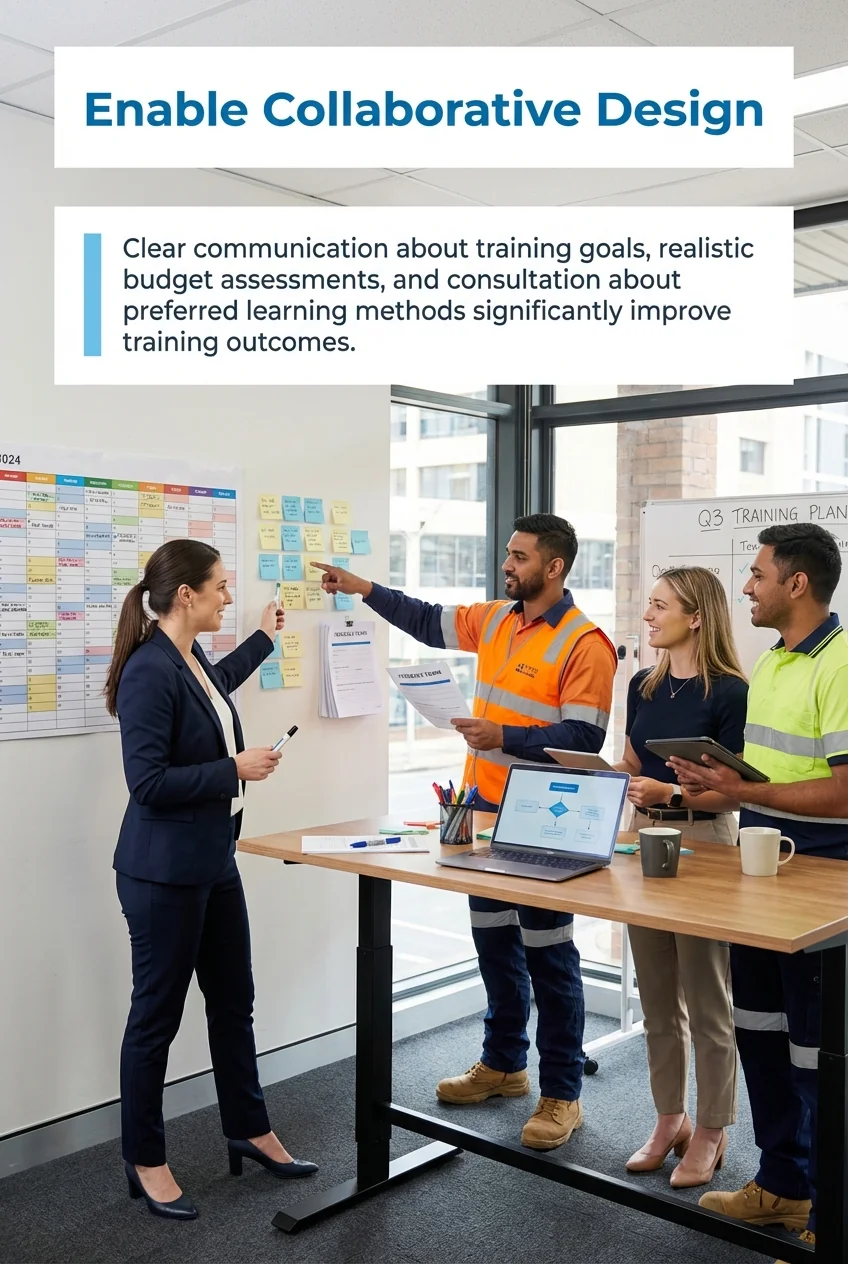
Clear communication about training goals, realistic budget assessments, and consultation about preferred learning methods significantly improve training outcomes by increasing participant engagement and organisational support.
This collaborative approach transforms training from something done to people into something developed with them.
Involving Participants in Design Decisions
Organisations achieve better training outcomes when they involve target participants in program design. This doesn’t mean letting people choose whether compliance matters. It means gathering input about learning preferences, scheduling constraints, scenario priorities, and delivery methods that fit their operational reality.
This consultation produces practical benefits immediately.
Participants identify the specific scenarios they find most challenging in their actual work. They highlight knowledge gaps in current training approaches. They suggest practical delivery methods that fit within operational constraints. They become invested in program success because they helped shape its design.
Building Peer Learning Networks
Individual training creates individual capability. Network-based learning builds organisational capability that persists despite staff turnover. The most effective programs deliberately create peer learning networks where participants support each other’s ongoing development.
These networks operate both formally and informally.
Formal structures include regular discussion groups where participants share challenges and solutions. Someone describes a difficult scheduling scenario they faced. The group discusses what CoR duties applied, what reasonable steps they could have taken, and how they might handle similar situations better.
Informal networks develop when organisations create communication channels for compliance questions. A Slack channel or Teams group where people ask quick questions and share insights produces continuous micro-learning throughout daily operations.
Management Support Beyond Budget Allocation
Executive support for CoR training extends far beyond approving budget requests. Visible leadership engagement signals that compliance capability matters genuinely rather than serving as performative box-checking.
This support manifests through specific actions.
Executives attend training sessions alongside their teams. They reference CoR principles in operational meetings. They recognize people who demonstrate strong compliance judgment. They make time available for learning activities rather than treating training as something that happens only when operations allow.
The increasing focus on Chain of Responsibility enforcement and penalties makes visible executive commitment to training increasingly important for building genuine compliance culture.
District and State Variations: Adapting Training to Context
Heavy Vehicle National Law creates consistent requirements across Australian jurisdictions. The practical implementation context varies substantially based on operational factors, regional characteristics, and organisational maturity.
Effective training acknowledges these contextual differences explicitly.
Metropolitan versus Regional Operational Challenges
Metropolitan operations face different compliance challenges than regional transport. Urban environments create pressure around speed management, route compliance, and time-sensitive delivery expectations. Regional operations encounter fatigue management complexity from longer distances, limited driver availability, and maintenance challenges from remote locations.
Training scenarios must reflect these different operational realities.
A Sydney-based distribution centre needs training focused on urban loading zone time pressures, traffic congestion impacts on scheduling, and managing frequent small deliveries. A regional agricultural transport operator requires training addressing harvest season fatigue pressures, remote maintenance management, and limited substitute driver availability.
Generic scenarios that ignore these contextual differences produce training that feels irrelevant to participants.
Industry-Specific Compliance Considerations
Different industry sectors face distinctive CoR challenges that generic training misses completely. Construction logistics deals with constantly changing site access conditions and load securing complexity. Retail distribution manages high-frequency multi-drop routes with aggressive timing expectations. Mining operations face extreme vehicle operating conditions and remote location challenges.
Quality training incorporates industry-specific scenarios that participants recognize immediately.
Someone working in construction logistics needs practice with scenarios involving load restraint for varied equipment, managing site-specific access restrictions, and coordinating with multiple subcontractors. These specific challenges require different judgment than someone managing retail distribution with standardized palletized freight.
Organisational Maturity and Resource Availability
Large organisations with dedicated compliance teams face different implementation challenges than small operators where the owner handles multiple roles including compliance management. Training approaches that work well for mature organisations with established systems often overwhelm smaller operators lacking that infrastructure.
This reality requires differentiated training approaches.
Small operators need training focused on building foundational systems from scratch. Large organisations need training addressing system refinement, cross-functional coordination, and managing compliance across complex operations. Medium-sized organisations in growth phases need training about scaling compliance systems as operational complexity increases.
The essential compliance checklist considerations help organisations at different maturity levels identify their specific development priorities.
Measuring Effectiveness: Assessment and Ongoing Verification
Organisations struggle determining whether their CoR training investment produces actual capability improvement. Traditional assessment methods measure knowledge recall effectively but miss the judgment and application skills that matter most during operational pressure.
Better measurement approaches exist when organisations look beyond simple testing.
Scenario-Based Assessment Over Knowledge Recall
Multiple-choice tests about HVNL definitions measure whether someone can recognize correct answers. They don’t reveal whether that person will make correct decisions when facing complex operational scenarios with competing pressures.
Scenario-based assessment provides more meaningful evaluation.
Present someone with a realistic scenario involving multiple conflicting priorities. They must analyze what CoR duties apply, identify the relevant risks, explain what reasonable steps would address those risks, and describe what evidence would demonstrate their compliance. This assessment reveals judgment and application capability rather than memorization.
Operational Metrics as Training Effectiveness Indicators
The ultimate measure of training effectiveness appears in operational outcomes. Organisations can track specific metrics that indicate whether training translates into changed behaviour and improved compliance.
Consider which metrics actually demonstrate training impact.
Declining vehicle defect rates suggest maintenance management training affected inspection quality. Reduced scheduling-related fatigue management breaches indicate better planning capability. Fewer loading-related incidents demonstrate improved consignor duty application. These operational metrics provide more meaningful effectiveness measurement than training attendance records or assessment scores.
Continuous Verification Through Audit Findings
Regular compliance audits provide ongoing training effectiveness verification. Audit findings reveal the gap between training content and operational application. They identify specific scenarios where training preparation proved insufficient, highlighting areas requiring additional focus.
This creates a continuous improvement cycle.
Audit findings inform training program updates. New scenarios get added addressing commonly missed compliance points. Additional practice focuses on judgment areas where audit results show inconsistent application. Follow-up coaching targets individuals or teams showing specific capability gaps.
Understanding the practical guidance in addressing Chain of Responsibility implementation challenges helps organisations use audit findings constructively for training improvement rather than punitive responses.
Moving Forward: Building Sustainable Training Systems
Organisations that successfully overcome CoR training challenges share one fundamental characteristic. They stop treating training as an event and start building it as a system.
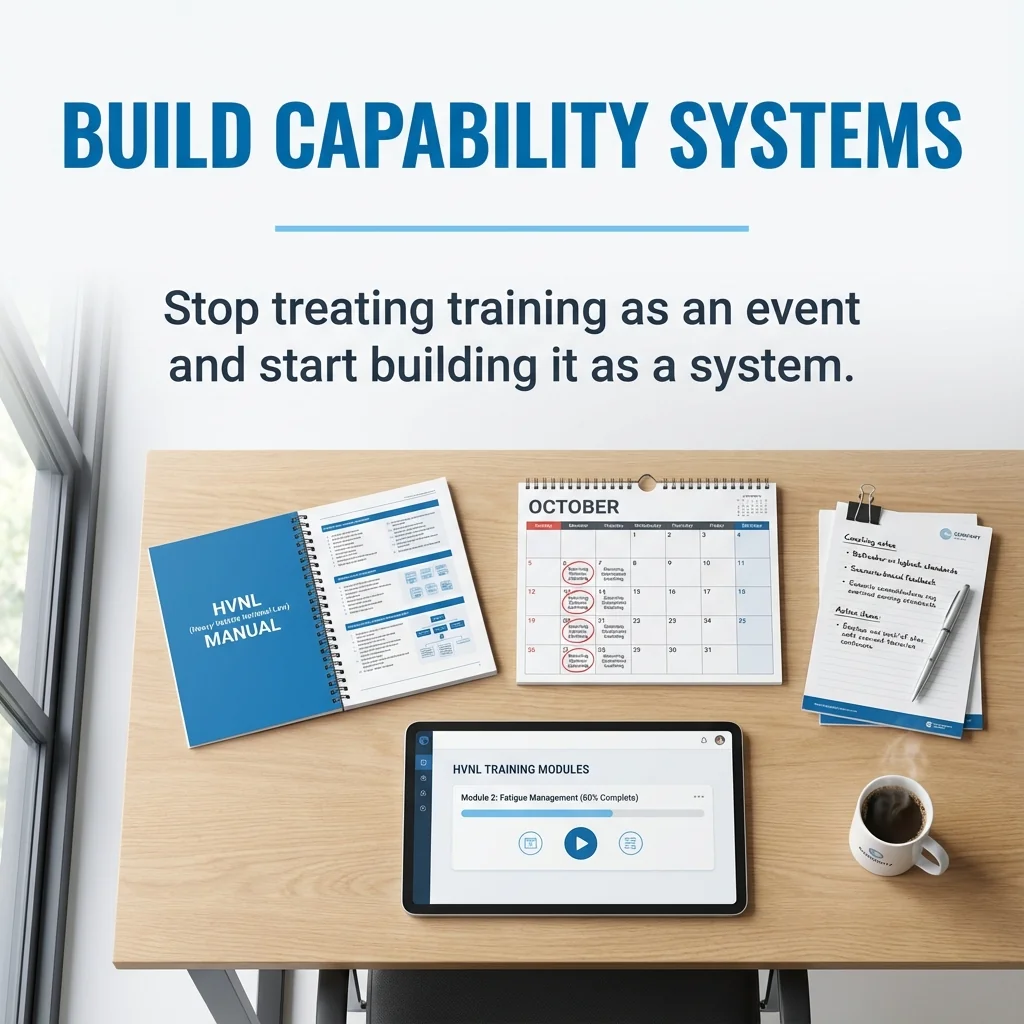
This shift requires different thinking about capability development entirely.
Begin with realistic assessment of your current situation. How many hours of structured CoR training do your people actually receive? What follow-up and reinforcement occurs after initial sessions? What support systems exist for applying training during operational pressure? Where do operational metrics suggest training gaps persist?
These questions reveal your starting point honestly.
Next, design a phased improvement approach rather than attempting perfect implementation immediately. Perhaps you start with better scenario practice in existing training sessions. Then you add monthly reinforcement discussions. Later you implement job-embedded coaching. Eventually you integrate technology-enabled continuous learning.
This gradual building approach fits within budget and time constraints while producing consistent progress toward more effective capability development.
The investment in quality Chain of Responsibility training delivers returns far beyond compliance alone. Organisations with strong CoR capability face fewer incidents, lower insurance costs, improved customer relationships, reduced regulatory attention, and enhanced competitive positioning through demonstrated professionalism.
Your next step starts with honest assessment of current training effectiveness. Gather operational metrics showing where application gaps persist. Consult with participants about the scenarios they find most challenging. Review audit findings for patterns indicating systematic preparation gaps.
That assessment creates the foundation for targeted improvement that addresses your specific challenges rather than generic best practices that may not fit your operational reality.
Building sustainable compliance capability takes time. The alternative, continuing with ineffective training that produces temporary awareness instead of lasting competence, guarantees you’ll face the same challenges repeatedly.